


Old Afghan | 138 x 89 cm | Nr. Z-566


|
1-3 working days delivery time (within Germany) |

|
14-day home trial |

|
Free delivery & returns within the EU |
Old Afghan
Craftsmanship and timeless elegance come together in this rug in curry and dark brown. Its knot density of approx. 90,000 knots per m² makes the elaborate workmanship plain to see – right down to the fine detailing. At 138 × 89 cm, it is in good hands beside the bed. It also cuts a fine figure in a bedroom or hallway. Colouring and texture give any room a homely, exclusive note – a one-of-a-kind piece made to last for years.
| Availability | In stock | Delivery time: 1–3 working days |
| Origin | Afghanistan |
| Dimensions | 138 cm x 89 cm (= 1.23 m²) |
| Construction | hand-knotted |
| Material |
Pile: wool (hand-spun, natural dyes) Weft & Warp: wool |
| knots | 90,000 knots |
| Pile height | 2 mm |
| Year of manufacture | 1940 |
| Condition | pre-owned, cleaned & partially restored |
| Colour | Curry, dark brown |
| Edition | one-of-a-kind piece |

Origin
Rugs made in Afghanistan – known as Afghan rugs, or simply Afghans – are unmistakable. In Afghanistan's cultural melting pot, Baluch, Turkmen, Kazakh and Uzbek weavers came together, each bringing influences from their homelands. During the 19th century, Turkoman tribes settled villages in Afghanistan, which brought Turkoman weaving styles into the region. The designs of the various tribal groups – among them Esari, Salor, Tekke and Yomut – are wonderfully varied. What holds them together stylistically is the use of intricate elephant's foot motifs (known as guls), lively reds, decorative bands and ornamental end panels.Tribal weavers used natural dyes to create an enormous range of reds, from deep aubergine brown to warm burnt orange. These glowing colours are traditionally combined with clear blues and ivory accents. While the tribes of Afghanistan frequently use guls and serrated stars, it is in the decorative borders and end panels that weavers have traditionally worked a little of themselves and their culture into the design. The same is true of the decorative rugs from Bukhara, where all-over gul motifs are widespread.
The gul is a versatile motif, used as a medallion or for repeating patterns. It can be set against a monochrome field or linked into a striking tile pattern. The rich colours and bold design of antique Afghan rugs make them spectacular statement pieces that complement a wide variety of interior styles perfectly.
Because of the political situation in Afghanistan, only a few Afghan rugs are still made today.
This Old Afghan is around 86 years old and a true collector's piece.
Material
The technique used to make the materials for the pile of this Old Afghan is more than 200 years old. The wool was dyed with natural dyes and spun by hand. Dyeing with natural or plant dyes is more complicated, more expensive and more time-consuming than dyeing with chemical colours. For a luminous red, for example, you need around one kilo of ground madder root as dyestuff per kilo of wool. For a strong yellow that is not too pale, you even need two kilograms of the dyestuff weld per kilo of wool. Spinning the wool is just as time- and labour-intensive. And fewer and fewer people still know how to spin wool by hand.But the effort is worth it: dyeing with natural colours allows the high-quality wool to keep its natural oil content. Wool that has been dyed with natural colours and spun by hand creates fascinating, shimmering patterns. The charm of hand-spun wool, with its slight irregularities and natural shades, comes into its own as a contrast in modern interiors, but equally in rooms furnished in a more traditional or country style.
The foundation (weft and warp threads) of this Old Afghan is made of new wool.
Condition
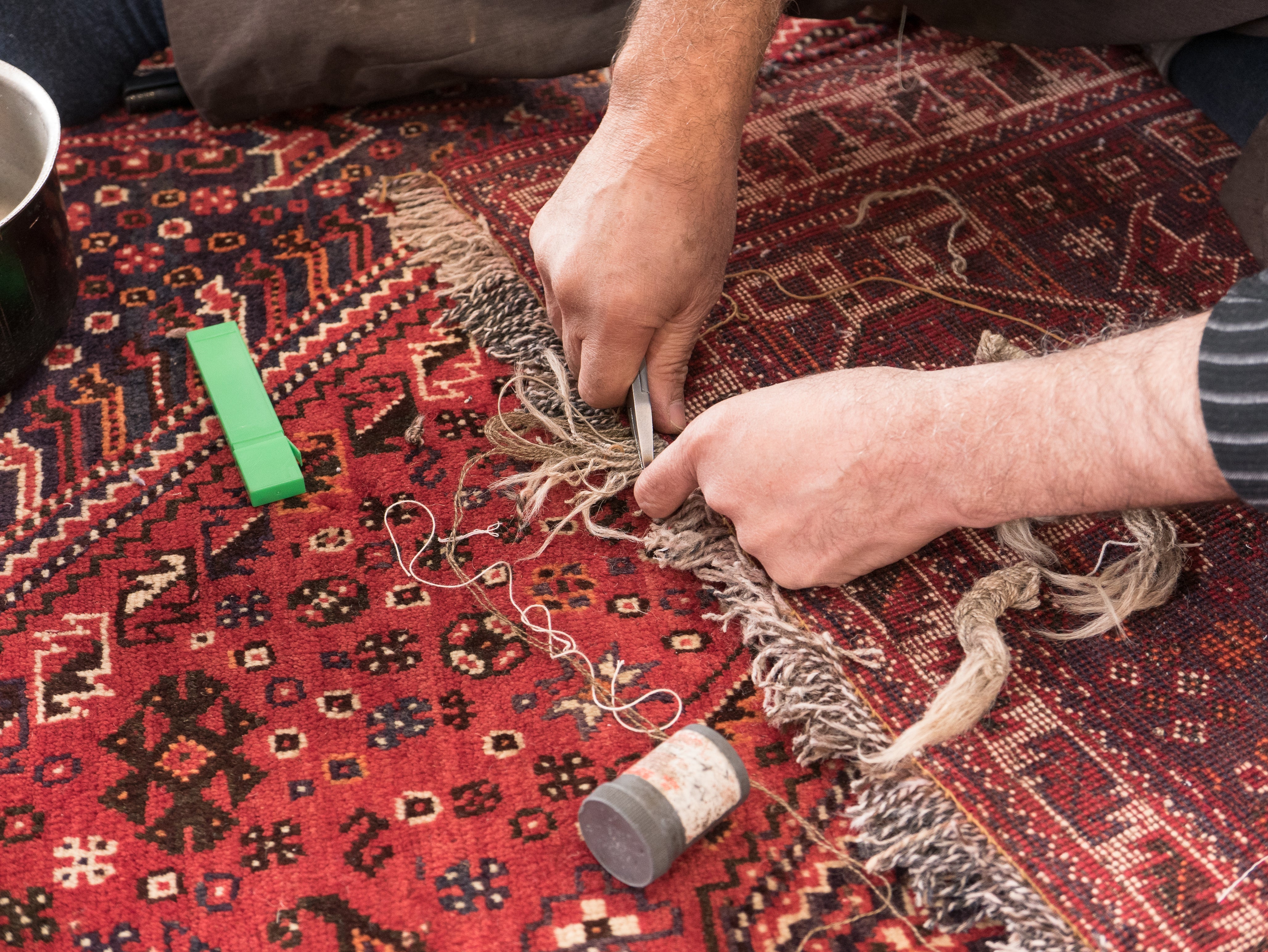
You are not the first to take a liking to this Old Afghan. It has had owners before you who valued it and put it to use. It was knotted around 1940. It has been cleaned thoroughly and is in good, though only partly restored, condition. The pile is evenly worn. The fringes could do with a repair. We have not fully restored this Old Afghan, because we feel it has a special presence just as it is. If you would like us to, we will of course carry the restoration further for you. We can bring almost any rug back to near-perfect condition.
A note on the photos
Child labour? No thanks.

The rug trade against child labour: Children belong in school, not at a knotting or weaving loom. For us it therefore goes without saying that we only offer rugs made under fair conditions and without child labour. We place particular importance on good working conditions and tolerate no child labour at our producers.
We are proud to be a member of the Care & Fair campaign against child labour.
The industry-wide campaign CARE & FAIR - the rug trade against child labour was founded in 1994. The initiative has made it its mission to fight the excesses of illegal child labour in the knotting countries and, at the same time, to improve the overall situation of rug knotters and their families in the knotting regions of India, Nepal and Pakistan.
Our goals:
- Ending illegal child labour in India and Pakistan.
- Creating better living conditions for knotters' families.
- Socially responsible production. We only accept goods that have been made under fair conditions. Working with our producers as partners, we want to make clear to them that taking on social responsibility benefits everyone.
Together with Care & Fair we currently support 10 schools, 6 adult education centres and 3 day clinics in India and Pakistan.
Choose options
|
|
1-3 working days delivery time (within Germany) |
|
|
14-day home trial |
|
|
Free delivery & returns within the EU |