

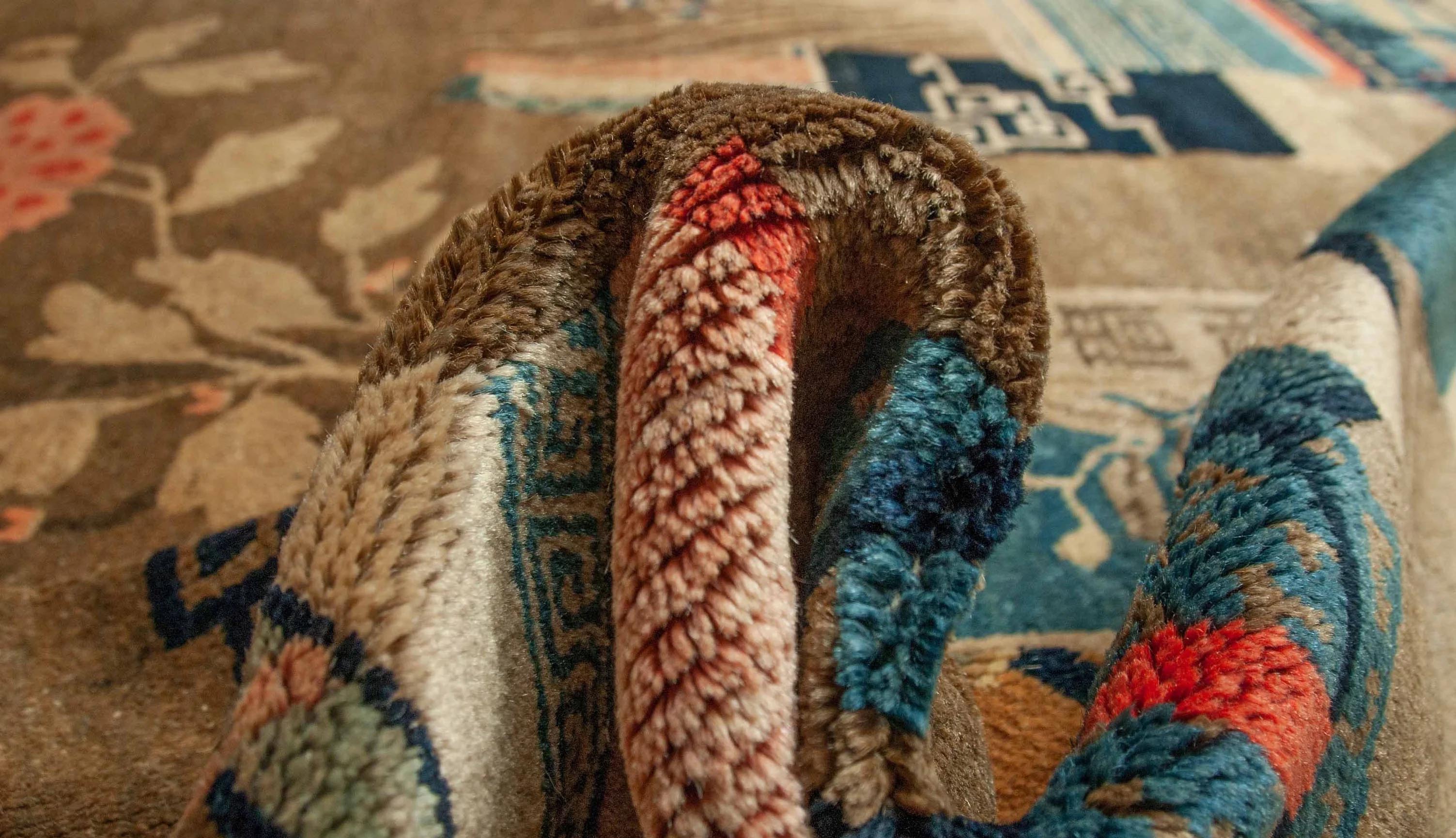
Chinese Rugs
Chinese rugs are hand-knotted rugs from China with just a few clearly placed motifs – dragons, vases, peonies, lotus – on calm fields of colour, inspired by the porcelain of the Ming and Qing dynasties. At Zomorrodi you'll find above all old and antique Chinese rugs from 1910 to 1980 (many of them bought back from American ownership) as well as Chinese silk rugs.
Rugs have been hand-knotted in China for a very long time. Over the centuries, a distinctive style of rug knotting developed all of its own.
Chinese rugs at a glance
- Origin: China (including Peking, Tientsin, Ningxia); antique pieces often via the US export trade of the 1920s–1930s
- Material: new wool on cotton; fine pieces in pure silk
- Pile: dense, usually 3–8 mm; pattern often carved in relief
- Knot density: approx. 60,000 to 250,000 knots per m² in wool
- Motifs: Dragons, vases, peonies, lotus, cloud bands, meander and good-luck symbols; corners and borders geometric
- Age: mostly old and antique (1910–1980), cleaned and partly or fully restored
The history of the China rug
Rugs were in all likelihood known in China very early on. The Mongol invasion of 1279 gave a boost to the local rug production that already existed at the time, as the invaders brought Central Asian rugs with them in particular and used them for tents and saddlery. An exhibition in Saint Louis (USA) in 1903 awakened interest in Chinese rugs in the Western world. Soon afterwards, rugs were being made in China solely for export to Europe and North America. Many of these export rugs from the 1920s to the 1930s are now coming back from the USA to Europe – hence the description “US Import” on some of our pieces.
How to recognise a China rug
The palette is pared back to a few select colours. The handful of decorative elements is arranged with great subtlety. The proportions are generous, and the detached placement of the motifs makes them look modern. Typical motifs are dragons, vases and peonies on abstracted leaves and vines. Along the edges you often find geometric forms, especially interwoven meander and good-luck symbols. The motifs take their cue from those on Chinese porcelain made during the Ming and Qing dynasties.
Another characteristic: on many China rugs the pile is bevelled along the motifs, so that the pattern stands out in relief.
Why a China rug suits modern rooms
Few motifs, plenty of open ground, muted colours such as beige, blue, dusky pink or gold: a China rug reads like a large-format picture and goes with clean, modern interiors just as well as with a period building. The dense wool pile is hard-wearing – the old pieces have already proved that.
Frequently asked questions about China rugs
What is a China rug?
A China rug is a hand-knotted rug from China with a few clearly placed motifs such as dragons, vases, peonies or lotus blossoms on calm fields of colour. The motifs come from Chinese art, above all from the porcelain of the Ming and Qing dynasties.
What does “US Import” mean on a China rug?
From the 1920s to the 1930s, large quantities of rugs were knotted in China for export to the USA. Many of these rugs we now buy back from American owners, clean and restore. They are old to antique and, as a rule, very finely knotted.
What do the motifs on China rugs mean?
The dragon stands for strength and good fortune, the peony for prosperity, the lotus for purity, the vase for peace, the bat for luck. Cloud bands and meanders in the borders symbolise longevity and permanence.
Are China rugs hard-wearing?
Yes. China rugs in wool have a dense, medium-high pile and are suited to living rooms, dining rooms and bedrooms. Chinese silk rugs are finer and belong in quieter areas.
What does a China rug cost?
At Zomorrodi, old and antique China rugs range from a few hundred to a few thousand euros, depending on size, age and condition. The price and the price per square metre are given with every rug.