


Antique Perepedil | 178 x 125 cm | Nr. 9989


|
1-3 working days delivery time (within Germany) |

|
14-day home trial |

|
Free delivery & returns within the EU |
Antique Perepedil
This rug in dark brown and dark red brings together traditional craftsmanship and timeless elegance. With a knot density of approx. 150,000 knots per m², the painstaking workmanship shows above all in the precise drawing of the pattern and the fine execution of the details. At 178 × 125 cm it suits a bedroom or a study. It shows just as well in a child's room or a dressing room. This one-of-a-kind piece brings individual character to a room and holds its value far beyond short-lived trends.
| Availability | In stock | Delivery time: 1–3 working days |
| Origin | Caucasus |
| Dimensions | 178 cm x 125 cm (= 2.23 m²) |
| Construction | hand-knotted |
| Material |
Pile: wool (hand-spun, natural dyes) Weft & Warp: wool |
| knots | 150,000 knots |
| Pile height | 4 mm |
| Year of manufacture | 1910 |
| Condition | pre-owned, but in very good condition (cleaned & restored) |
| Colour | Dark brown, dark red |
| Edition | one-of-a-kind piece |

Origin
Perepedil rugs belong to the family of Kuba rugs. Kuba rugs (also Kuba Schirwan or Kuba Shirvan) are knotted by hand in the town of Kuba and the surrounding area in the eastern Caucasus, in the Shirvan region. So the Kuba in the name has – contrary to what you might assume – nothing to do with the country of Cuba. Shirvan rugs are generally knotted from exceptionally fine wool and have a low pile. Old Shirvans are greatly appreciated and highly valued by collectors in Europe. They not infrequently have a knot count of up to 300,000 knots per m².What is characteristic of Perepedil rugs is their imaginative geometric pattern. The field of Perepedil rugs is typically framed by a wide border. A broad main stripe is flanked by 2 – 6 secondary stripes. In terms of colour, these rugs are often marked by blue, though red and ivory knotting is also found.
This antique Perepedil is a collector's piece. It is around 116 years old, and that alone makes it something quite special. Antique rugs like this Perepedil are as sought after as ever and fetch top prices at renowned auction houses.
Material
The technique used to prepare the materials for the pile of this Antique Perepedil is more than 200 years old. The wool was dyed with natural dyes and spun by hand. Dyeing with natural or plant dyes is more involved, more costly and more time-consuming than dyeing with chemical colours. For a luminous red, for example, you need roughly one kilo of ground madder root as dyestuff for every kilo of wool. For a strong yellow that is not too pale, it even takes two kilograms of weld per kilo of wool. Spinning the wool is just as time- and labour-intensive. And fewer and fewer people still master spinning wool by hand.But the effort is worth it: dyeing with natural colours allows the high-quality wool to keep its natural oil content. Wool that has been dyed with natural colours and spun by hand creates fascinating, shimmering patterns. The charm of hand-spun wool, with its slight irregularities and natural shades, comes into its own as a contrast in modern interiors, but equally in rooms furnished in a more traditional or country style.
The foundation (weft and warp threads) of this Antique Perepedil is made of new wool.
Condition
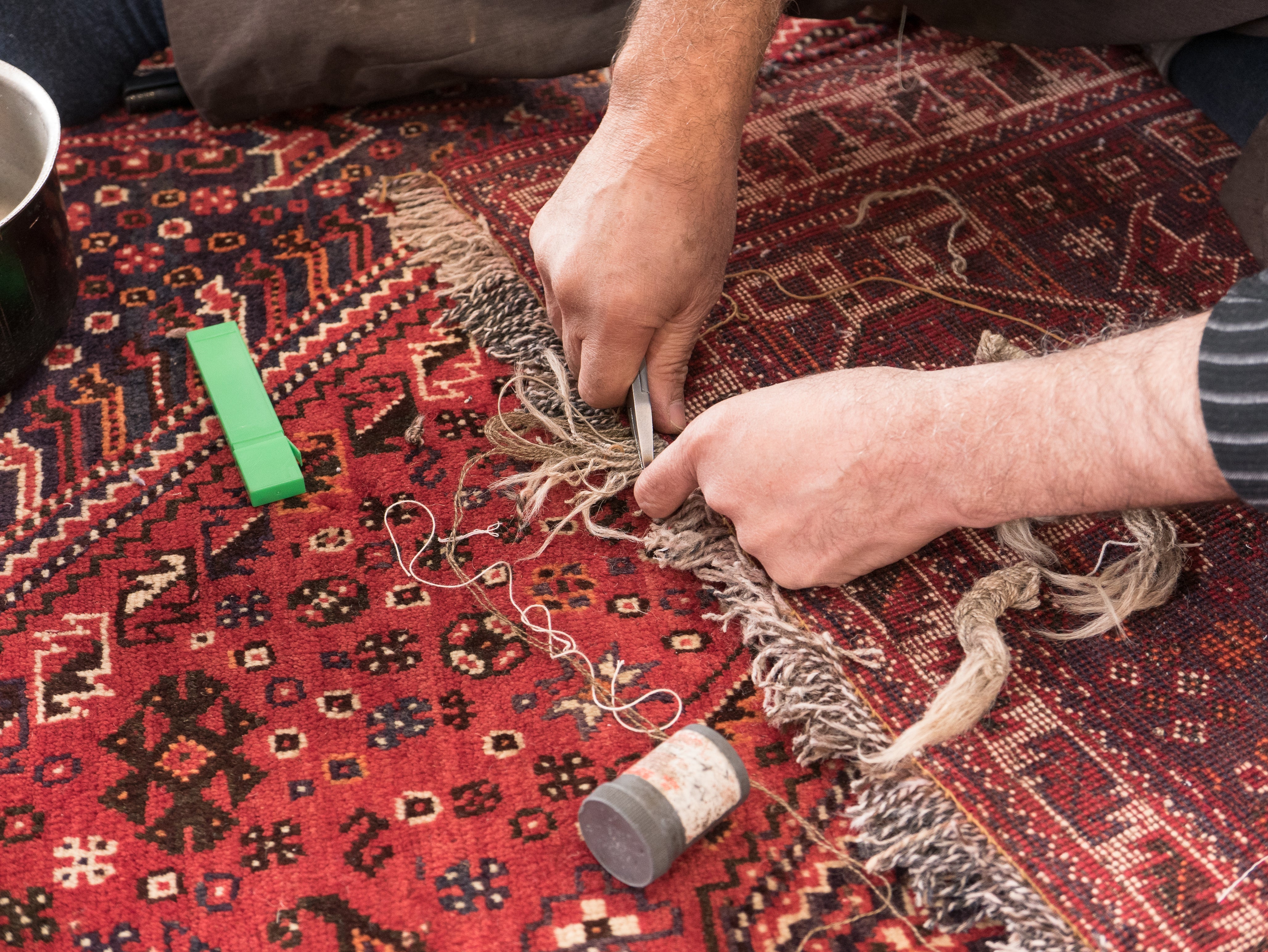
This Antique Perepedil had admirers before you. On this well-preserved piece, only the fringes had to be restored. It was knotted around 1910. We have cleaned it thoroughly and restored it with great care. Despite its age, it is therefore in very good condition.
A note on the photos
Child labour? No thanks.

The rug trade against child labour: Children belong in school, not at a knotting or weaving loom. For us it therefore goes without saying that we only offer rugs made under fair conditions and without child labour. We place particular importance on good working conditions and tolerate no child labour at our producers.
We are proud to be a member of the Care & Fair campaign against child labour.
The industry-wide campaign CARE & FAIR - the rug trade against child labour was founded in 1994. The initiative has made it its mission to fight the excesses of illegal child labour in the knotting countries and, at the same time, to improve the overall situation of rug knotters and their families in the knotting regions of India, Nepal and Pakistan.
Our goals:
- Ending illegal child labour in India and Pakistan.
- Creating better living conditions for knotters' families.
- Socially responsible production. We only accept goods that have been made under fair conditions. Working with our producers as partners, we want to make clear to them that taking on social responsibility benefits everyone.
Together with Care & Fair we currently support 10 schools, 6 adult education centres and 3 day clinics in India and Pakistan.
Choose options
|
|
1-3 working days delivery time (within Germany) |
|
|
14-day home trial |
|
|
Free delivery & returns within the EU |