


Kelim Bag | 159 x 47 cm | Nr. Z-1391


|
1-3 working days delivery time (within Germany) |

|
14-day home trial |

|
Free delivery & returns within the EU |
Kelim pouch
This one-of-a-kind piece in light red and light green combines traditional craftsmanship with timeless elegance. At 159 × 47 cm, it is well placed as a hallway runner. It looks just as good in the kitchen in front of the worktop. The harmonious colouring and the distinctive texture lend any room an exclusive, homely atmosphere. A rug of this quality is far more than a piece of furnishing – it is a piece of traditional textile art with individual character and lasting value.
| Availability | In stock | Delivery time: 1–3 working days |
| Origin | Turkish |
| Dimensions | 159 cm x 47 cm (= 0.75 m²) |
| Construction | hand-woven |
| Material |
Weft (pile): wool Warp: cotton |
| Pile height | 5 mm |
| Year of manufacture | 1980 |
| Condition | pre-owned and cleaned |
| Colour | Light red, light green |
| Edition | one-of-a-kind piece |

Origin
Kelims (also Kilim, Qilim) were traditionally made only for the weavers' own use. Nomads and farmers used, and still use, their Kelims as rugs on the floor, but also as tent or wall hangings, blankets, cushions or – like this Kelim – as containers for transport. This Kelim bag was probably woven as a saddlebag for donkeys, camels or a bicycle. If you don't have a donkey or a camel, you can use the bag on your bicycle or to keep your newspapers and magazines in – there are no limits to your imagination.Because Kelims were and still are constant companions in everyday life, their patterns – however naive they may look – always carry a personal message and hold meaning for the weavers and their families.
Kelims are hand-woven and consist only of warp and weft threads, so they have no thick, upward-facing pile. Kelims show the same pattern on both sides. The pattern is created by the coloured weft threads that are woven into the warp threads. A new thread has to be used for every new colour in every row. The thread ends are woven in as well.
In Europe, Kelims from Turkey, the Caucasus region, Iran, Afghanistan and the Turkmen cultural area are particularly well known and popular. In fact, rugs are hand-woven in every country where rugs are knotted.
Material
Kelim bags are made from hand-woven Kelims. Once the weaving is done, the Kelims are sewn together into bags and – the finer bags in particular – embroidered by hand afterwards.The Kelims that are made into Kelim bags consist only of warp and weft threads, so they have no thick, upright pile. Kelims show the same pattern on both sides and can therefore be used either way up. The pattern is created by the coloured weft threads that are woven into the warp threads.
The weft threads of this Kelim are made of hand-spun sheep's wool dyed with plant colours. Before the Kelim was woven, the sheep were first shorn and the wool was then cleaned, combed and finally spun. After spinning, the wool for the Kelim bags is dyed with natural colours in an elaborate process. Thanks to this traditional method, the pile of the Kelim bags feels dry and slightly furry. Cotton was used for the warp threads.
Condition
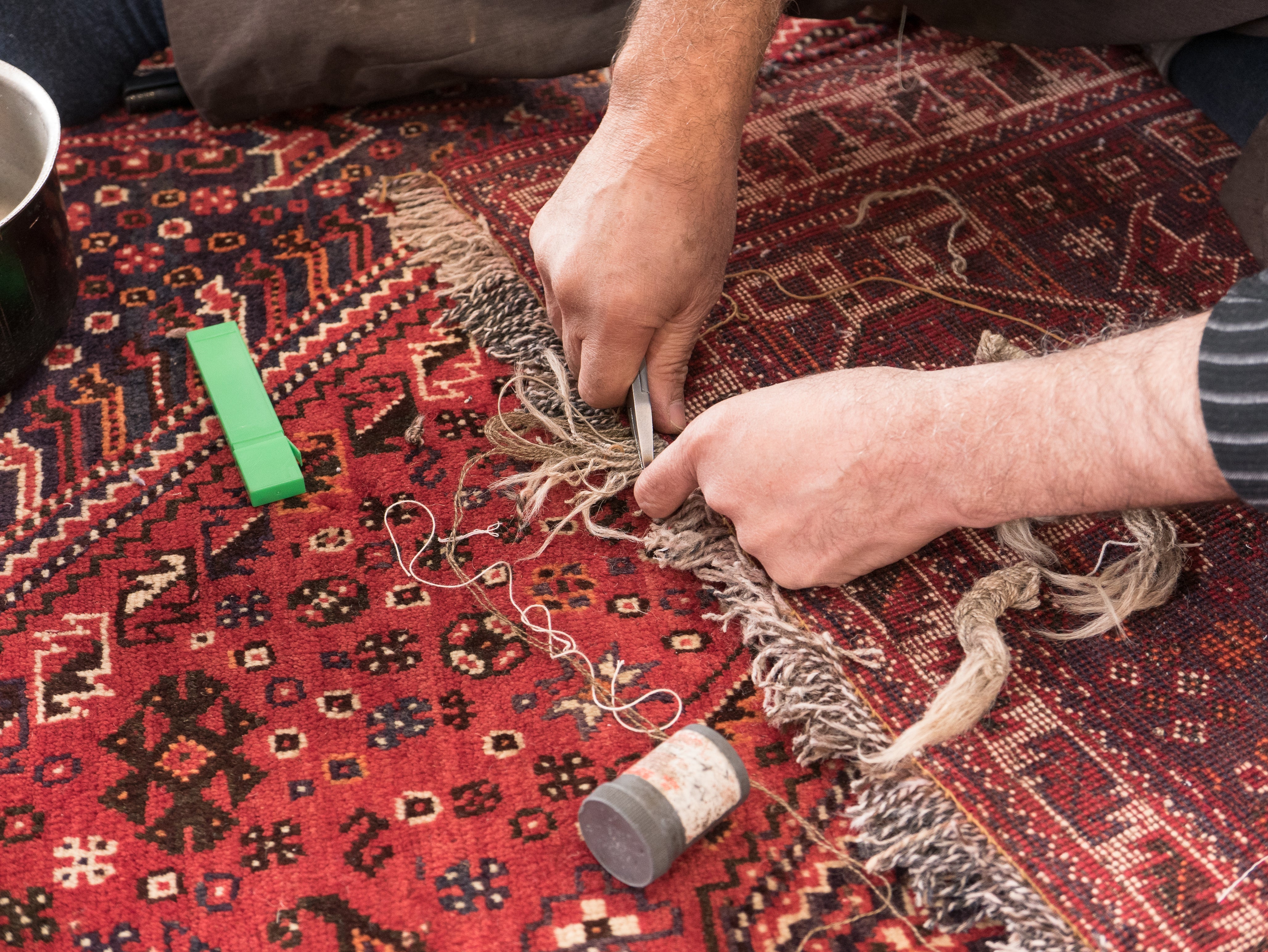
You are not the first to take a liking to this Kelim bag. It has had owners before you who valued and used it. It was hand-woven around 1980. It has been thoroughly cleaned and is in good but unrestored condition. The rug has a hole 3 cm in diameter. We have not restored this Kelim bag, because we feel it has a special presence just as it is. If you would prefer otherwise, we will of course gladly restore the rug for you. Either way, this Kelim bag will give you pleasure for decades to come.
A note on the photos
Child labour? No thanks.

The rug trade against child labour: Children belong in school, not at a knotting or weaving loom. For us it therefore goes without saying that we only offer rugs made under fair conditions and without child labour. We place particular importance on good working conditions and tolerate no child labour at our producers.
We are proud to be a member of the Care & Fair campaign against child labour.
The industry-wide campaign CARE & FAIR - the rug trade against child labour was founded in 1994. The initiative has made it its mission to fight the excesses of illegal child labour in the knotting countries and, at the same time, to improve the overall situation of rug knotters and their families in the knotting regions of India, Nepal and Pakistan.
Our goals:
- Ending illegal child labour in India and Pakistan.
- Creating better living conditions for knotters' families.
- Socially responsible production. We only accept goods that have been made under fair conditions. Working with our producers as partners, we want to make clear to them that taking on social responsibility benefits everyone.
Together with Care & Fair we currently support 10 schools, 6 adult education centres and 3 day clinics in India and Pakistan.
Choose options
|
|
1-3 working days delivery time (within Germany) |
|
|
14-day home trial |
|
|
Free delivery & returns within the EU |