


Old Tekke | 196 x 100 cm | Nr. 20098


|
14-day home trial |

|
Free delivery & returns within the EU |
Geometric old Tekke, dark brown with border and diamonds
| Origin |
|
| Dimensions | 196 cm x 100 cm (= 1.96 m²) |
| Construction | hand-knotted |
| Material |
Pile: wool
|
| knots per m²2 | 120.000 |
| Pile height | 5mm |
| Year of manufacture | 1940 |
| Colour | Dark brown, Beige |
| Edition | one-of-a-kind piece |
Origin
The Tekke are the main tribe of the Turkmen. They live in the Republic of Turkmenistan and in Afghanistan. In earlier times the Tekke were nomads and much given to raiding. Today most of them are settled and live peacefully as farmers. After the break-up of the Soviet empire, however, some returned to a nomadic way of life. The majority of the Tekke live in the now independent Republic of Turkmenistan, where they knot rugs in the cities of Ashgabat and Mary and the surrounding areas.
During the communist revolution, numerous Tekke clans moved to the neighbouring states of Afghanistan and Iran. Others live in Uzbekistan and Tajikistan. Tekke rugs are among the famous Turkmen rugs, whose patterns are also copied in Pakistan. Tekke rugs are also traded as Bukhara rugs. Bukhara (sometimes also spelled Bochara) is an oasis city in Uzbekistan that lies on the former Silk Road. Although no rugs were ever knotted in Bukhara itself, the city has given its name to many Oriental rugs, because they were traditionally exported to the West from Bukhara. These rugs were in fact knotted by Turkmen tribes such as the Yomut or the Tekke. This old Tekke is around 80 years old and a real collector's piece.
Pattern
The abstract, geometric composition is what gives this Tekke its understated elegance. The pattern flatters the design of the room and never draws attention away from the furniture, the décor and the architectural elements. It creates a pleasant atmosphere without dominating the style of the room.
The decorated surround (border) forms a wonderful contrast to the centre and shapes the transition at the edge of the rug.
The repeating elements of this Tekke rug have no specific centre. The recurring repeat pattern feels calming, yet never dull. Rugs with a repeat pattern are also described as all-over patterned.
In the pattern of this Tekke it is above all the diamonds that catch the eye. A diamond is a rhombus standing on one of its points; in Oriental rugs its four equal sides can be serrated, stepped or set with hooks. The diamond is one of the oldest basic forms in the Oriental rug. In the Islamic world it carries a symbolic meaning: it represents the immortality of the soul. That is why it is so often found as a filler motif.
The background of this Tekke is dark brown. The border is worked in dark brown, beige and dark red.
Condition
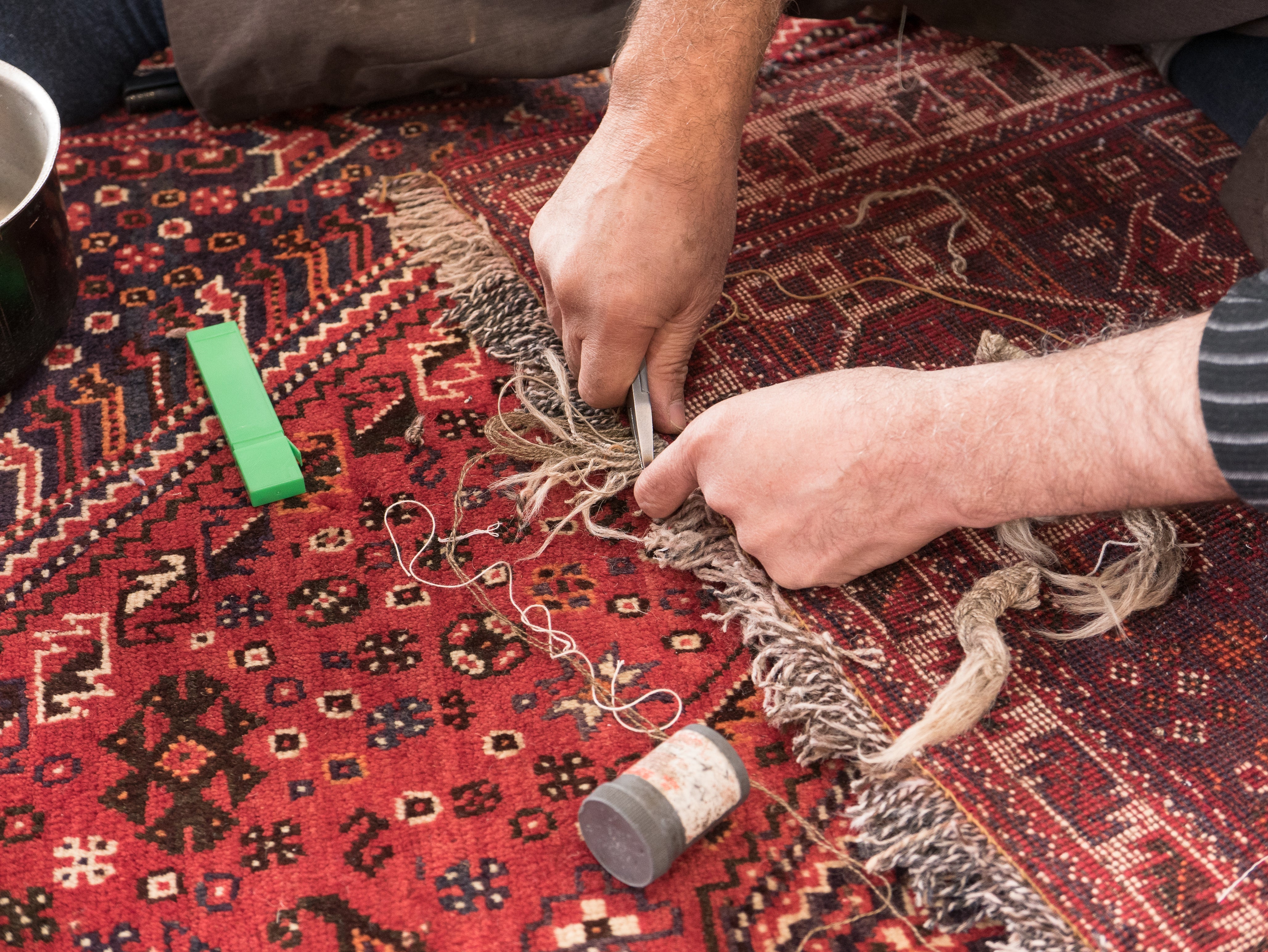
You aren't the first to take a liking to this Tekke. It had owners before you who valued it and lived with it. It was hand-knotted around 1940. It has been thoroughly cleaned and is in good but unrestored condition. In a few spots the pile has grown very thin over the years. The edges could do with a repair. We haven't restored this Tekke, because we feel it has a special presence just as it is. If you'd rather we did, we'll of course be happy to restore the rug for you. Either way, this Tekke will give you pleasure for decades to come.
Material
The pile of this Tekke was hand-knotted from high-quality new wool. New wool is obtained by shearing sheep gently. New wool is a renewable, natural raw material with a whole range of impressive qualities: thanks to the natural lanolin content of the wool, the surface repels droplets of water and is therefore naturally protected against dirt. Wool also offers excellent thermal insulation, helps regulate the indoor climate and dampens sound. The foundation (weft and warp threads) of this Tekke is made of new wool.
A note on the photos
Child labour? No thanks.

The rug trade against child labour: Children belong in school, not at a knotting or weaving loom. For us it therefore goes without saying that we only offer rugs made under fair conditions and without child labour. We place particular importance on good working conditions and tolerate no child labour at our producers.
We are proud to be a member of the Care & Fair campaign against child labour.
The industry-wide campaign CARE & FAIR - the rug trade against child labour was founded in 1994. The initiative has made it its mission to fight the excesses of illegal child labour in the knotting countries and, at the same time, to improve the overall situation of rug knotters and their families in the knotting regions of India, Nepal and Pakistan.
Our goals:
- Ending illegal child labour in India and Pakistan.
- Creating better living conditions for knotters' families.
- Socially responsible production. We only accept goods that have been made under fair conditions. Working with our producers as partners, we want to make clear to them that taking on social responsibility benefits everyone.
Together with Care & Fair we currently support 10 schools, 6 adult education centres and 3 day clinics in India and Pakistan.
Choose options
|
|
14-day home trial |
|
|
Free delivery & returns within the EU |