


Tabriz | 390 x 300 cm | Nr. Z-661


|
14-day home trial |

|
Free delivery & returns within the EU |
Tabriz
Craftsmanship and timeless elegance meet in this rug in black and dark red. At around 360,000 knots per m², the workmanship is correspondingly intricate, as you can see in the precise drawing and the finely worked details. Its 390 × 300 cm make it a rug for generous living spaces. It shows to equally good effect beneath a large dining table. Colouring and texture lend any room a homely, exclusive note – a one-of-a-kind piece that will last for years.
| Delivery time | 2 days |
| Origin | Persia |
| Dimensions | 390 cm x 300 cm (= 11.7 m²) |
| Construction | hand-knotted |
| Material |
Pile: wool & viscose Weft & Warp: cotton |
| knots | 360.000 |
| Year of manufacture | 2003 |
| Condition | pre-owned, but in very good condition (cleaned & restored) |
| Edition | one-of-a-kind piece |

Origin
Standing on Persia's northern border at the crossroads of countless caravan routes, the city of Tabriz (also written Tabris or Täbriz) has always been a melting pot of different ethnic and religious groups. Although the city lies on the border with Azerbaijan, the dialect spoken in Tabriz is related to Turkish. The bazaars of Tabriz have traded in craftwork for centuries, and above all in rugs from the surrounding villages.
Material
The pile of this Tabriz is made from a hard-wearing blend of wool and viscose. Viscose (also known as acetate silk or rayon) is always obtained from cellulose, a natural product, and thus from wood as its raw material. In India the cellulose pulp is obtained from bamboo. In an elaborate process the pulpy cellulose is drawn into a continuous textile yarn. This is why viscose is also described as continuous filament yarn. Because of the silky sheen of the yarn, viscose obtained from bamboo is also called "bamboo silk". The colloquially common term "artificial silk" is not permitted under the German Textile Labelling Act (TKG).The weft and warp threads of this Tabriz are made of cotton. This versatile material is tear-resistant and elastic, which makes it particularly suitable for a hard-wearing foundation weave.
Condition
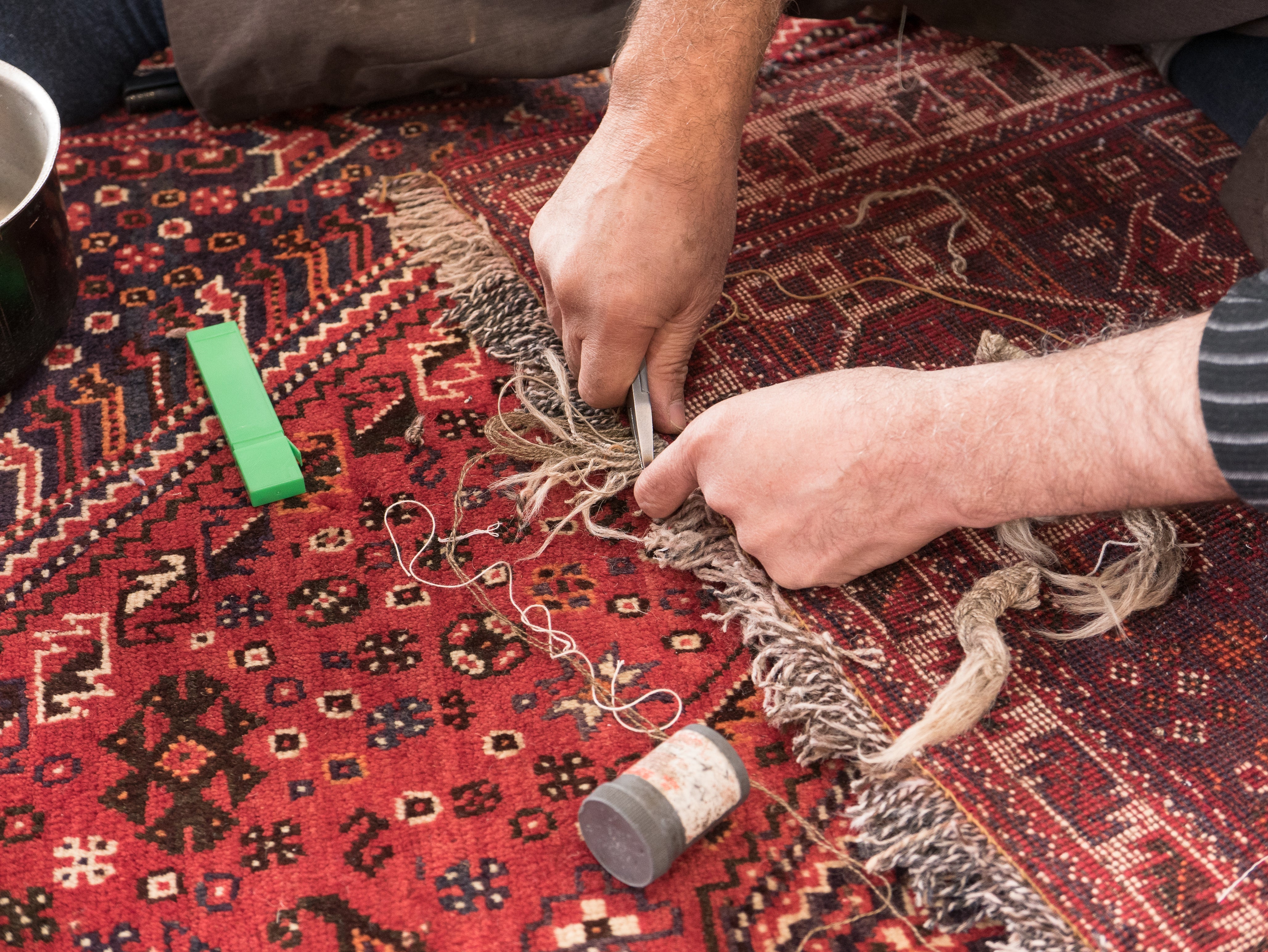
This Tabriz has had admirers before you. It was knotted around 2003. We have cleaned it thoroughly and restored it with care. That is why – despite its age – it is in very good condition.
A note on the photos
Child labour? No thanks.

The rug trade against child labour: Children belong in school, not at a knotting or weaving loom. For us it therefore goes without saying that we only offer rugs made under fair conditions and without child labour. We place particular importance on good working conditions and tolerate no child labour at our producers.
We are proud to be a member of the Care & Fair campaign against child labour.
The industry-wide campaign CARE & FAIR - the rug trade against child labour was founded in 1994. The initiative has made it its mission to fight the excesses of illegal child labour in the knotting countries and, at the same time, to improve the overall situation of rug knotters and their families in the knotting regions of India, Nepal and Pakistan.
Our goals:
- Ending illegal child labour in India and Pakistan.
- Creating better living conditions for knotters' families.
- Socially responsible production. We only accept goods that have been made under fair conditions. Working with our producers as partners, we want to make clear to them that taking on social responsibility benefits everyone.
Together with Care & Fair we currently support 10 schools, 6 adult education centres and 3 day clinics in India and Pakistan.
Choose options
|
|
14-day home trial |
|
|
Free delivery & returns within the EU |