
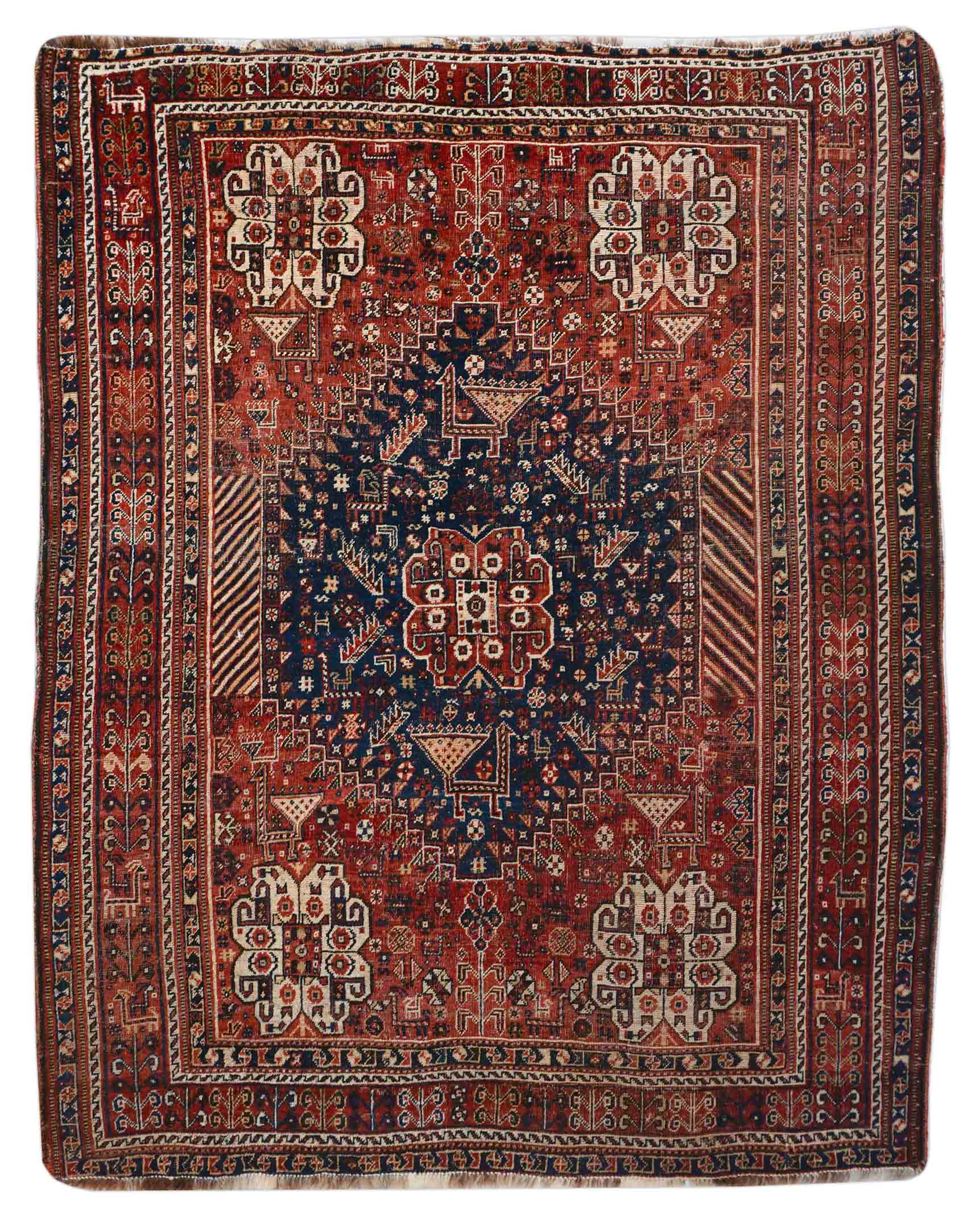
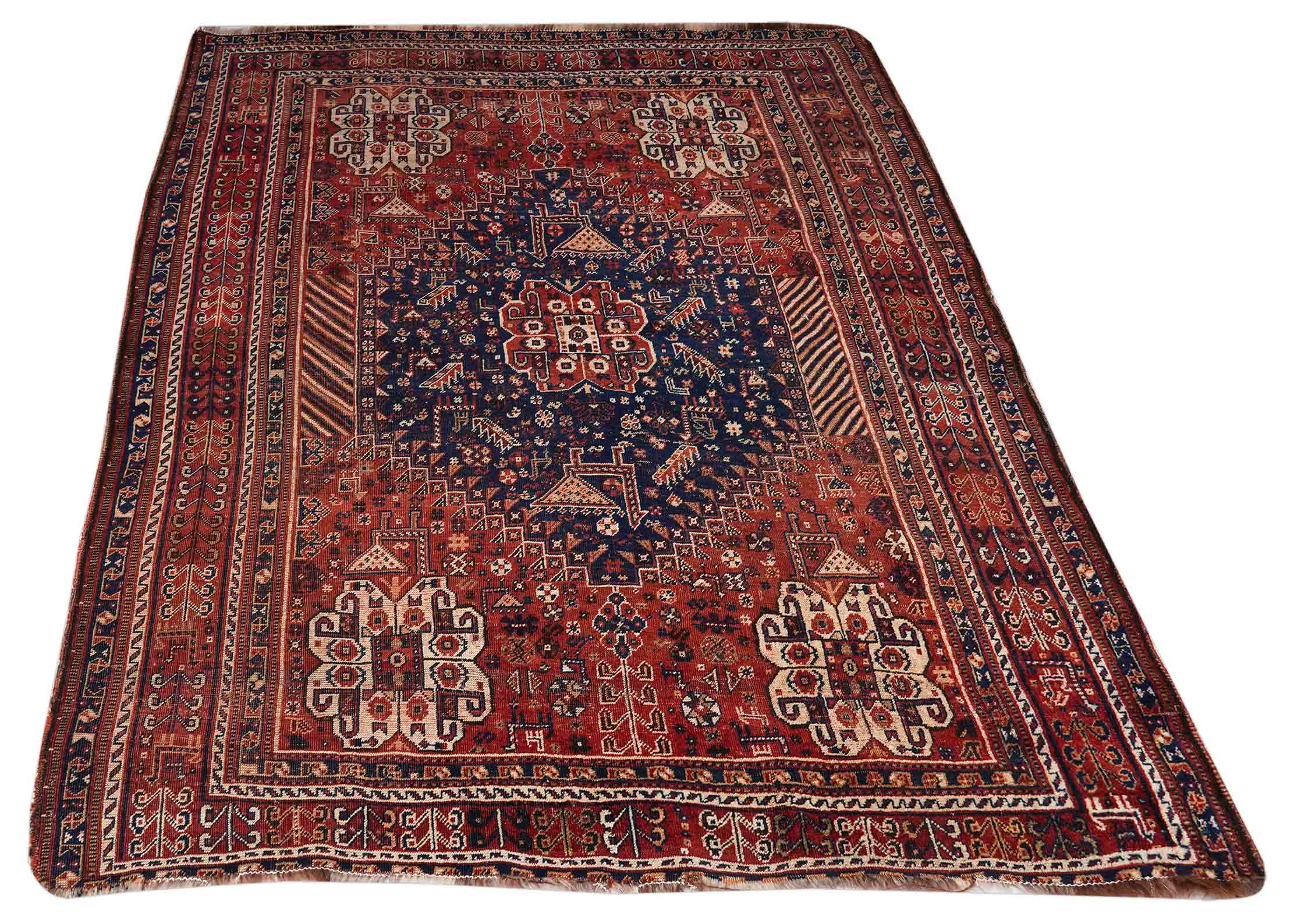
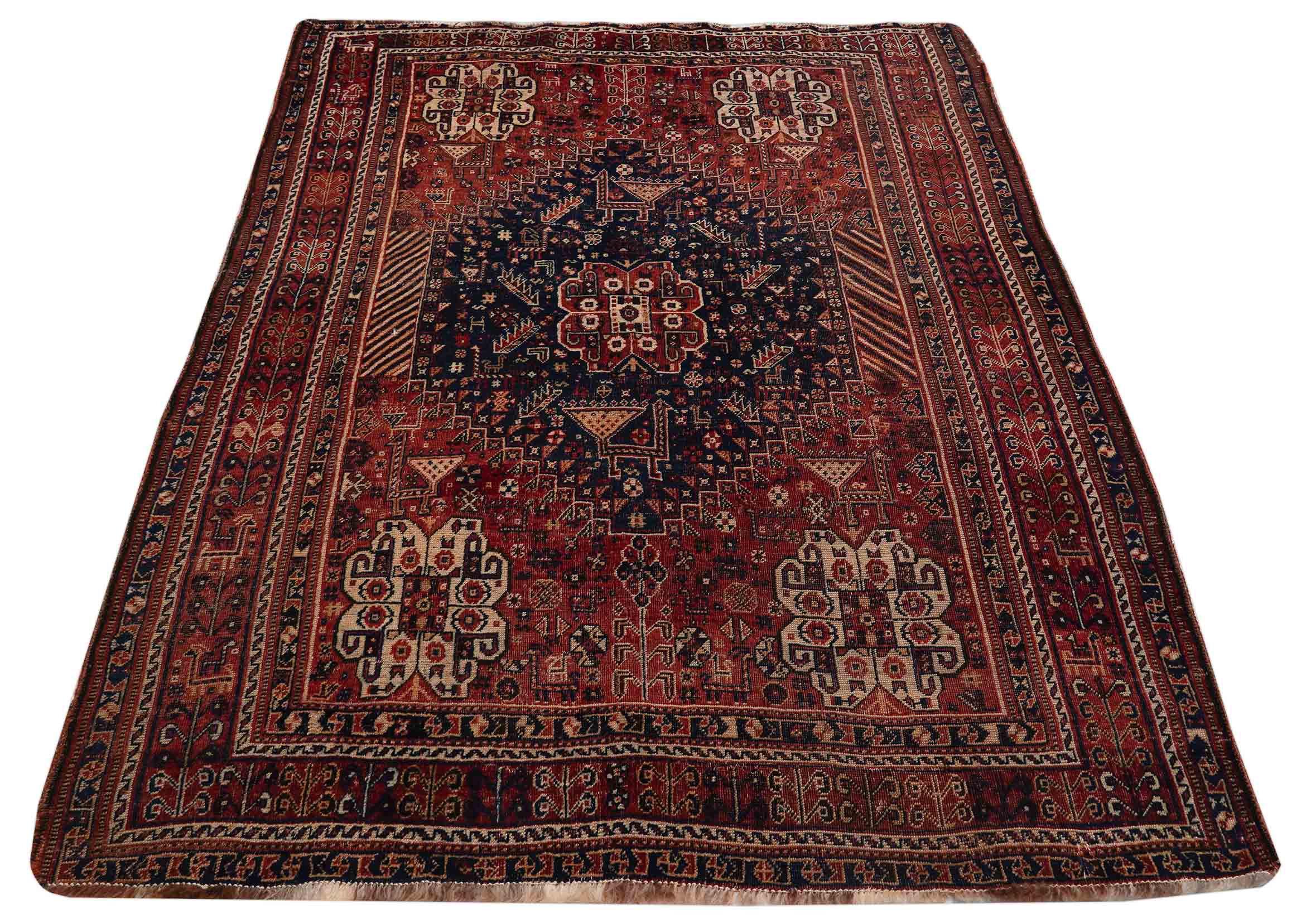
Old Ghasghai | 208 x 163 cm | Nr. Z-2454

|
1-3 Werktage Lieferzeit (deutschlandweit) |

|
14 Tage Probelegen |

|
Kostenlose Lieferung & Retoure innerhalb der EU |
Old Ghasghai, rust red with border and medallion
| Origin |
|
| Dimensions | 208 cm x 163 cm (= 3.39 m²) |
| Construction | hand-knotted |
| Material |
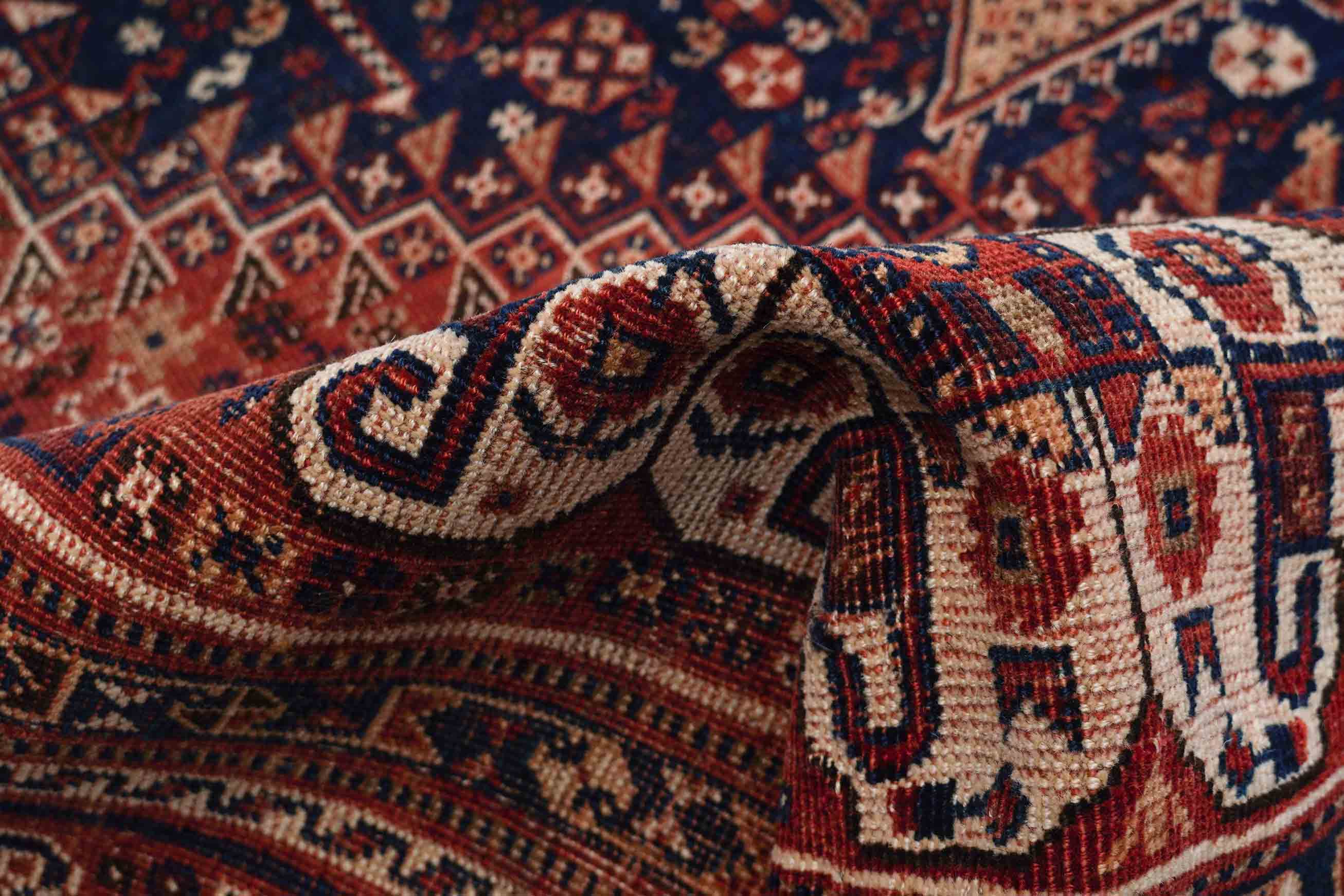
Pile: wool (hand-spun, natural dyes)
|
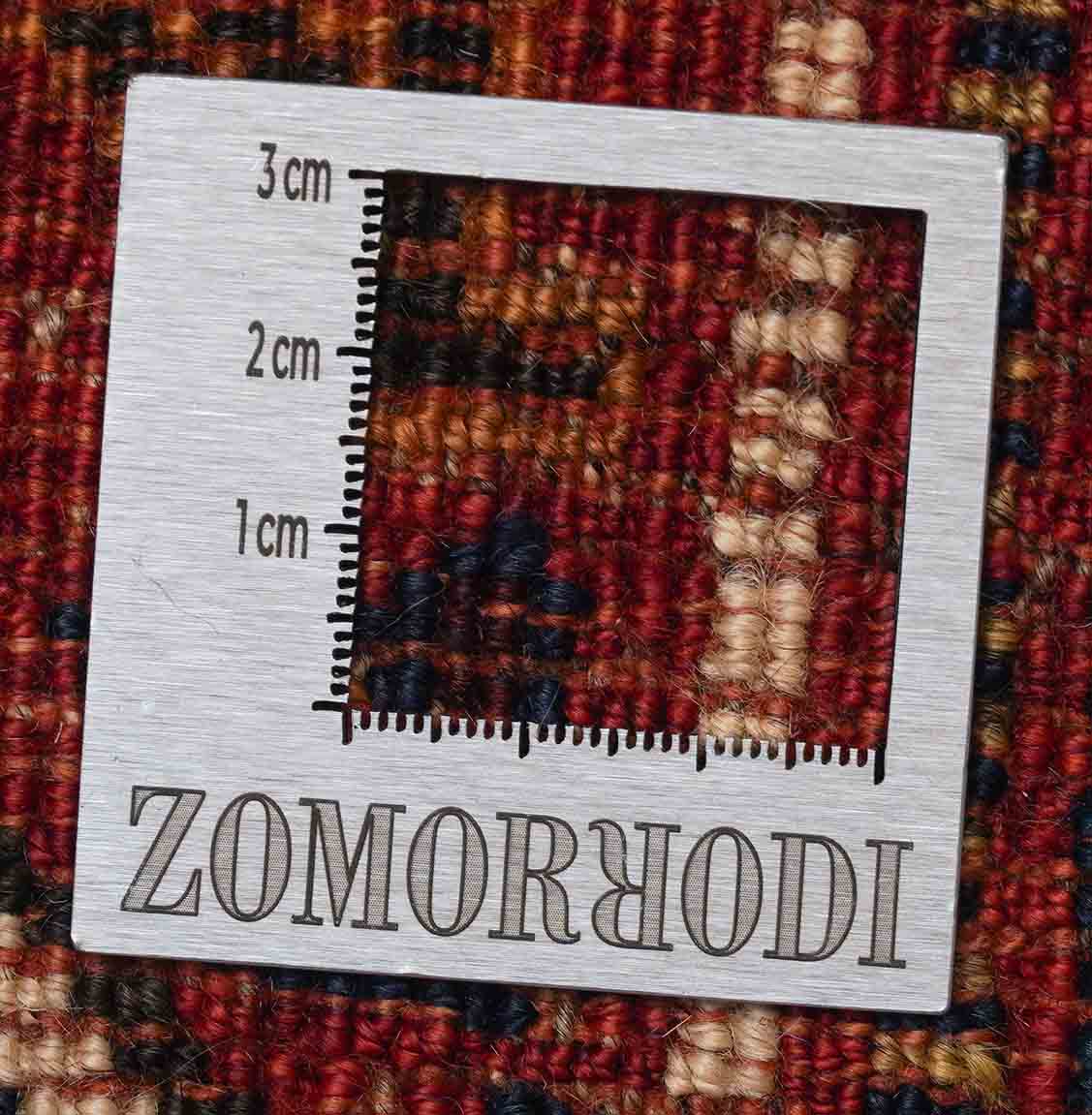
| knots per m²2 | 160.000 |
| Pile height | 5mm |
| Year of manufacture | 1920 |
| Colour | Rust red |
| Edition | one-of-a-kind piece |

Origin
The Ghashghai are the great Persian nomadic people and have lived in the south of Iran, in the province of Fars, for centuries. They are made up of seven tribes in all. The most important tribe of the Ghashghai – at least as far as rug making goes – are the Kashghuli (also Kaschguli, Kashguli, Qashguli). Old and antique Ghashghai rugs are sought-after collectors' pieces today. Ghasghai rugs are known as the king among Persian nomadic rugs.
A large share of Ghashgai rugs is adorned with the so-called geometric Heibathlou pattern: a diamond-shaped central field with a rather plain medallion that is repeated in the corners. The inner field is filled with an unusually large number of ornaments. The motifs range from stars, lions and camels to trees, blossoms and boteh or paisley symbols. Some motifs are stylised, others rendered true to life. The frequently repeated motifs are never entirely alike. They differ considerably in their colouring. The symbols are rarely arranged symmetrically. Symmetry along the length is often ignored. The individual elements in the borders, too, alternate in different colours. Small rows of little boxes at the ends of the rugs are typical. The variation in the pattern comes from the fact that the Ghashgai had no knotting templates: every rug was knotted from memory and filled with interesting motifs.
By now most Ghashghai have settled in one place. It is only because they have largely become settled that the Ghashghai can also make rugs in large formats. The few clans still living as nomads move up to the summer pastures in the Zagros Mountains twice a year. In autumn they return to the milder winter quarters down in the valley. The Ghashghai have a reputation for being particularly proud, hard-working and honourable. Even though the Ghashghai come across as less wild and warlike today, they still have an influence on Iranian domestic politics that shouldn't be underestimated. This old Ghasghai is around 100 years old and a real collector's piece.
Pattern
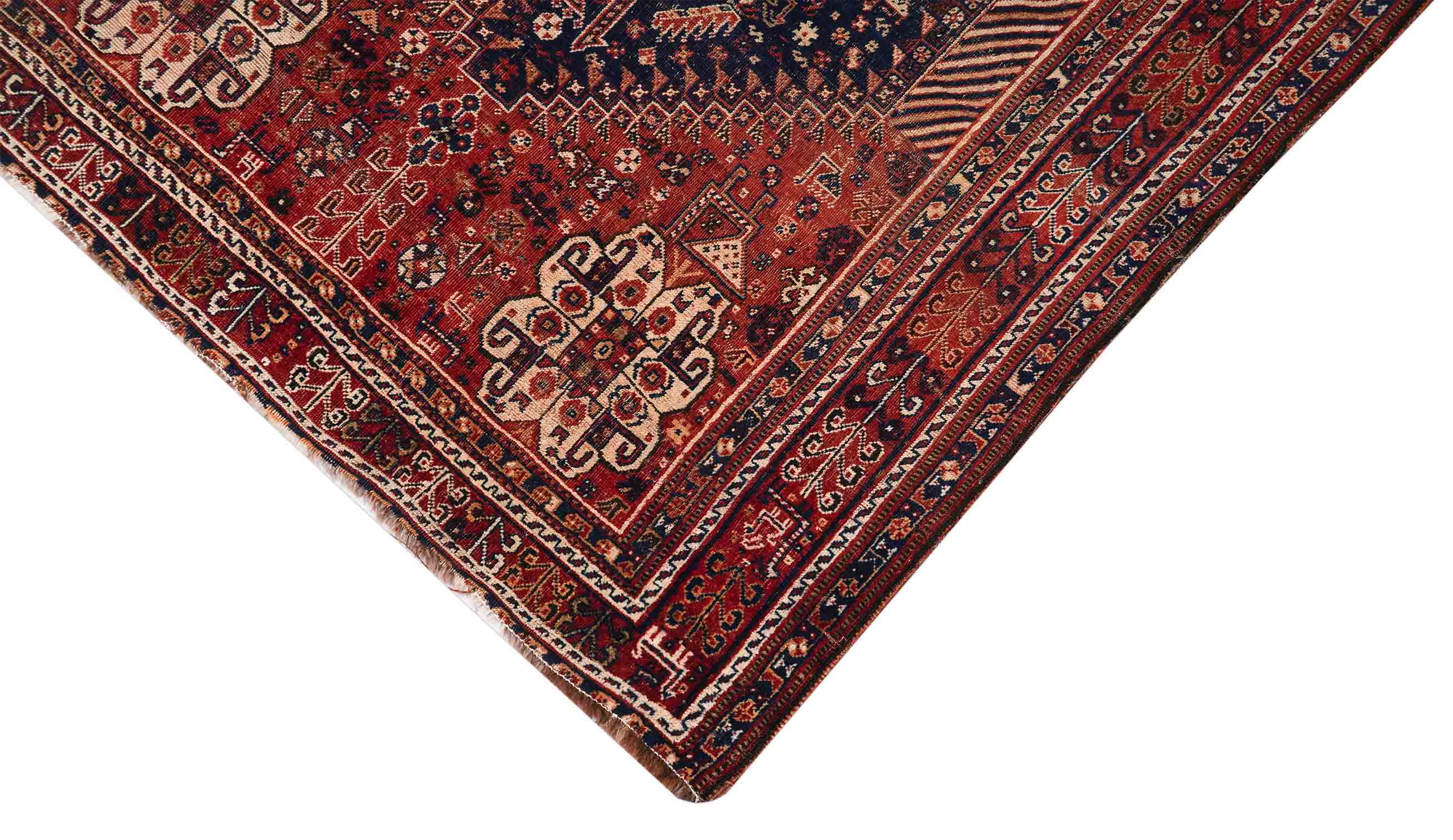
The ornate border forms a wonderful contrast with the centre and shapes the transition at the edge of the rug.
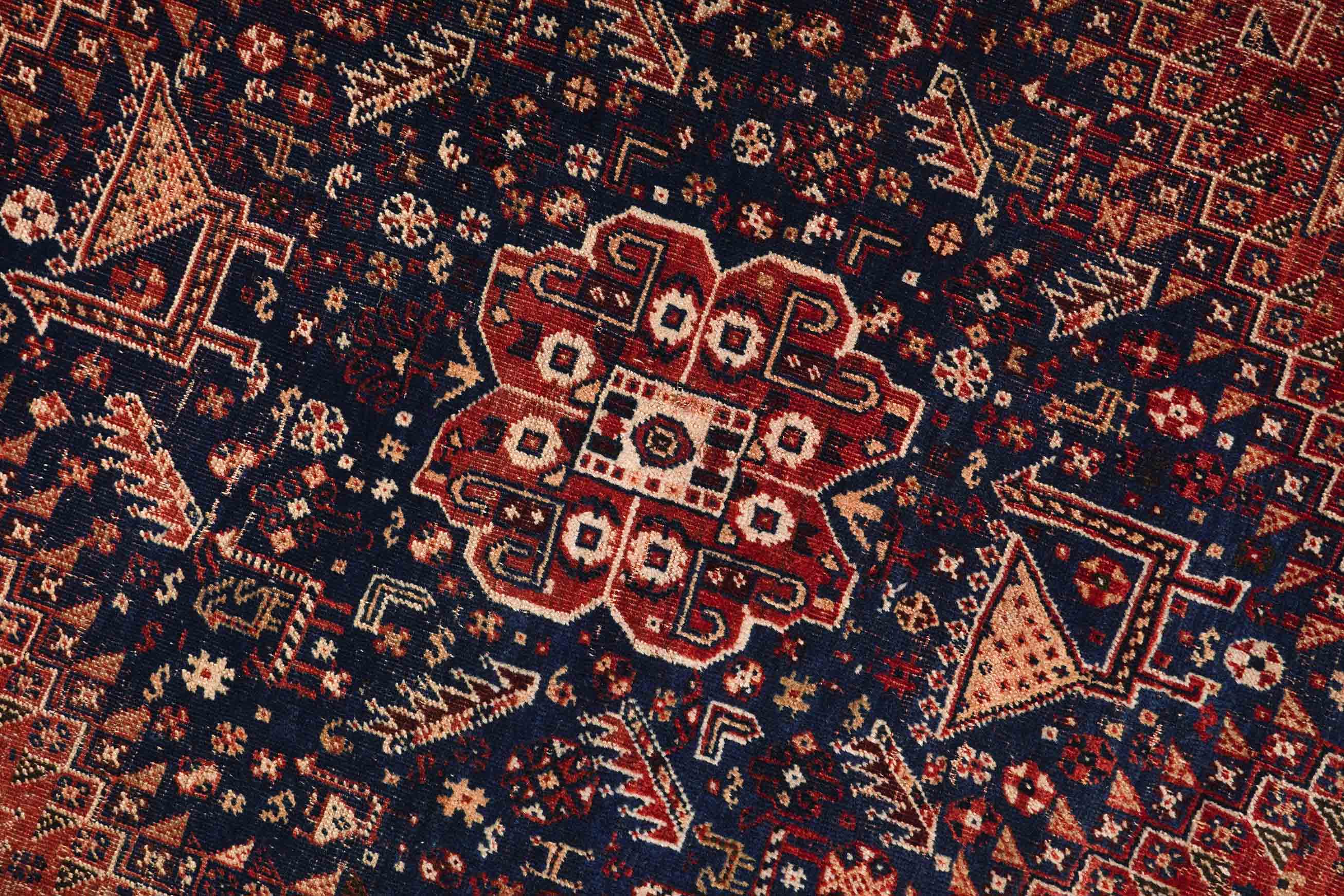
At the middle of the central field of this Ghasghai lies the symmetrical centre, also known as the medallion. The design of the field is subordinate to the medallion, so that the medallion seems to float on the field.
The background of this Ghasghai is rust red. The border is kept in rust red. The centre is dark blue.
Condition
This Ghasghai has had admirers before you. It was hand-knotted around 1920. It has been thoroughly cleaned and is in good condition. The pile has grown evenly thinner over the years.
Material
The technique used to make the materials for the pile of this Ghasghai is over 200 years old. The wool was dyed with natural dyes and spun by hand. Dyeing with natural or plant dyes is more complicated, more expensive and more time-consuming than dyeing with chemical colours. For a luminous red, for example, you need around one kilo of ground madder root as dyestuff per kilo of wool. For a strong yellow that is not too pale, it even takes two kilograms of weld dye per kilo of wool. Spinning the wool is time-consuming and labour-intensive too. On top of that, fewer and fewer people still master the art of spinning wool by hand.
But the effort is worth it: dyeing with natural colours lets the high-quality wool keep its natural lanolin content. Wool dyed with natural colours and spun by hand creates fascinating, shimmering patterns. The charm of hand-spun wool, with its slight irregularities and natural shades, comes into its own as a contrast in modern interiors, but equally in rooms furnished in a more traditional or country-house style. The foundation (weft and warp threads) of this Ghasghai is made of new wool.
A note on the photos
Child labour? No thanks.
Child labour? No thanks. Children belong in school, not at a knotting frame or a loom. For us it therefore goes without saying that we only offer rugs made under fair conditions and without child labour.
We attach particular importance to humane working conditions and tolerate no child labour at any of our producers. Thank you for helping us to ensure fair conditions.
That is why we support the initiative Care & Fair against child labour in the rug trade.

Choose options
|
|
1-3 Werktage Lieferzeit (deutschlandweit) |
|
|
14 Tage Probelegen |
|
|
Kostenlose Lieferung & Retoure innerhalb der EU |