
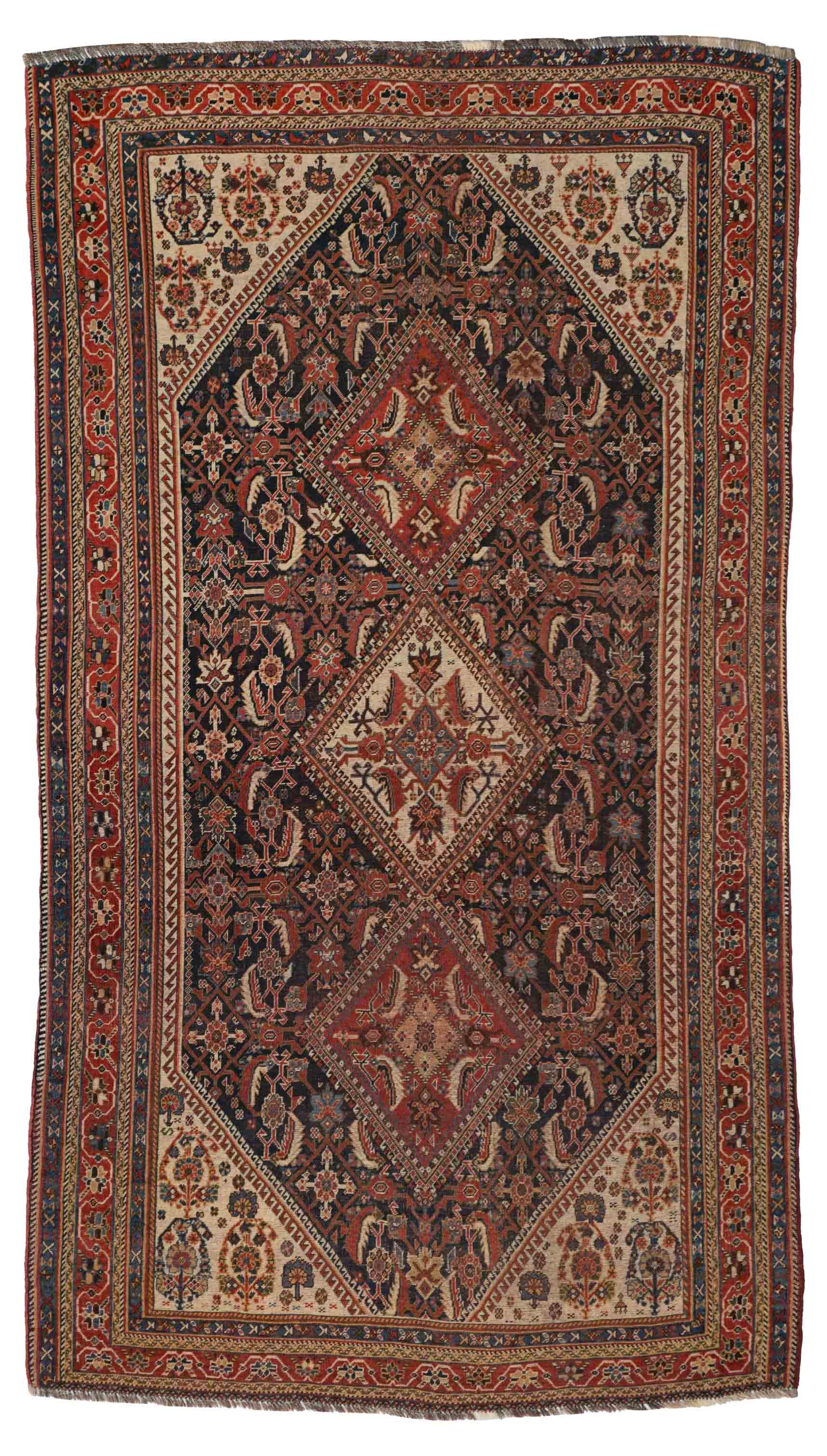
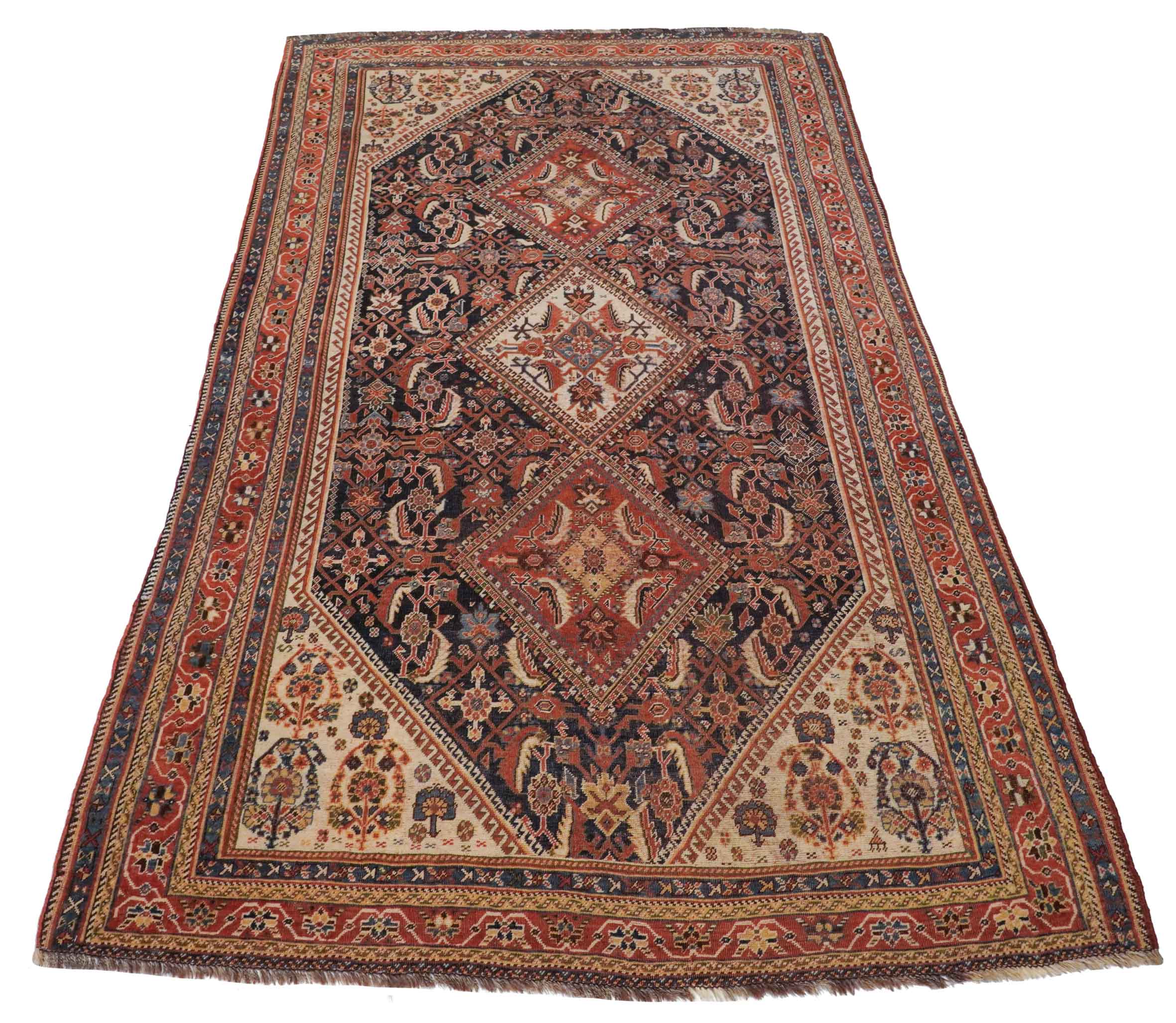
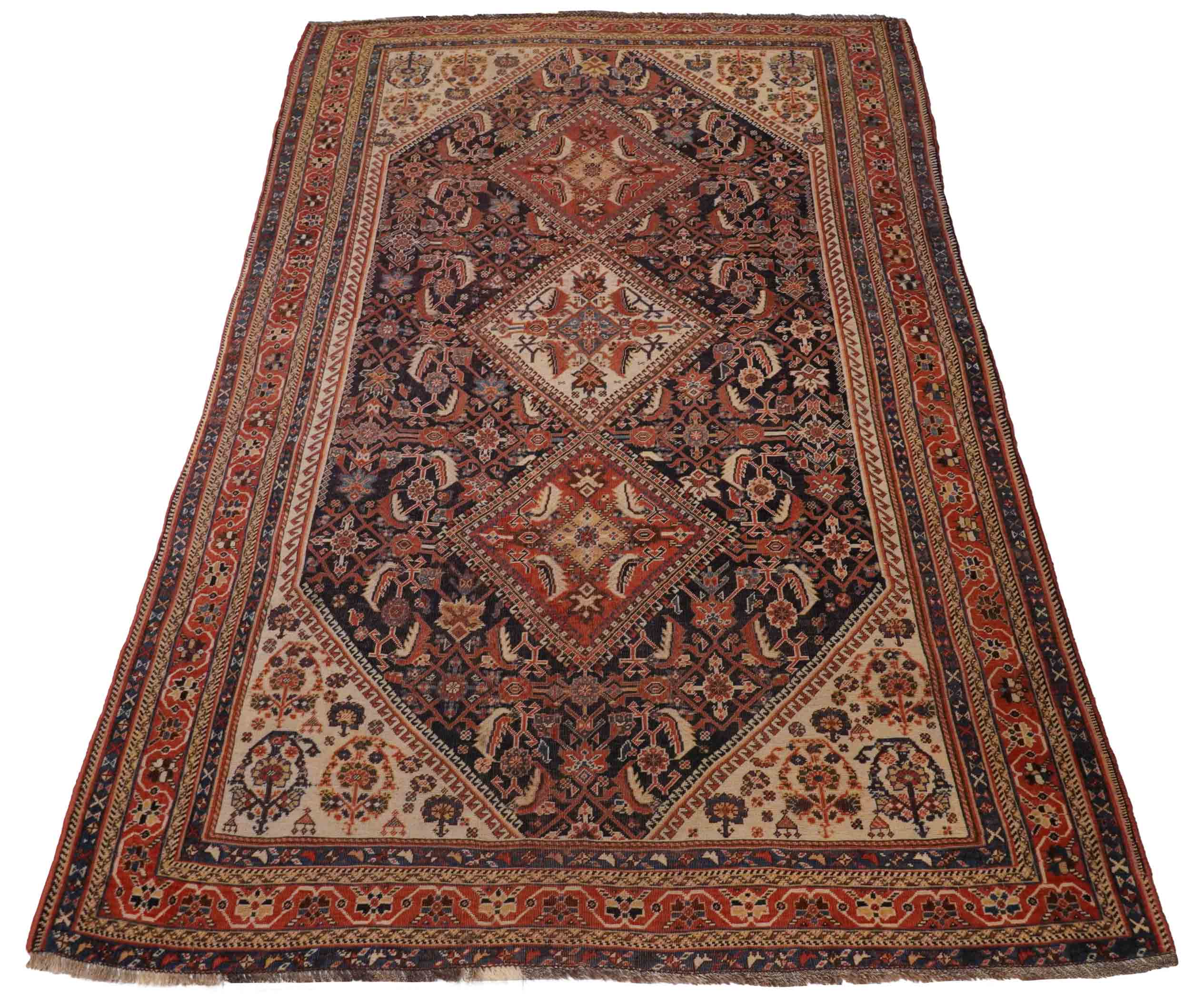
Old Ghashghai | 235 x 130 cm | Nr. 19591


|
14-day home trial |

|
Free delivery & returns within the EU |
Old Ghashghai
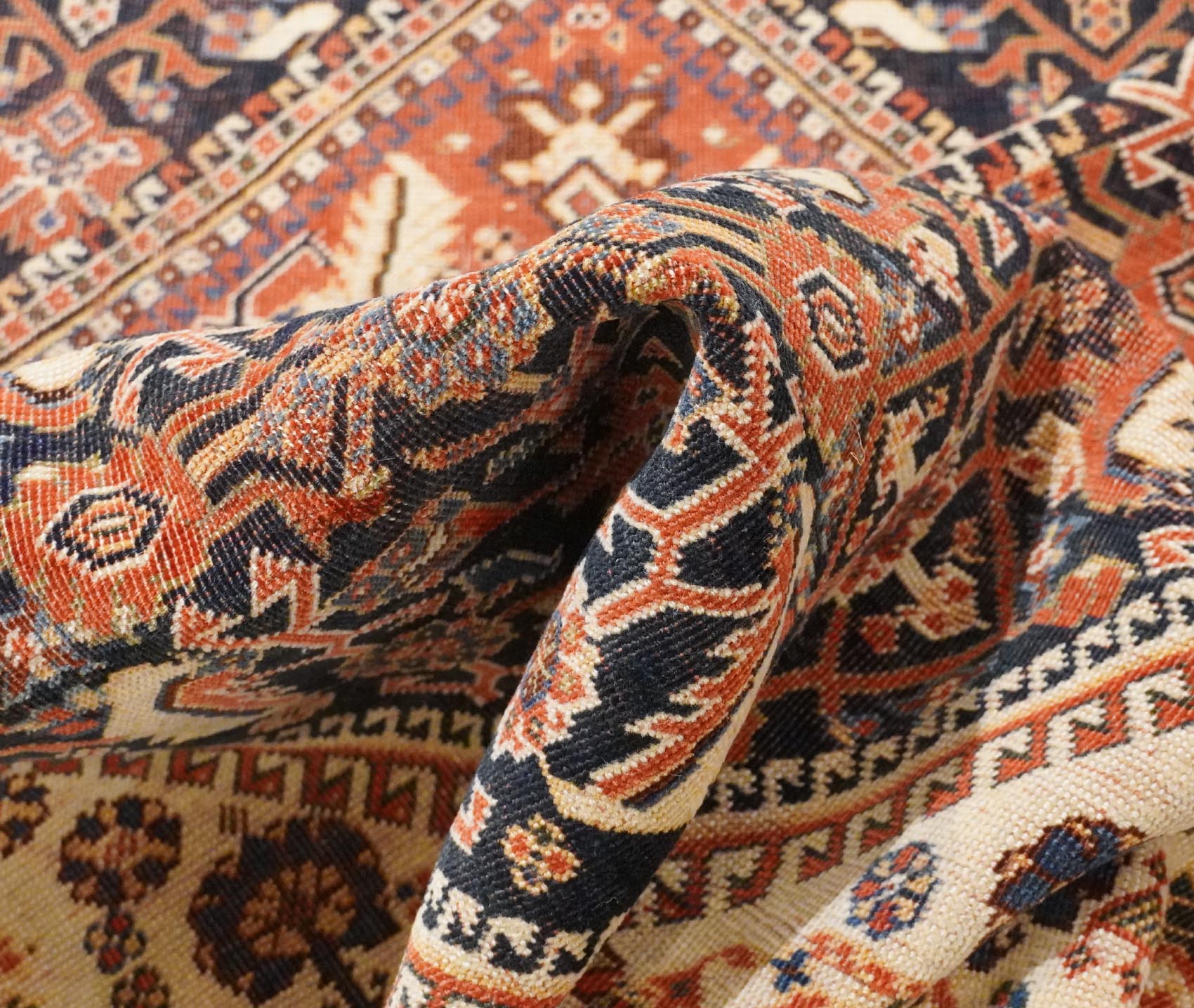
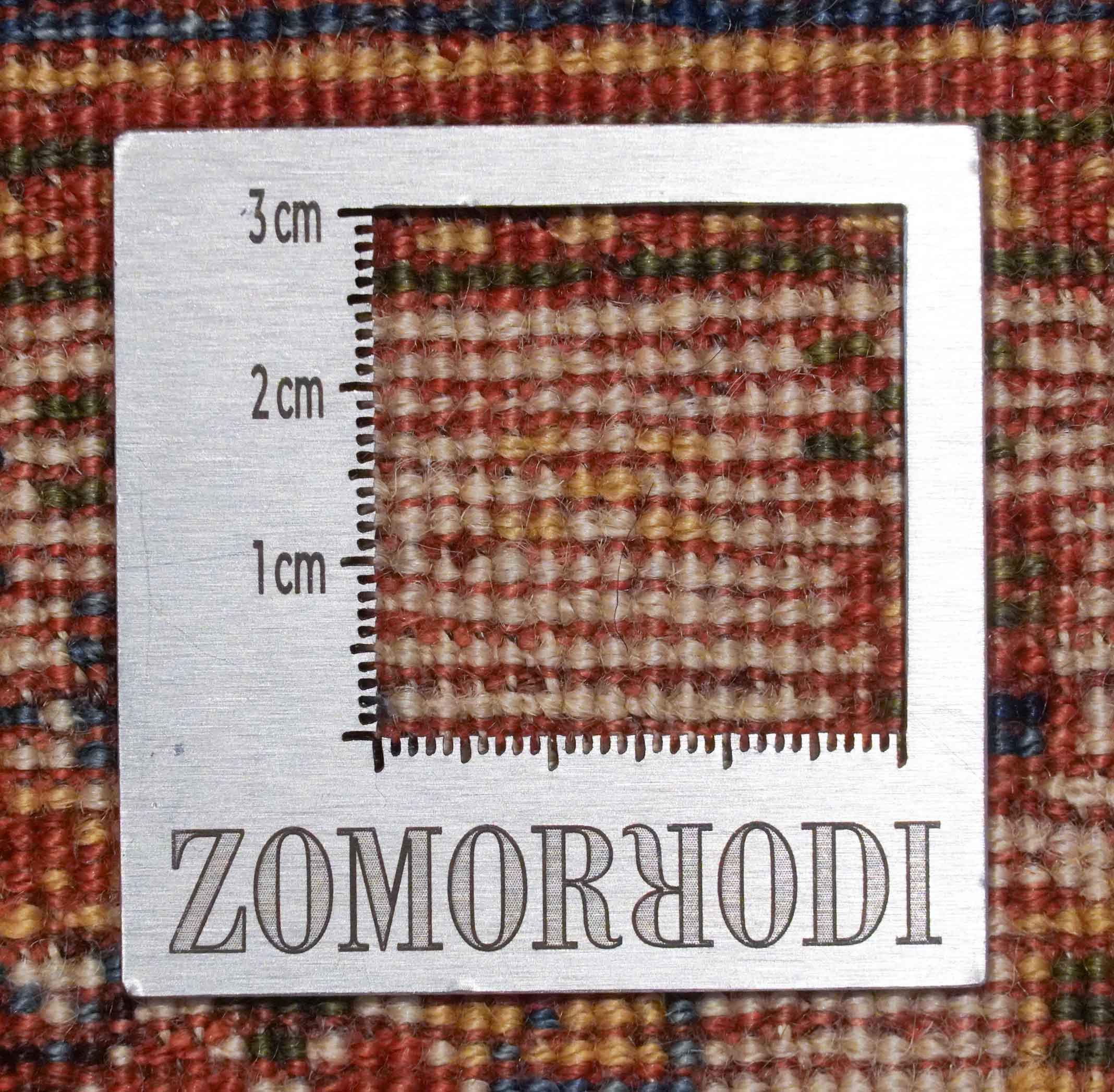
This one-of-a-kind piece in dark blue brings together traditional craftsmanship and timeless elegance. With a knot density of approx. 120,000 knots per m², the elaborate workmanship shows above all in the precise drawing of the pattern and the fine execution of the details. At 235 × 130 cm it works well as a living room rug. The harmonious colouring and the characteristic texture lend any room an exclusive, homely atmosphere. A rug of this quality is far more than a piece of furnishing – it is a piece of traditional textile art with individual character and lasting value.
| Delivery time | 2 days |
| Origin | Persia |
| Dimensions | 235 cm x 130 cm (= 3.06 m²) |
| Construction | hand-knotted |
| Material | Pile: wool |
| knots | 120.000 |
| Condition | pre-owned, but in very good condition (cleaned & restored) |
| Edition | one-of-a-kind piece |

Origin
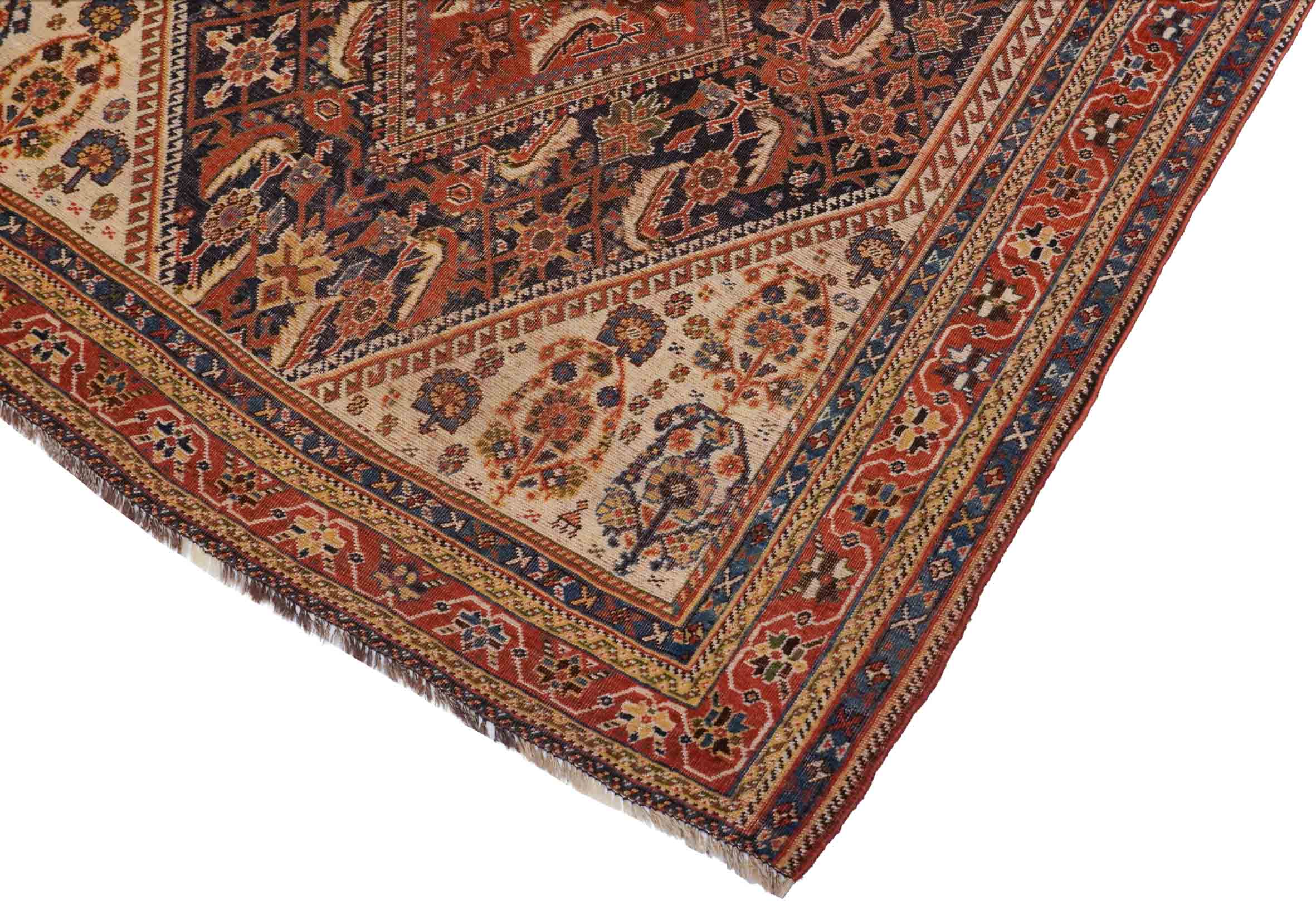
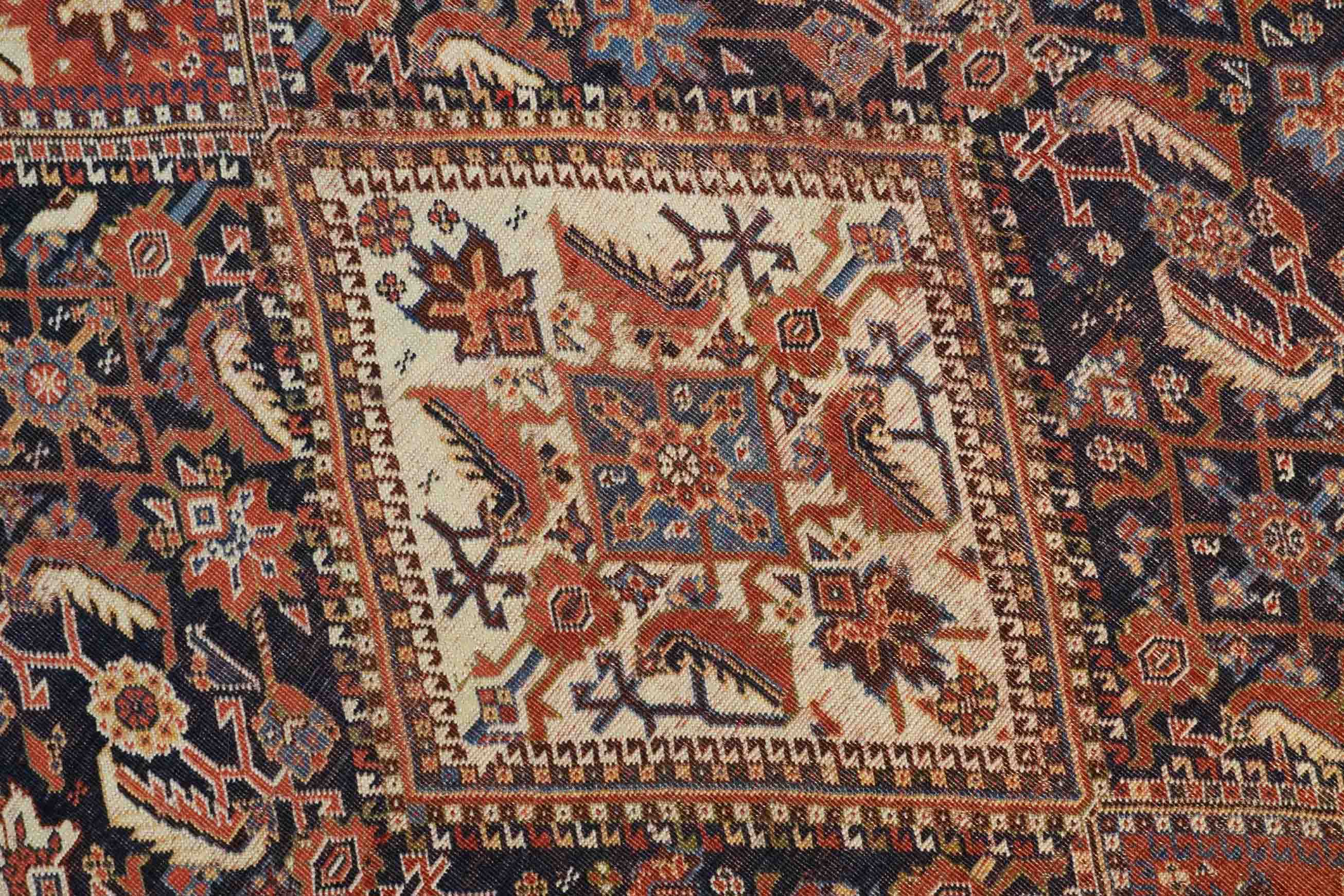
The Ghashghai are the great Persian nomadic people and have lived in the south of Iran, in the province of Fars, for centuries. They are made up of seven tribes in all. The most important tribe of the Ghashghai – at least as far as rug making goes – are the Kashghuli (also Kaschguli, Kashguli, Qashguli). Old and antique Ghashghai rugs are sought-after collectors' pieces today. Ghasghai rugs are known as the king among Persian nomadic rugs.A large share of Ghashgai rugs is adorned with the so-called geometric Heibathlou pattern: a diamond-shaped central field with a rather plain medallion that is repeated in the corners. The inner field is filled with an unusually large number of ornaments. The motifs range from stars, lions and camels to trees, blossoms and boteh or paisley symbols. Some motifs are stylised, others rendered true to life. The frequently repeated motifs are never entirely alike. They differ considerably in their colouring. The symbols are rarely arranged symmetrically. Symmetry along the length is often ignored. The individual elements in the borders, too, alternate in different colours. Small rows of little boxes at the ends of the rugs are typical. The variation in the pattern comes from the fact that the Ghashgai had no knotting templates: every rug was knotted from memory and filled with interesting motifs.
By now most Ghashghai have settled down. It is only because they have largely become settled that the Ghashghai can also make rugs in large formats. The few clans still living as nomads head up to the summer pastures in the Zagros Mountains twice a year. In autumn they return to the milder winter quarters down in the valley. The Ghashghai have a reputation for being especially proud, hard-working and honourable. Even though the Ghashghai come across as less wild and warlike today, they still have an influence on Iranian domestic politics that shouldn't be underestimated.
This Old Ghashghai is around 86 years old and a real collector's piece.
Material
The pile of this Old Ghashghai was hand-knotted from high-quality new wool. New wool is obtained by gently shearing sheep. New wool is a renewable, natural raw material with a number of impressive qualities: thanks to the wool's natural lanolin content, the surface repels droplets of water and is therefore naturally protected against dirt. Wool also offers excellent thermal insulation, helps regulate the indoor climate and absorbs sound.The foundation (weft and warp threads) of this Old Ghashghai is made of new wool.
Condition
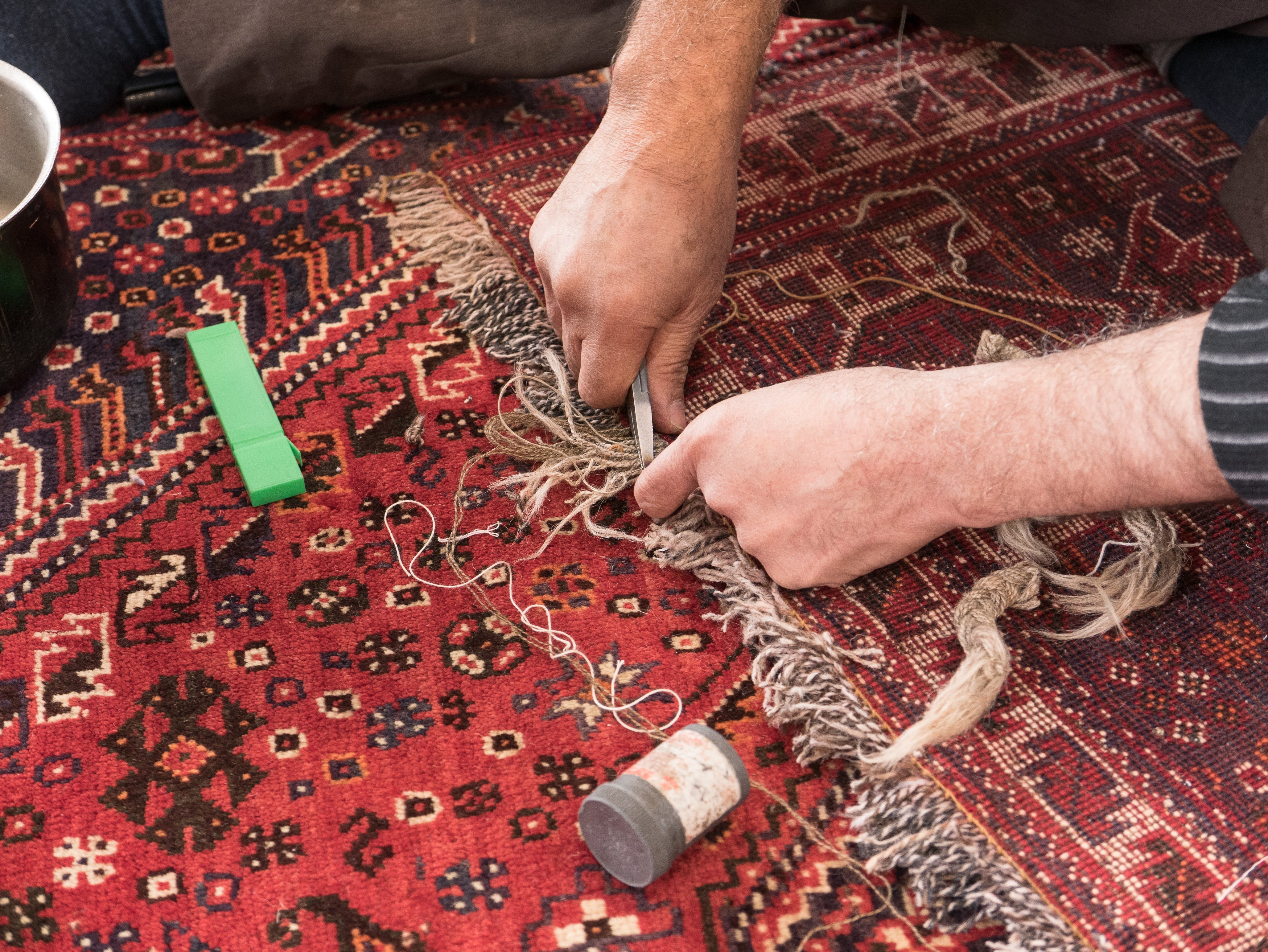
You are not the first to take a liking to this Old Ghashghai. It had owners before you who valued it and used it. The pile has grown thinner over the years. It was knotted around 86. We have cleaned it thoroughly and restored it with care. That is why – despite its age – it is in very good condition.
A note on the photos
Child labour? No thanks.
Child labour? No thanks. Children belong in school, not at a knotting frame or a loom. For us it therefore goes without saying that we only offer rugs made under fair conditions and without child labour.
We attach particular importance to humane working conditions and tolerate no child labour at any of our producers. Thank you for helping us to ensure fair conditions.
That is why we support the initiative Care & Fair against child labour in the rug trade.

Choose options
|
|
14-day home trial |
|
|
Free delivery & returns within the EU |