
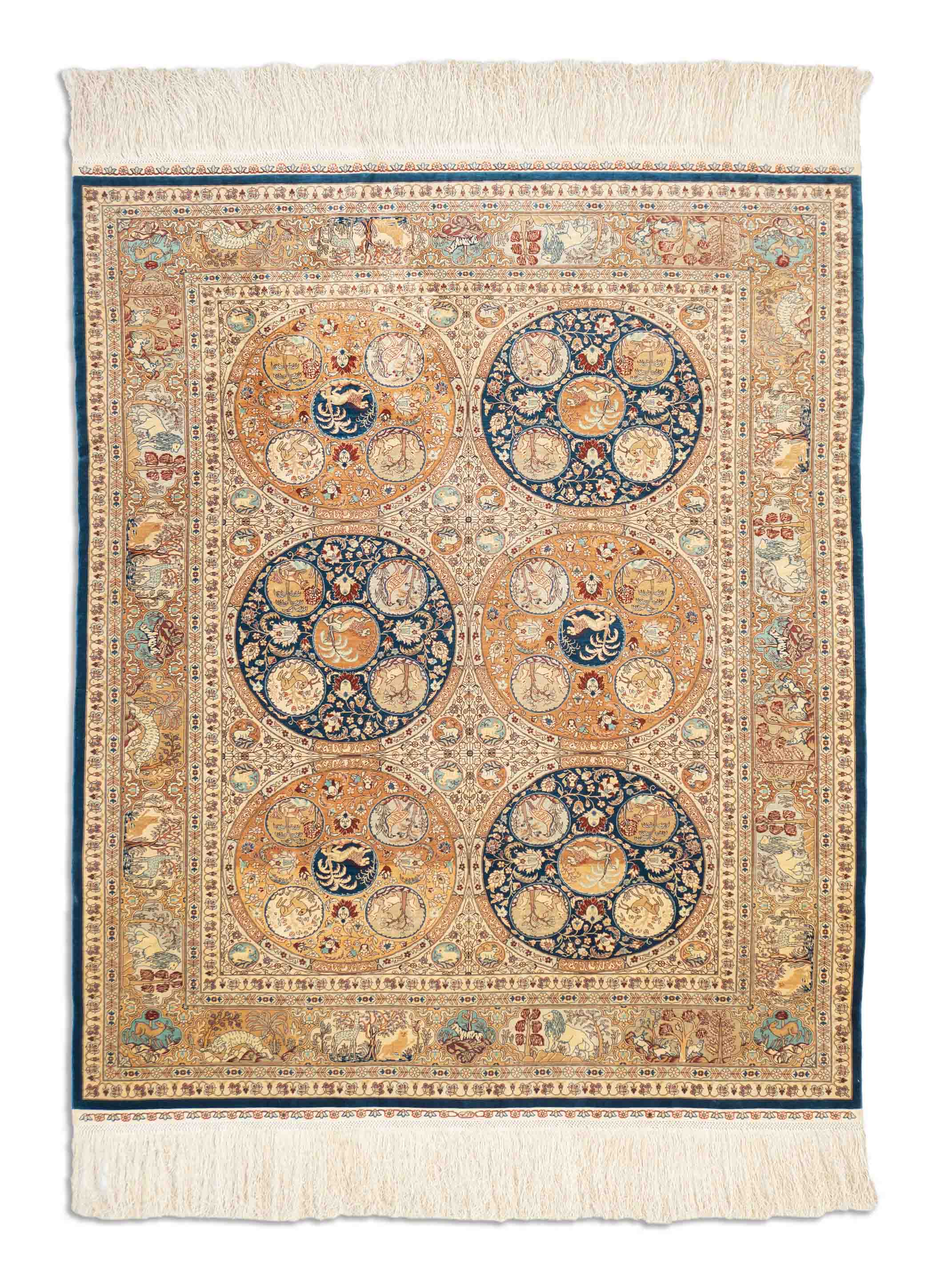
Antique Hereke in pure silk | 110 x 90 cm | Nr. 17044

|
1-3 Werktage Lieferzeit (deutschlandweit) |

|
14 Tage Probelegen |

|
Kostenlose Lieferung & Retoure innerhalb der EU |
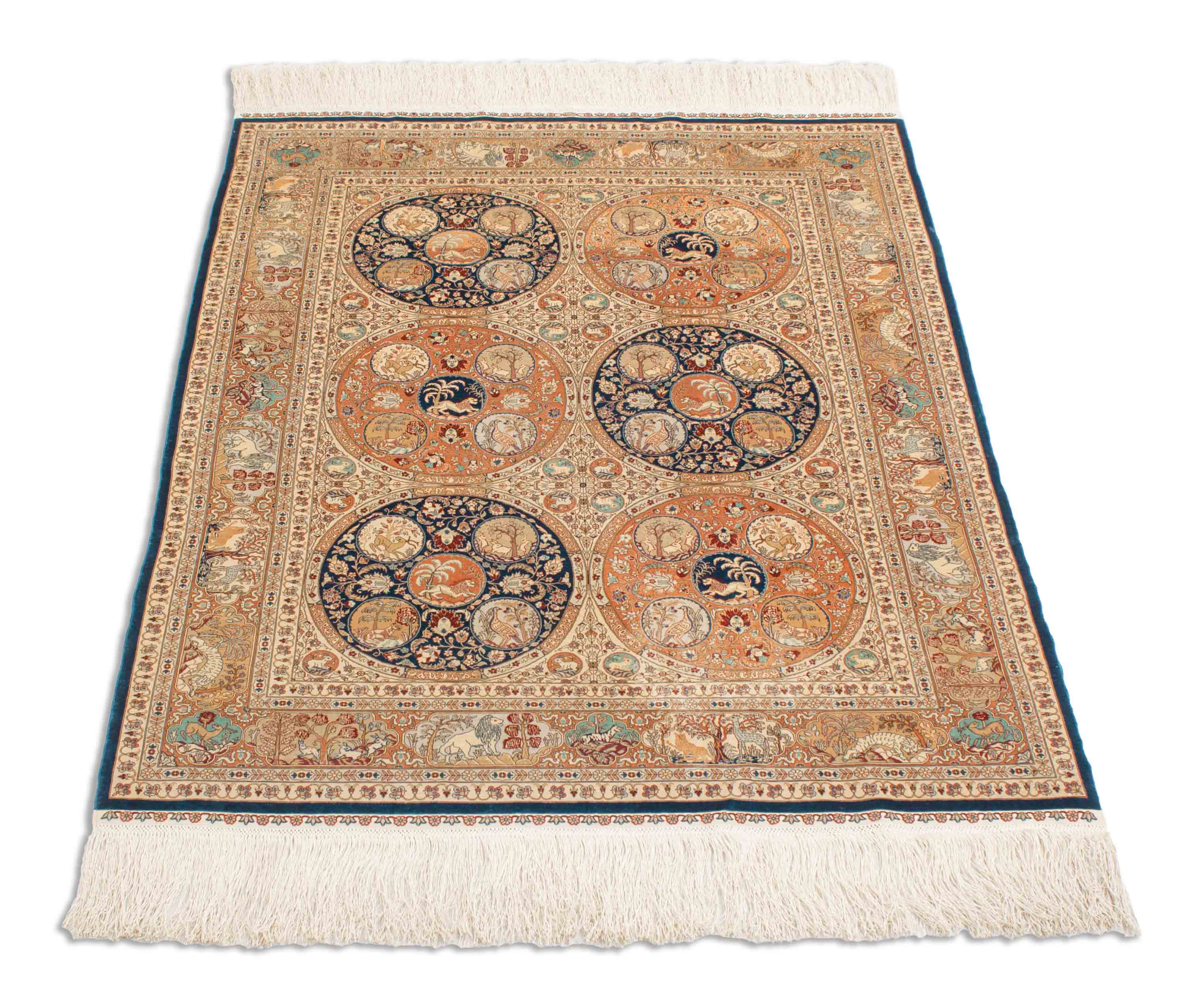
All-over patterned antique Hereke in pure silk, dark blue with panel pattern and motif
| Origin |
|
| Dimensions | 110 cm x 90 cm (= 0.99 m²) |
| Construction | hand-knotted |
| Material |
Pile: pure silk
|
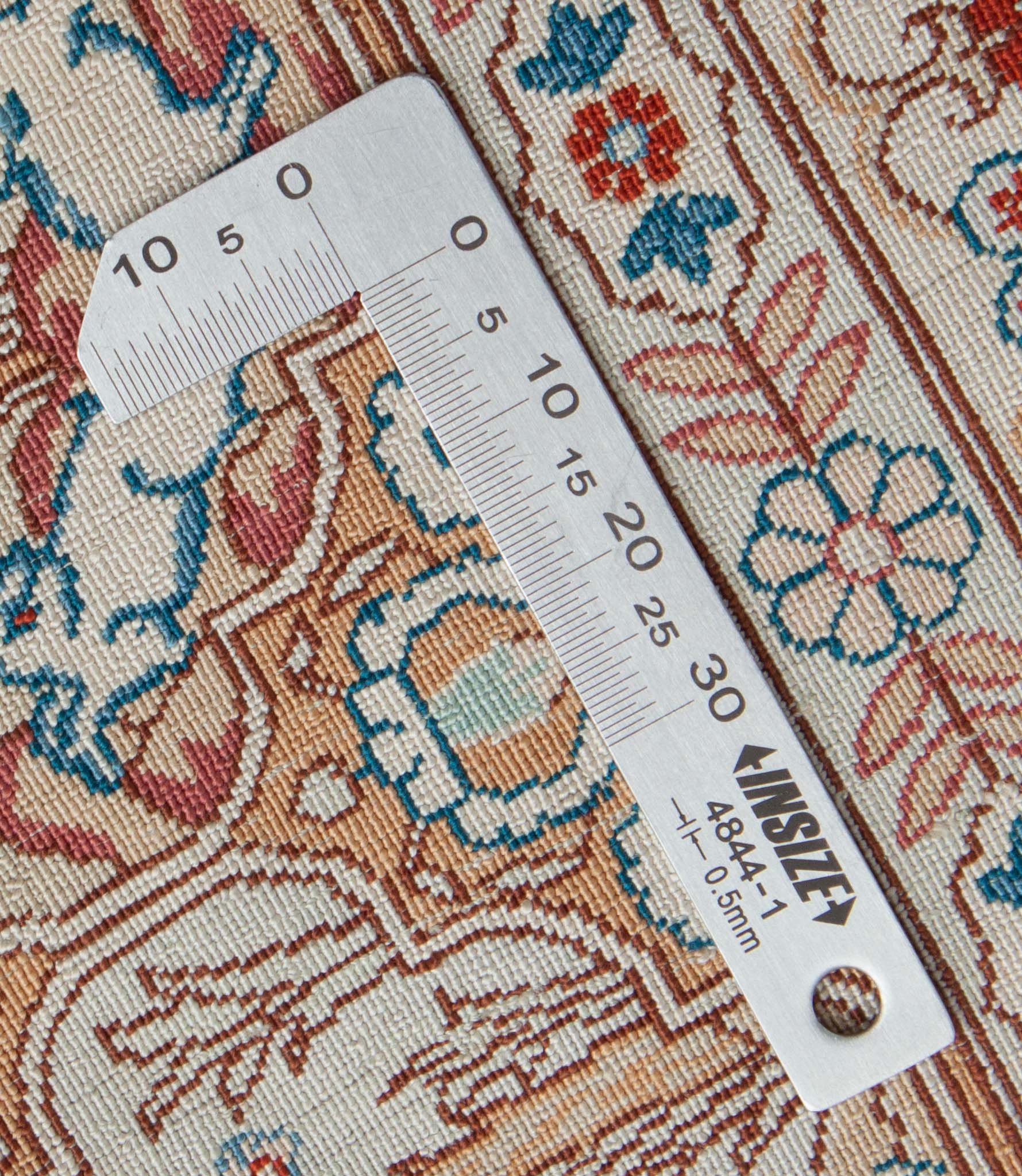
| knots per m²2 | 4.560.000 |
| Pile height | 1mm |
| Year of manufacture | 2000 |
| Colour | Dark blue, light brown |
| Edition | one-of-a-kind piece |

Origin
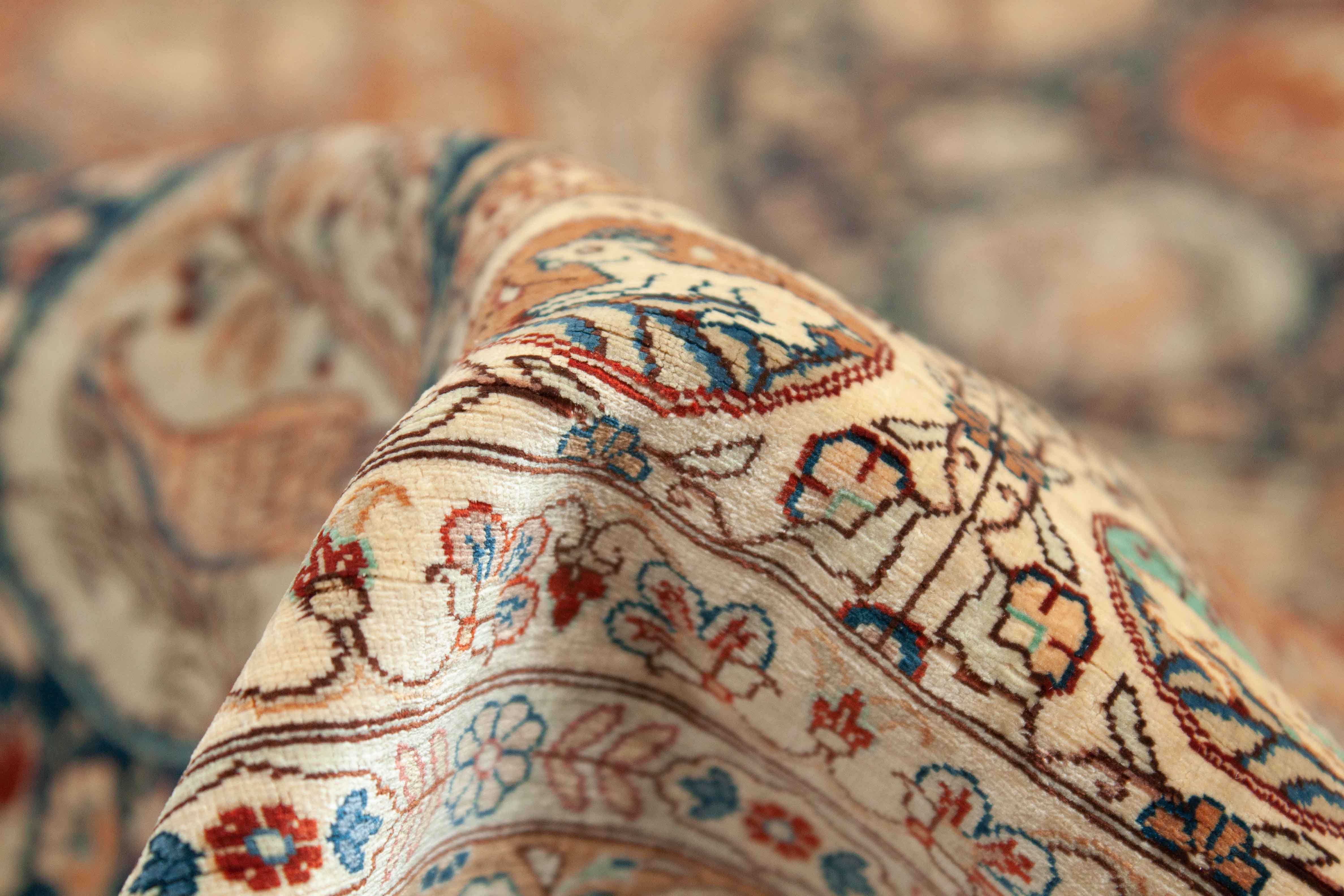
Very valuable silk rugs come from the Turkish town of Hereke. The tradition was fostered by the art-loving Sultan Abd-ul-Medjid (reigned 1839 - 1861). In 1844 he had the court workshops moved back from Cairo to Hereke. Hand-knotted Hereke silk rugs are among the finest rugs in the world and are knotted at densities of up to 6 million knots per m². Thanks to the knotting technique, incidentally, the pattern is just as clearly visible on the back as it is on the front. At renowned art auction houses, antique Turkish rugs fetch top prices.
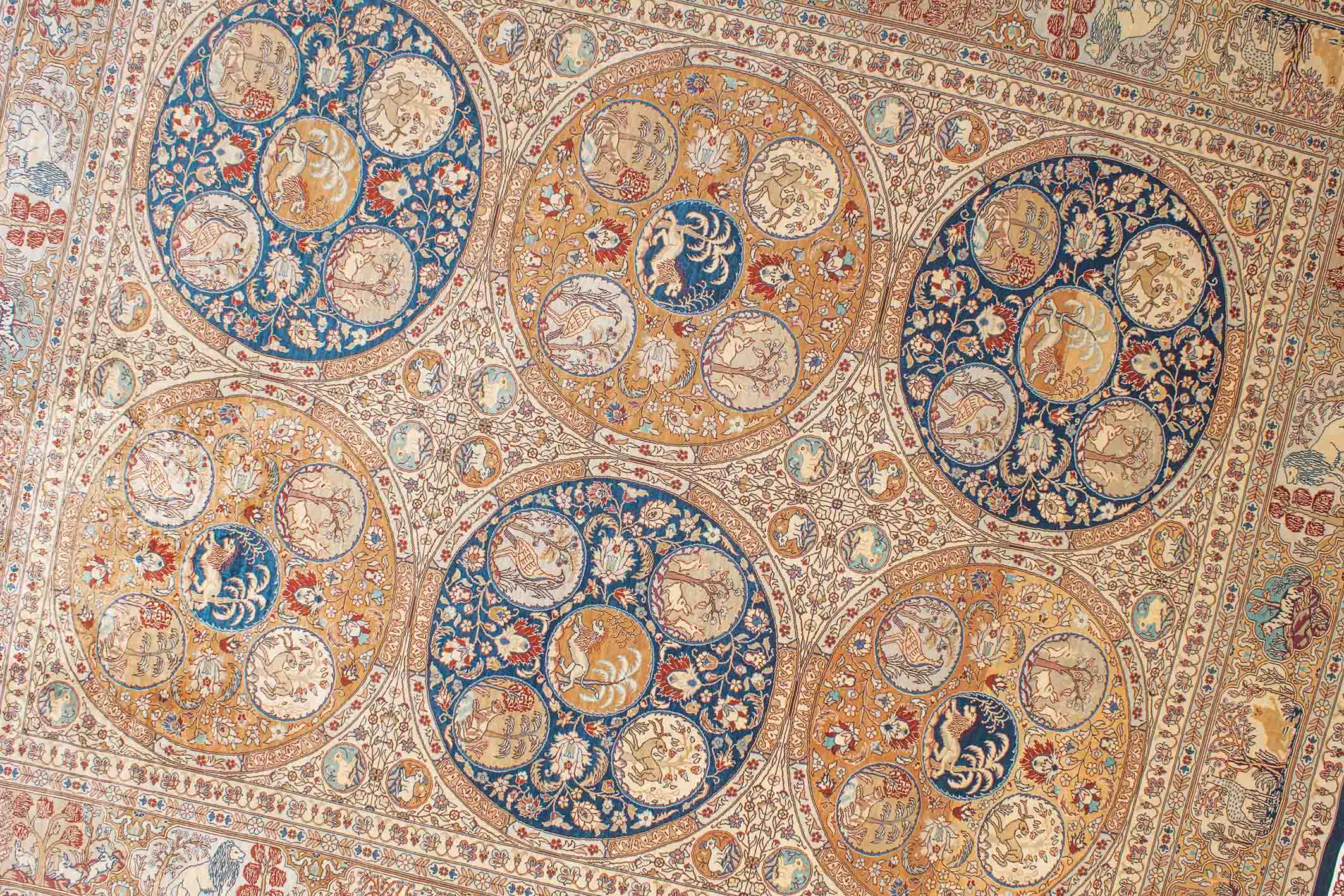
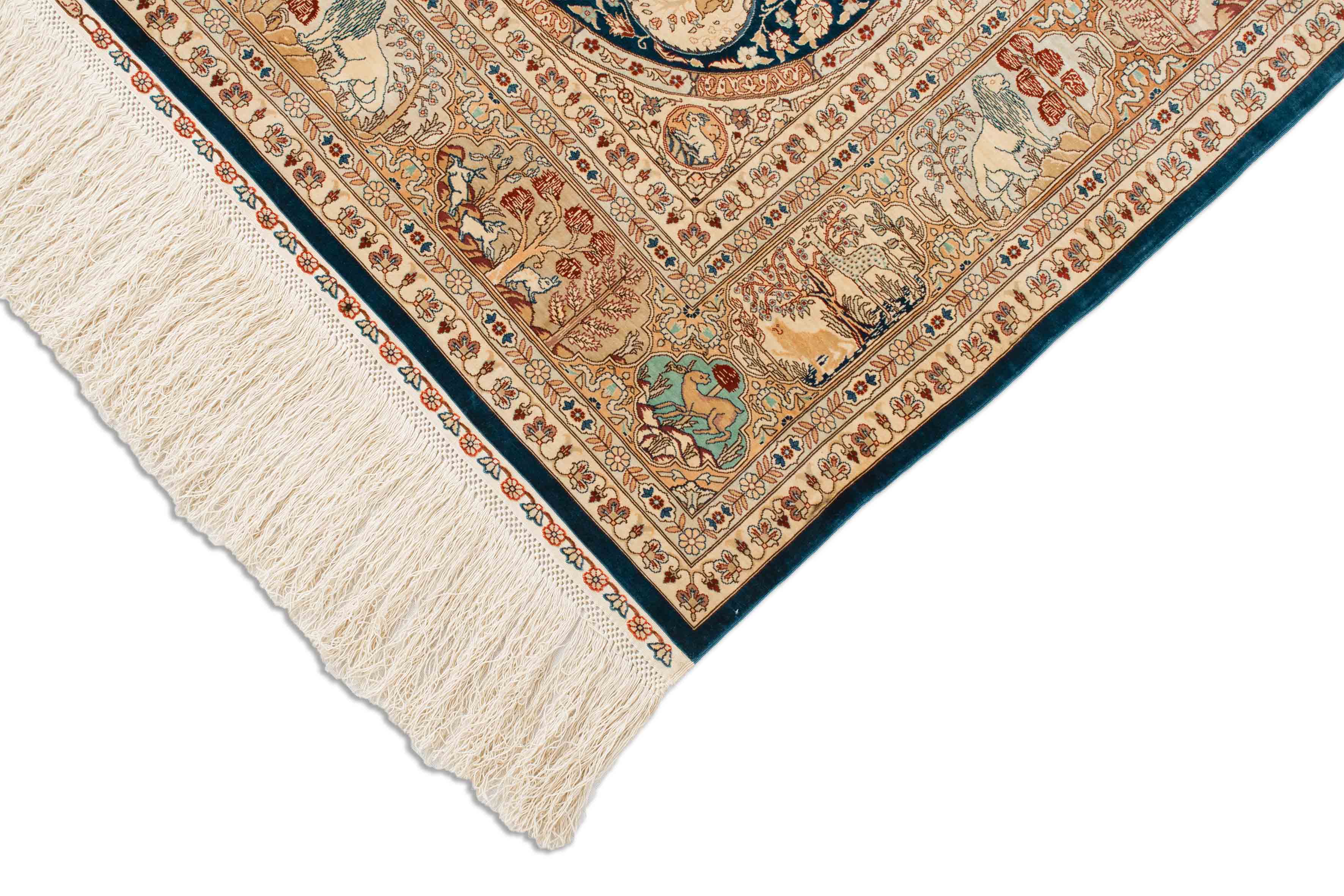
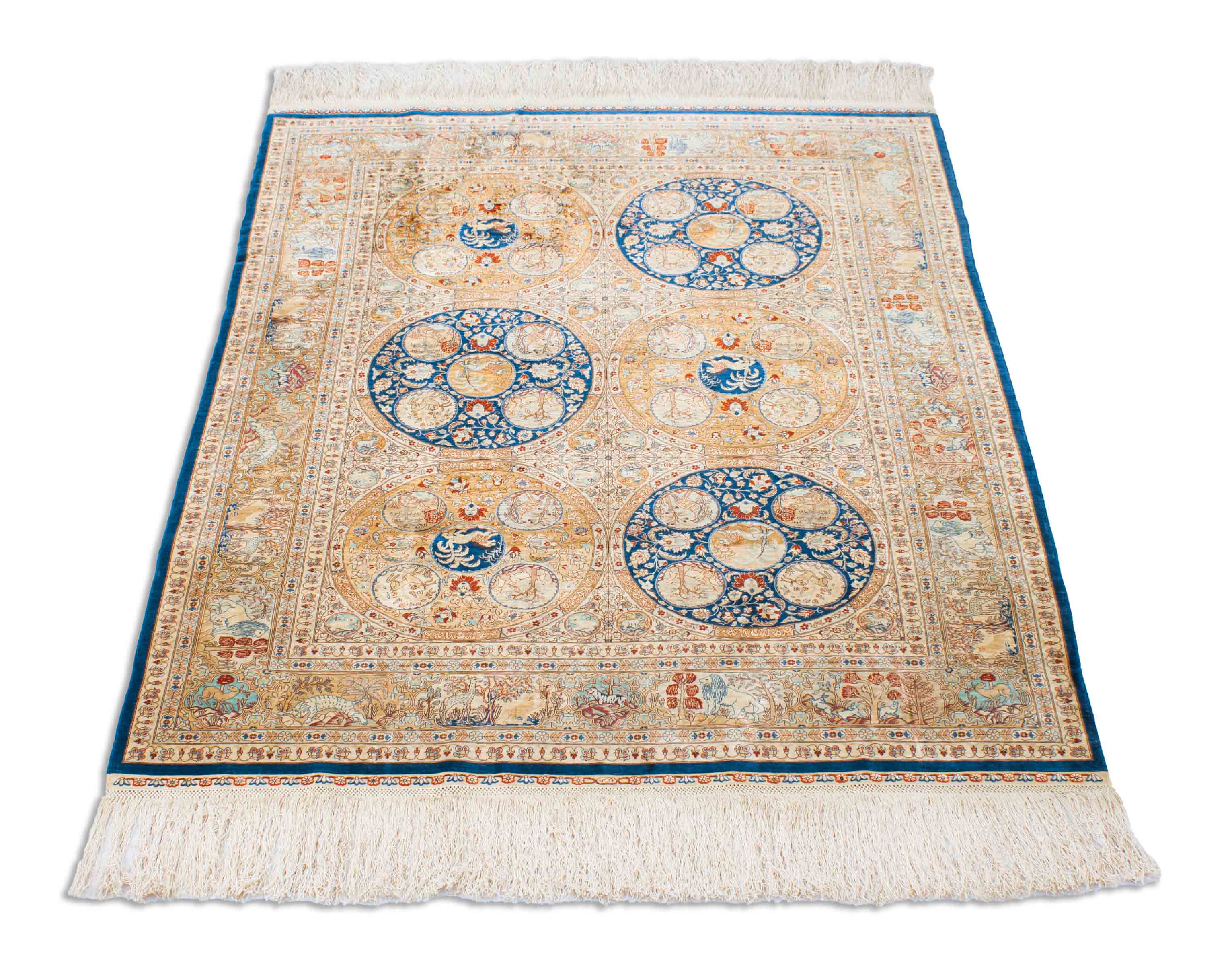
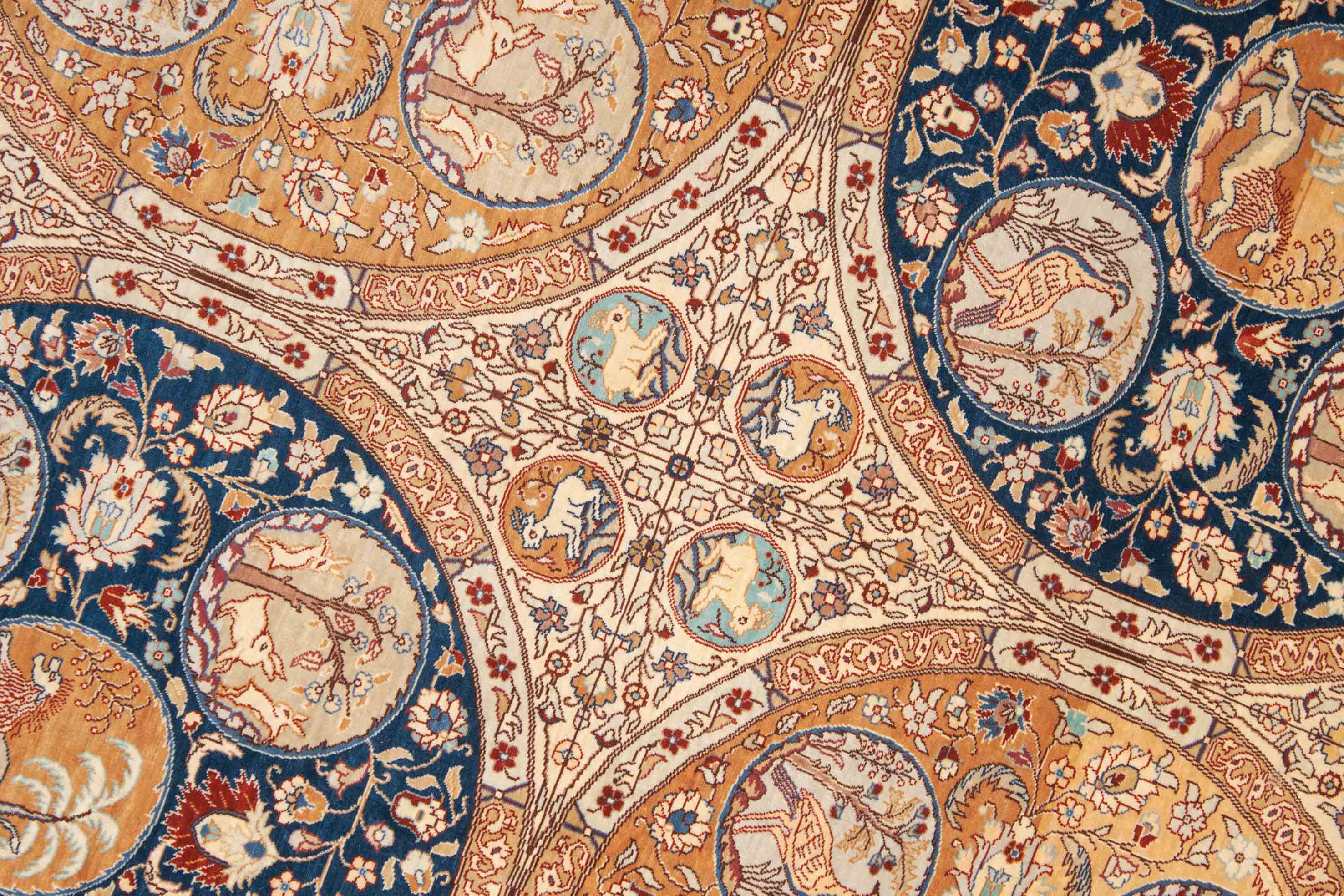
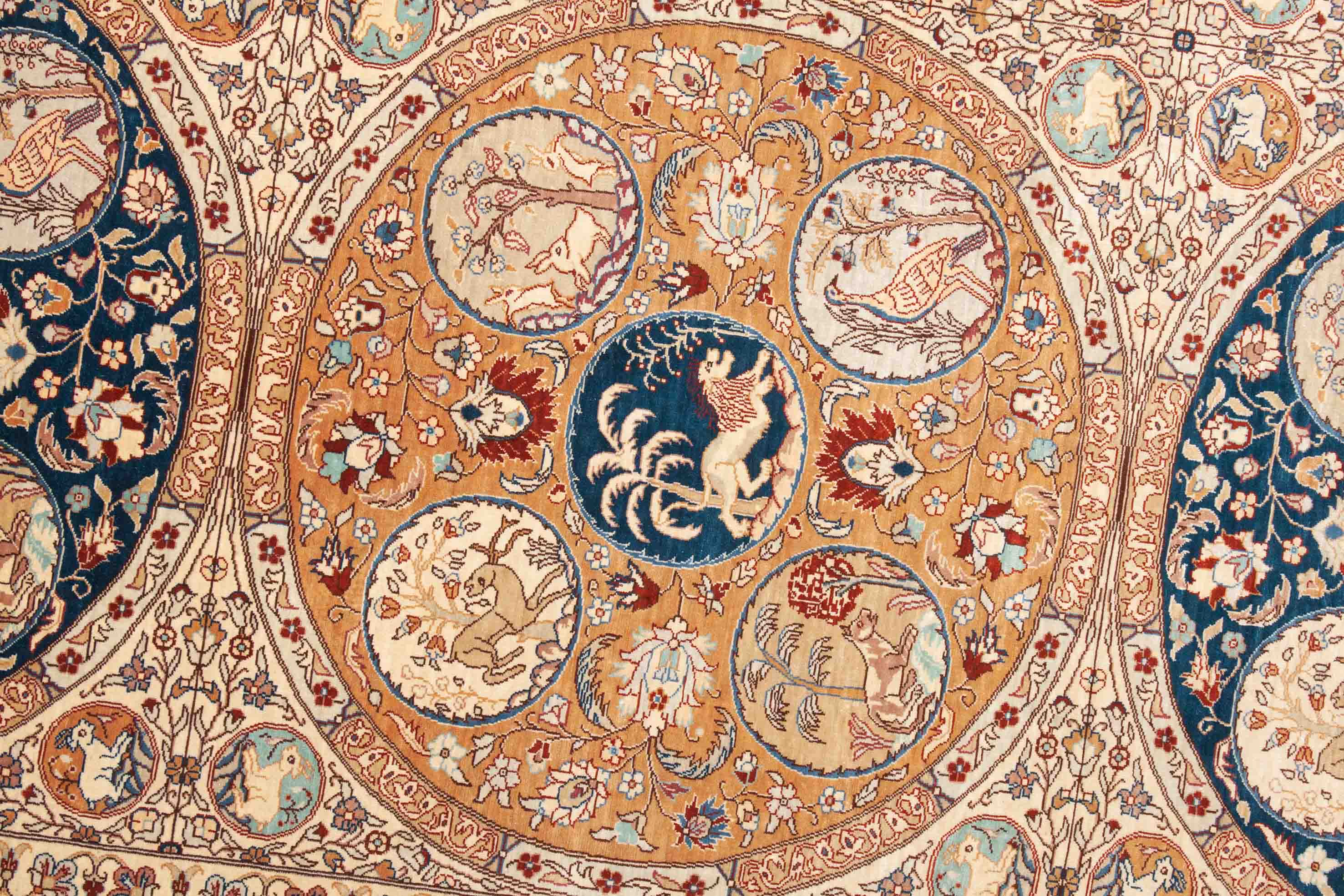
Typical motifs on Hereke rugs are flowers, branches and leaves, as well as birds, the tree of life and the so-called Mehrab or Mihrab pattern, a prayer niche shown together with oil lamps. Alongside traditional motifs and typically Ottoman or Turkish designs, Hereke silk rugs are today also knotted with more modern patterns in tune with contemporary taste. Typical colours for Hereke silk rugs are a deep dark blue, a radiant red, a lively green, a luminous yellow and various natural tones in every nuance. This antique Hereke is a collector's piece. It is around 20 years old, which alone makes it a truly special piece. Antique rugs like this Hereke are as sought after as ever and fetch top prices at renowned auction houses. This antique, extremely fine Hereke silk rug is adorned with a most unusual pattern. 6 circles, arranged in two rows of 3. Each circle is in turn decorated with 5 circles of its own. Around the large circles, too, there are 4 circles in the corners. In all the circles, and in the border as well, you'll find various animals such as tigers, lions, giraffes, deer, hares and fowl.
Pattern
The so-called panel pattern of this Hereke recalls a lushly planted garden with geometrically ordered beds, each individually framed. This layout is so characteristic that panel-pattern rugs are also known as garden rugs. The individual compartments of this Hereke's pattern show different motifs, yet follow a strictly symmetrical, rectangular arrangement.
There is a reason for this: large parts of Persia and many other regions of the Middle and Near East are desert- or steppe-like arid areas, where so-called irrigation horticulture is widely practised. Water is channelled to the beds through small irrigation canals. The panel pattern renders this irrigation system in heavily simplified form. Because of the dryness in these regions, blooming and verdant gardens are also something quite special. The panel pattern therefore probably goes back to the wish to bring a little garden – and with it a small paradise – into the home. In the Koran the term garden, as the earthly counterpart to paradise – a word of Old Persian origin, incidentally – appears very frequently.
The background of this Hereke is golden beige. Dark blue and light brown also dominate the overall impression. The border is worked in light brown and dark blue.
Condition
This Hereke has had admirers before you. It was hand-knotted around 2000. It has been thoroughly cleaned and is in good but unrestored condition. Even without restoration, this extremely fine antique Hereke is exceptionally well preserved and in flawless condition. We haven't restored this Hereke because we feel it has a special presence just as it is. If you'd like us to, we'll of course be happy to restore the rug for you. Either way, this Hereke will give you pleasure for decades to come.
Material
The silk of this Hereke's pile makes the colours of the pattern shine in ever-changing shades, depending on how the light falls. It turns this Hereke into a real jewel and creates an atmosphere in the room that is cosy and at the same time very elegant and refined. Silk is obtained by hand from the cocoons of the silk moth. Because the individual silk filaments are extremely long, very fine yarns can be spun that are light in weight yet still tear-resistant. Fine yarn allows smaller knots to be tied and therefore finer patterns to be created. This is why the finest rugs in the world are hand-knotted from pure silk. In this Hereke, even the foundation is made of pure silk. The thin but hard-wearing material of the weft and warp threads permits a particularly fine knotting, and with it a particularly fine pattern.
A note on the photos
Child labour? No thanks.
Child labour? No thanks. Children belong in school, not at a knotting frame or a loom. For us it therefore goes without saying that we only offer rugs made under fair conditions and without child labour.
We attach particular importance to humane working conditions and tolerate no child labour at any of our producers. Thank you for helping us to ensure fair conditions.
That is why we support the initiative Care & Fair against child labour in the rug trade.

Choose options
|
|
1-3 Werktage Lieferzeit (deutschlandweit) |
|
|
14 Tage Probelegen |
|
|
Kostenlose Lieferung & Retoure innerhalb der EU |