


Antique Senneh Kelim | 182 x 134 cm | Nr. Z-3264
Due to US sanctions, PayPal is not available for Persian rugs. You can use all other payment methods.


|
14-day home trial |

|
Free delivery & returns within the EU |
Antique Senneh Kelim
Craftsmanship and timeless elegance meet in this rug in rust red and beige. At 182 × 134 cm it suits the bedroom or study. It shows to equal advantage in a child's room or a dressing room. Colouring and texture give any room a homely, exclusive note – a one-of-a-kind piece that will last for years.
| Availability | In stock | Delivery time: 1–3 working days |
| Origin | Persia |
| Dimensions | 182 cm x 134 cm (= 2.44 m²) |
| Construction | hand-woven |
| Material |
Weft (pile): wool (hand-spun, natural dyes) Warp: wool |
| Pile height | 1 mm |
| Year of manufacture | 1890 |
| Condition | pre-owned |
| Colour | Rust red, Beige |
| Edition | one-of-a-kind piece |

Origin
Kelims (also kilim, qilim) were traditionally made for the weavers' own use only. Nomads and farmers used and still use their Kelims as rugs on the floor, but also as tent or wall hangings, blankets, cushions or bags. Because Kelims were constant companions in daily life, their patterns – however naive they may appear – always carry a personal message and hold meaning for the weavers and their families.In Europe it is above all the Kelims from Turkey, the Caucasus region, Iran, Afghanistan and the Turkmen cultural sphere that are known and loved. In fact, rugs are hand-woven in every country where rugs are knotted. This Kelim was hand-woven in the town of Senneh. Senneh is called Sanandaj today and is the centre of the western Persian province of Kurdistan. In Iran, incidentally, Sanandaj is famous not only for its rugs but also for its backgammon boards, handmade from the root wood of walnut trees. Senneh rugs are sometimes referred to as Sanandaj rugs today. Senneh Kelims are typically woven particularly finely.
Kelims are always hand-woven and consist only of warp and weft threads, so they have no thick, upright pile. Kelims show the same pattern on both sides and can therefore be used either way up. The pattern is created by the coloured weft threads woven into the warp threads.
This antique Senneh Kelim is a collector's piece. It is around 136 years old, which makes it a truly special piece in itself. Antique rugs like this Senneh Kelim are as sought after as ever and fetch top prices at renowned auction houses.
Material
The technique used to produce the materials for the pile of this antique Senneh Kelim is more than 200 years old. The wool was dyed with natural dyes and spun by hand. Dyeing with natural or plant dyes is more complicated, more expensive and more time-consuming than dyeing with chemical colours. For a luminous red, for example, you need around one kilo of ground madder root as dye for every kilo of wool. For a strong yellow that is not too pale, you even need two kilograms of dyer's weld per kilo of wool. Spinning the wool is just as time-consuming and labour-intensive. On top of that, fewer and fewer people still know how to spin wool by hand.But the effort is worth it: dyeing with natural colours allows the high-quality wool to keep its natural oil content. Wool that has been dyed with natural colours and spun by hand creates fascinating, shimmering patterns. The charm of hand-spun wool, with its slight irregularities and natural shades, comes into its own as a contrast in modern interiors, but equally in rooms furnished in a more traditional or country style.
Condition
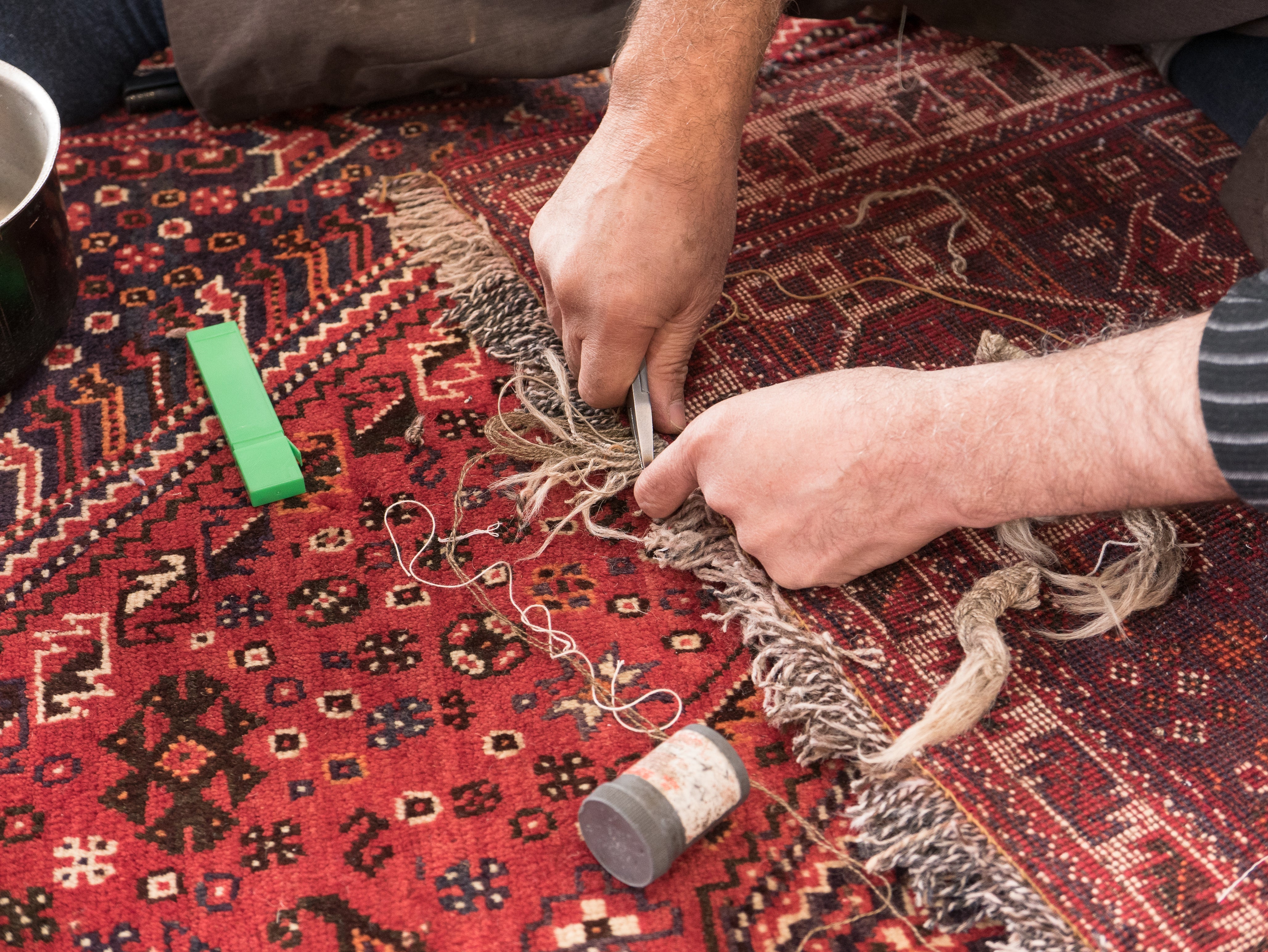
This antique Senneh Kelim has a history. It was hand-woven around 1890 and has given faithful service ever since. The edges are damaged in places. Overall it is nevertheless in good condition and can give pleasure for decades to come. We have not restored this antique Senneh Kelim, because we feel it has a special presence just as it is. If you would prefer otherwise, we will of course be glad to restore the rug for you.
A note on the photos
Child labour? No thanks.

The rug trade against child labour: Children belong in school, not at a knotting or weaving loom. For us it therefore goes without saying that we only offer rugs made under fair conditions and without child labour. We place particular importance on good working conditions and tolerate no child labour at our producers.
We are proud to be a member of the Care & Fair campaign against child labour.
The industry-wide campaign CARE & FAIR - the rug trade against child labour was founded in 1994. The initiative has made it its mission to fight the excesses of illegal child labour in the knotting countries and, at the same time, to improve the overall situation of rug knotters and their families in the knotting regions of India, Nepal and Pakistan.
Our goals:
- Ending illegal child labour in India and Pakistan.
- Creating better living conditions for knotters' families.
- Socially responsible production. We only accept goods that have been made under fair conditions. Working with our producers as partners, we want to make clear to them that taking on social responsibility benefits everyone.
Together with Care & Fair we currently support 10 schools, 6 adult education centres and 3 day clinics in India and Pakistan.
Choose options
Due to US sanctions, PayPal is not available for Persian rugs. You can use all other payment methods.
|
|
14-day home trial |
|
|
Free delivery & returns within the EU |