
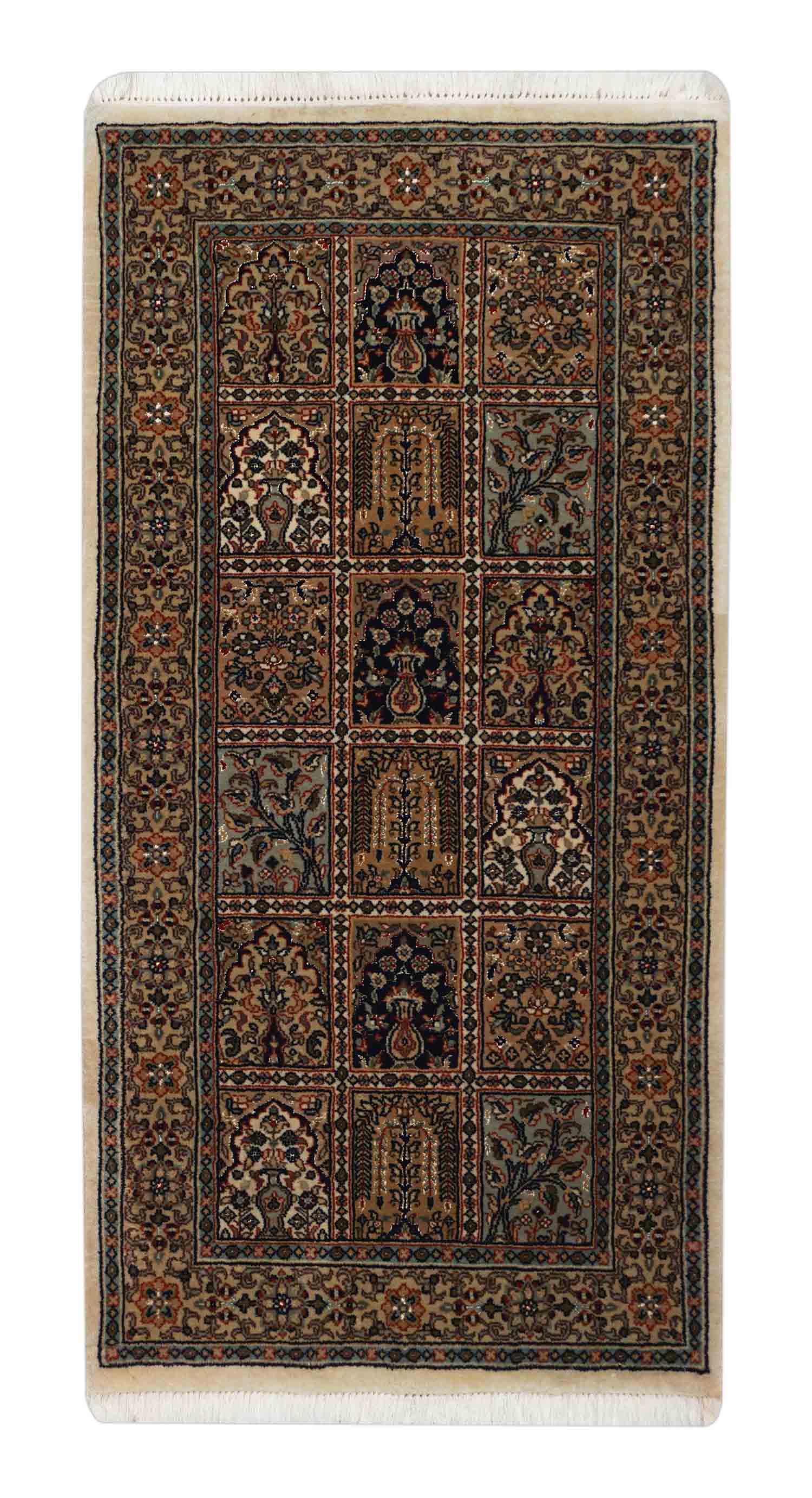
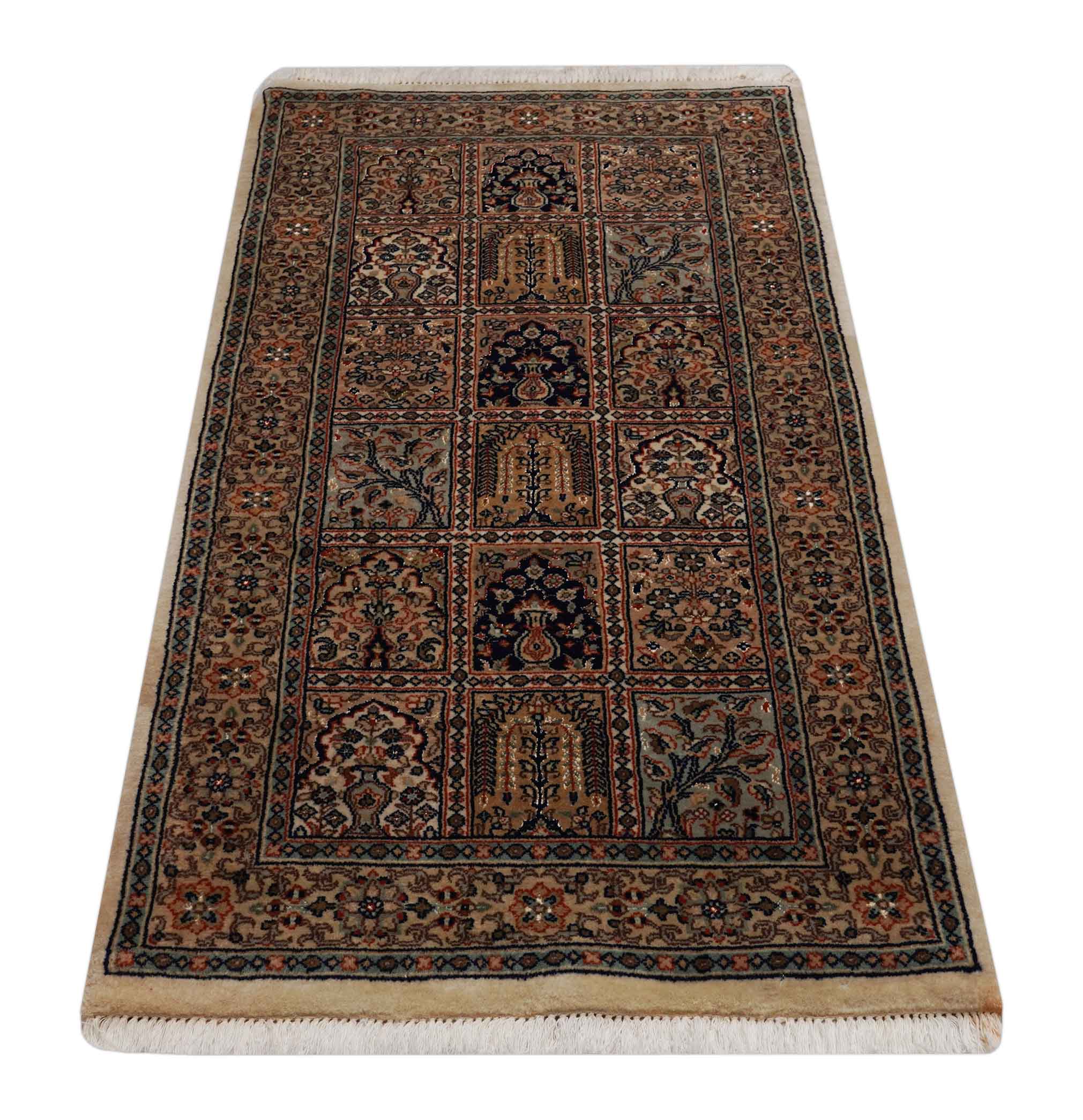
Bakhtiari Panel Design Rug | 143 x 71 cm | Nr. Z-2442

|
1-3 Werktage Lieferzeit (deutschlandweit) |

|
14 Tage Probelegen |

|
Kostenlose Lieferung & Retoure innerhalb der EU |
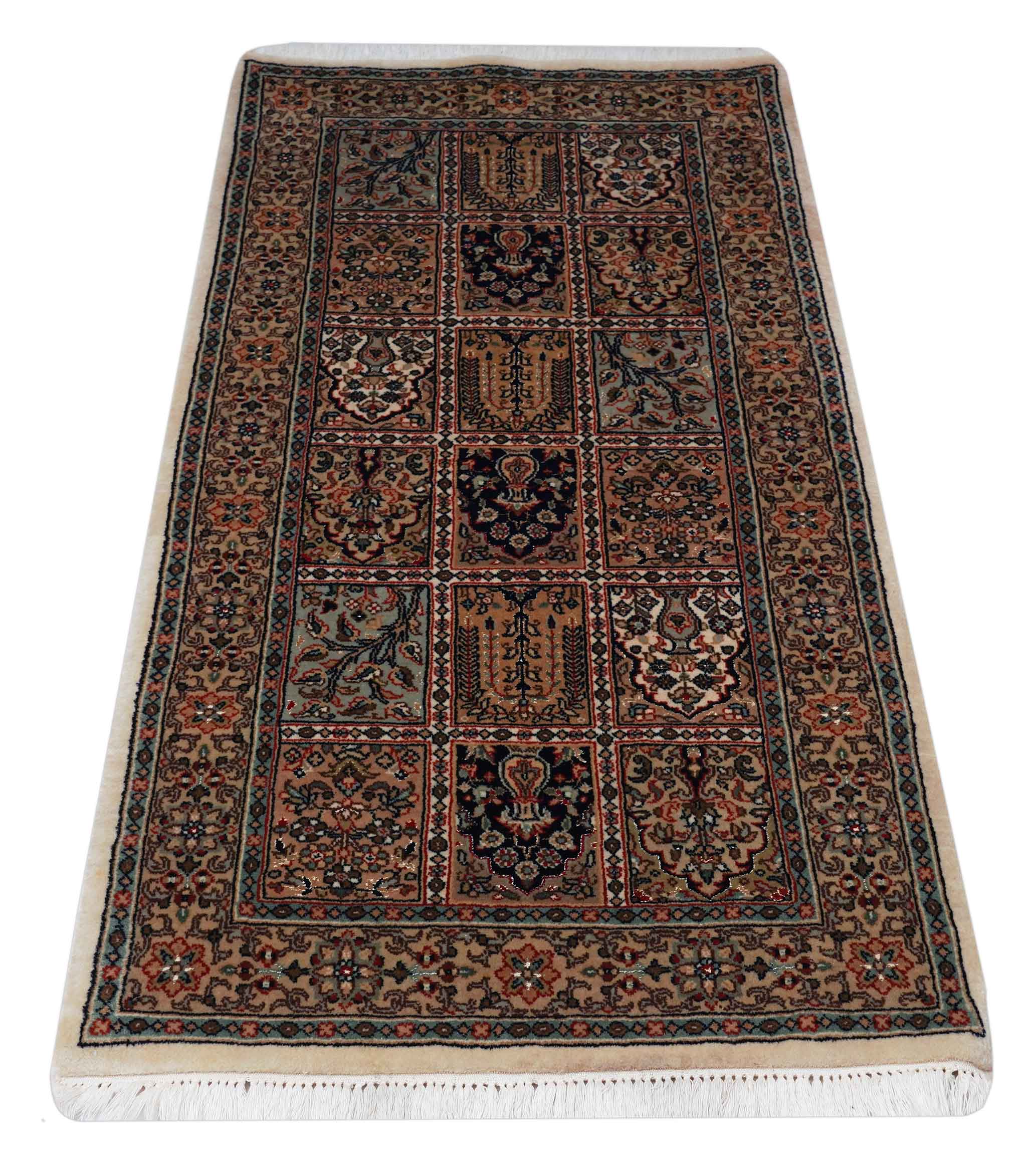
Bakhtiari panel-pattern rug, light brown with border and panel pattern
| Origin |
|
| Dimensions | 143 cm x 71 cm (= 1.02 m²) |
| Construction | hand-knotted |
| Material |
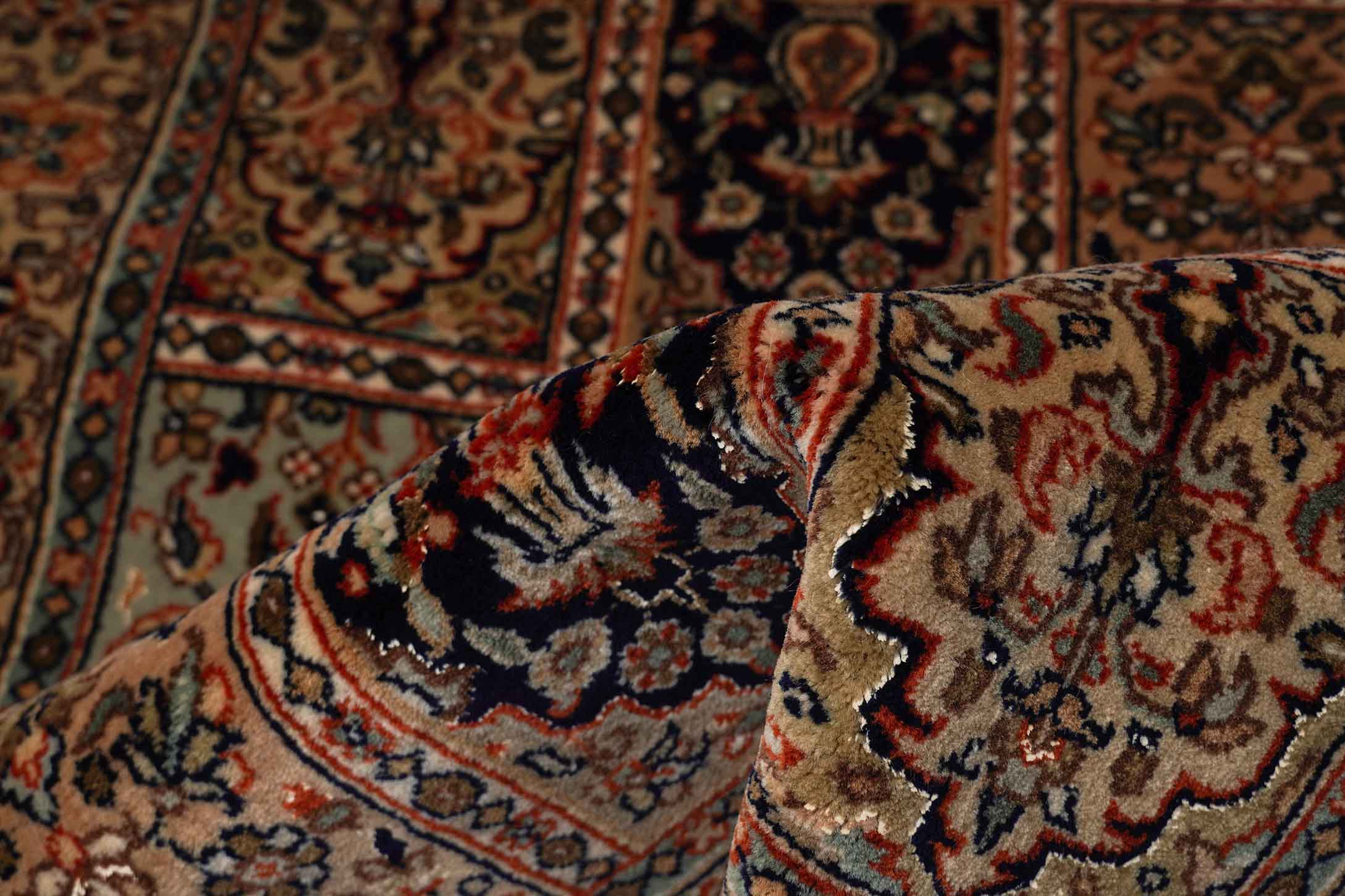
Pile: wool (hand-spun, natural dyes) & viscose
|
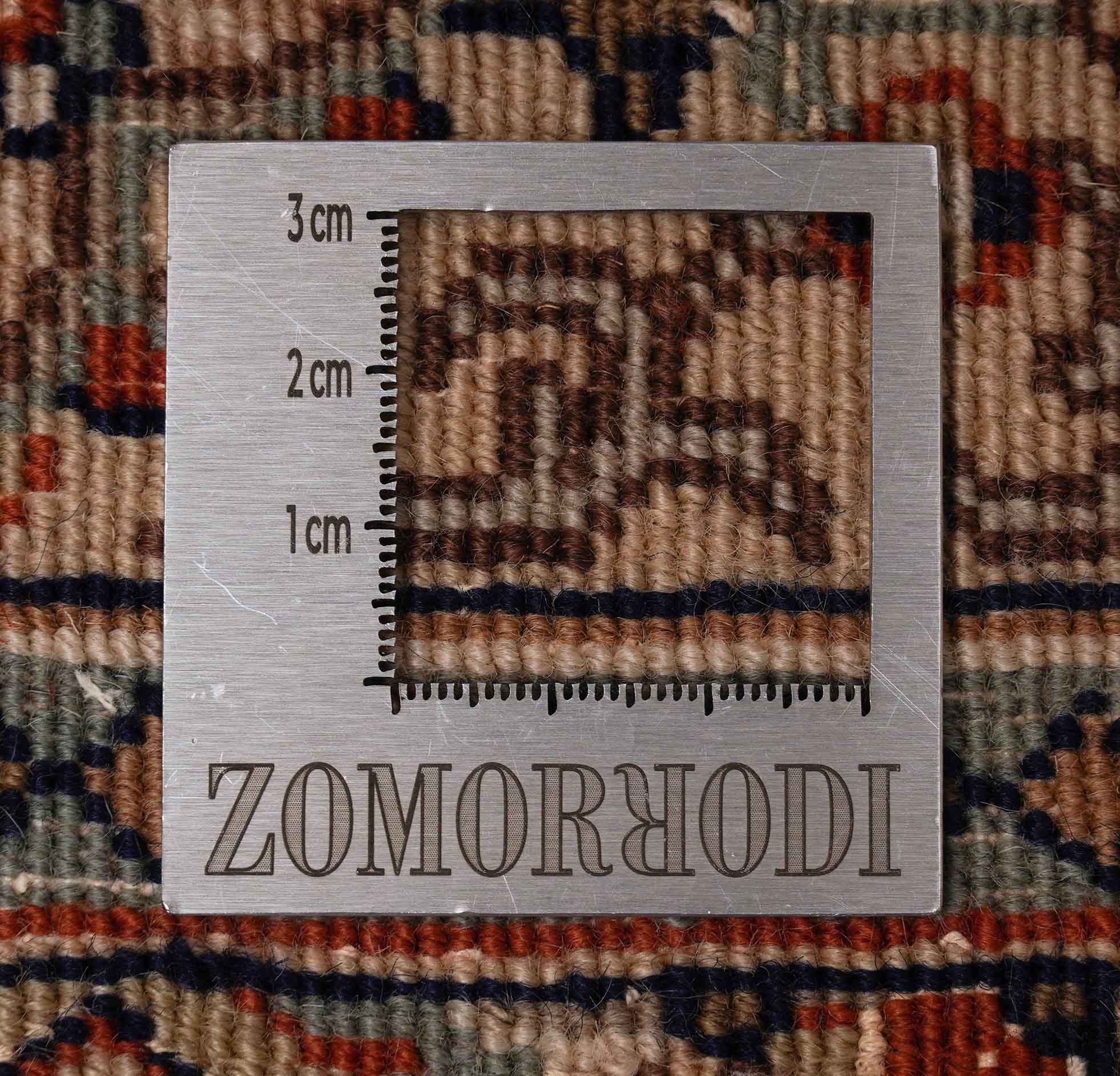
| knots per m²2 | 360.000 |
| Pile height | 8mm |
| Year of manufacture | 2010 |
| Colour | Light brown |
| Edition | one-of-a-kind piece |

Origin
The pattern of this Bakhtiari panel-pattern rug takes its cue from the pattern elements of classic Bakhtiari rugs. This rug, however, was not knotted in Iran but in Pakistan.
The Bakhtiari (also Bachtiari) are an ancient, widely branched people living in south-western Iran. Their rugs are known collectively as Bakhtiar or Bakhtiari, where the "i" corresponds to our preposition "of". Bakhtiari rugs – the rugs of the Bakhtiari – comprise numerous sub-provenances with a variety of pattern types.
In our Bakhtiari panel-pattern rugs the classic pattern elements are arranged in panels that seem to float on the contrasting, monochrome ground. As with classic Bakhtiari rugs, natural dyes and hand-spun wool were used in their making, so that despite their intensity they feel pleasantly restrained and resemble their classic models in workmanship and line.
Pattern
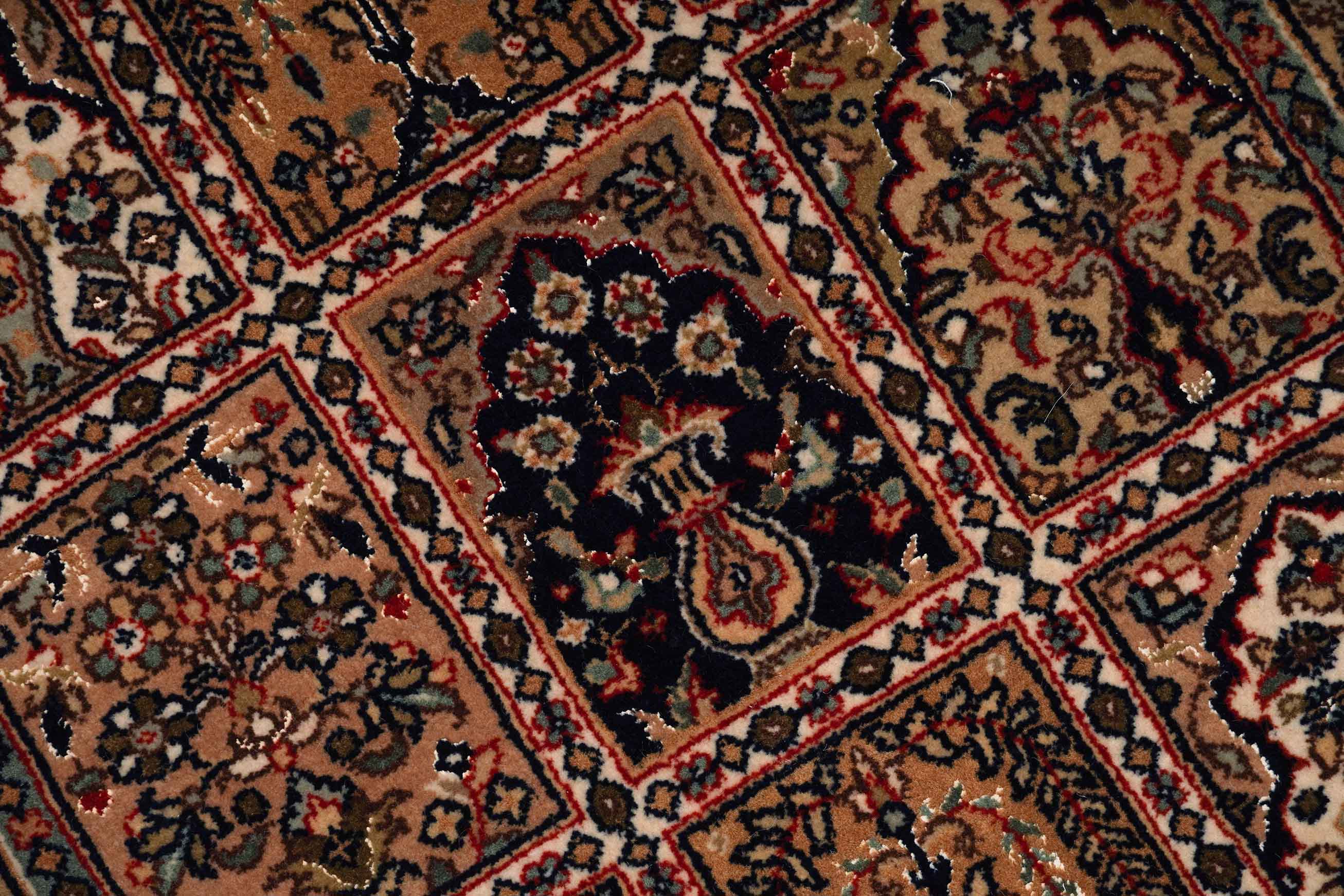
The so-called panel pattern of this Bakhtiari panel-pattern rug recalls a lushly planted garden with geometrically divided, individually framed beds. This design is typical, which is why panel-pattern rugs are also known as garden rugs in German. The individual compartments of the pattern of this Bakhtiari panel-pattern rug show different motifs, yet follow a strictly symmetrical, rectangular arrangement.
There is a reason for this: large parts of Persia and many other regions of the Middle and Near East are desert- or steppe-like arid areas, where so-called irrigation horticulture is widely practised. Water is channelled to the beds through small irrigation canals. The panel pattern renders this irrigation system in heavily simplified form. Because of the dryness in these regions, blooming and verdant gardens are also something quite special. The panel pattern therefore probably goes back to the wish to bring a little garden – and with it a small paradise – into the home. In the Koran the term garden, as the earthly counterpart to paradise – a word of Old Persian origin, incidentally – appears very frequently.
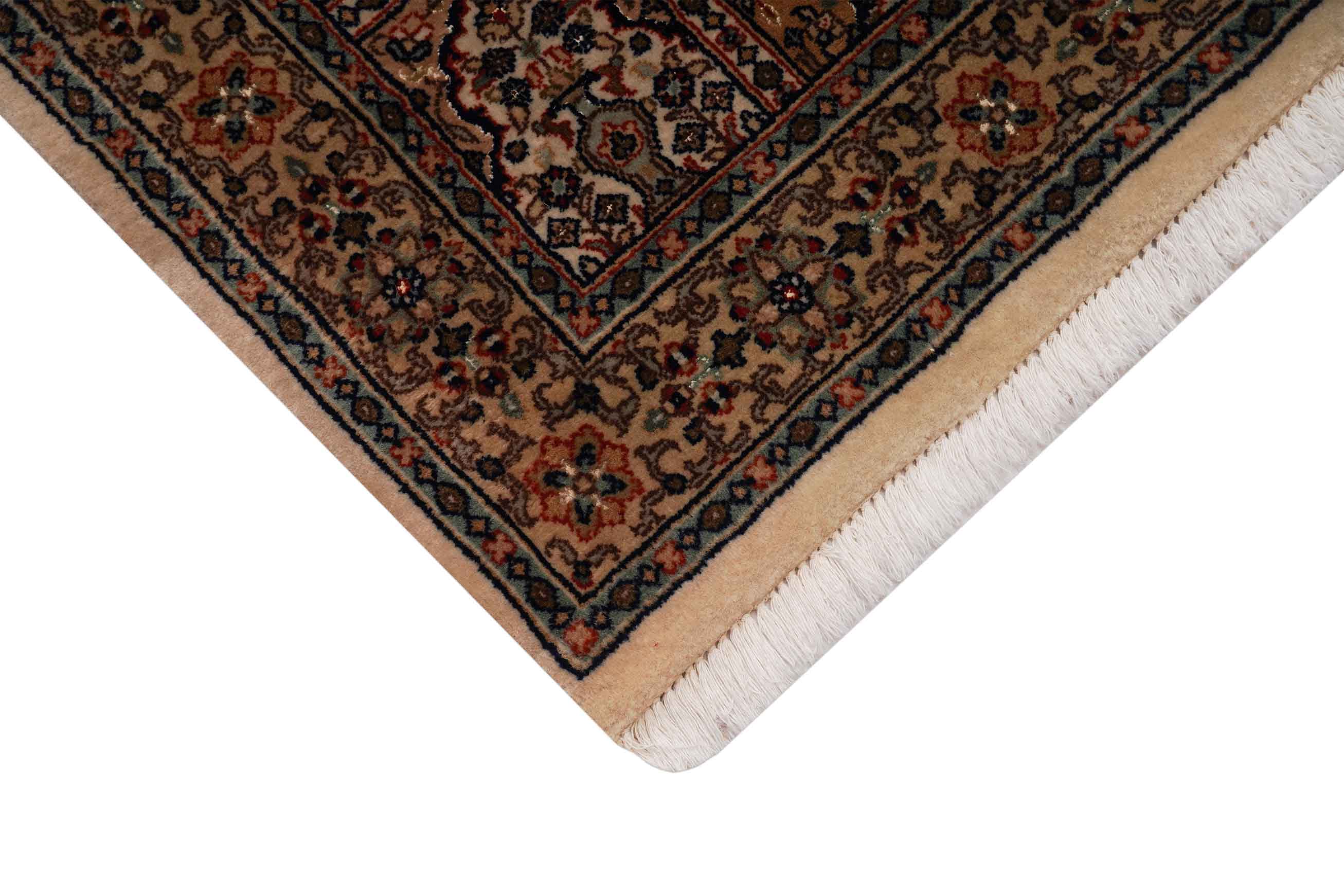
The overall impression is dominated by light brown. The border is worked in beige and light brown.
Condition
This Bakhtiari panel-pattern rug has a story to tell. Some areas of the rug have discoloured. It was hand-knotted around 2010. We have cleaned it thoroughly and restored it with care. Despite its age, it is therefore in very good condition.
Material
The pile of this Bakhtiari panel-pattern rug is made from a hard-wearing blend of hand-spun wool and viscose.
Viscose – also known as acetate silk or rayon – is always made from cellulose, a natural product, and therefore from wood as its raw material. In India, the cellulose pulp is obtained from bamboo. In an elaborate process, the pulpy cellulose is drawn out into one continuous textile yarn. That is why viscose is also referred to as a continuous filament yarn. Because of the silky sheen of the yarn, viscose made from bamboo is also called "bamboo silk". The colloquial term "artificial silk" is not permitted under the German Textile Labelling Act (TKG).
The technique used to prepare the wool for the pile of this Bakhtiari panel-pattern rug is over 200 years old. The wool was dyed with natural colours and spun by hand. Dyeing with natural or plant-based colours is more complicated, more expensive and more time-consuming than dyeing with chemical dyes. For a luminous red, for instance, you need around one kilo of ground madder root as dyestuff per kilo of wool. For a strong yellow that isn't too pale, you even need two kilograms of the dyestuff weld per kilo of wool. Spinning the wool is just as time-consuming and labour-intensive. On top of that, fewer and fewer people still know how to spin wool by hand.
But the effort is worth it: dyeing with natural colours allows the high-quality wool to keep its natural oil content. Wool that has been dyed with natural colours and spun by hand creates fascinating, shimmering patterns. The charm of hand-spun wool, with its slight irregularities and natural shades, comes into its own as a contrast in modern interiors, but equally in rooms furnished in a more traditional or country style.
The weft and warp threads of this Bakhtiari panel-pattern rug are made of cotton. This versatile material is tear-resistant and yet elastic, which makes it particularly well suited to a hard-wearing foundation.
A note on the photos
Child labour? No thanks.
Child labour? No thanks. Children belong in school, not at a knotting frame or a loom. For us it therefore goes without saying that we only offer rugs made under fair conditions and without child labour.
We attach particular importance to humane working conditions and tolerate no child labour at any of our producers. Thank you for helping us to ensure fair conditions.
That is why we support the initiative Care & Fair against child labour in the rug trade.

Choose options
|
|
1-3 Werktage Lieferzeit (deutschlandweit) |
|
|
14 Tage Probelegen |
|
|
Kostenlose Lieferung & Retoure innerhalb der EU |