

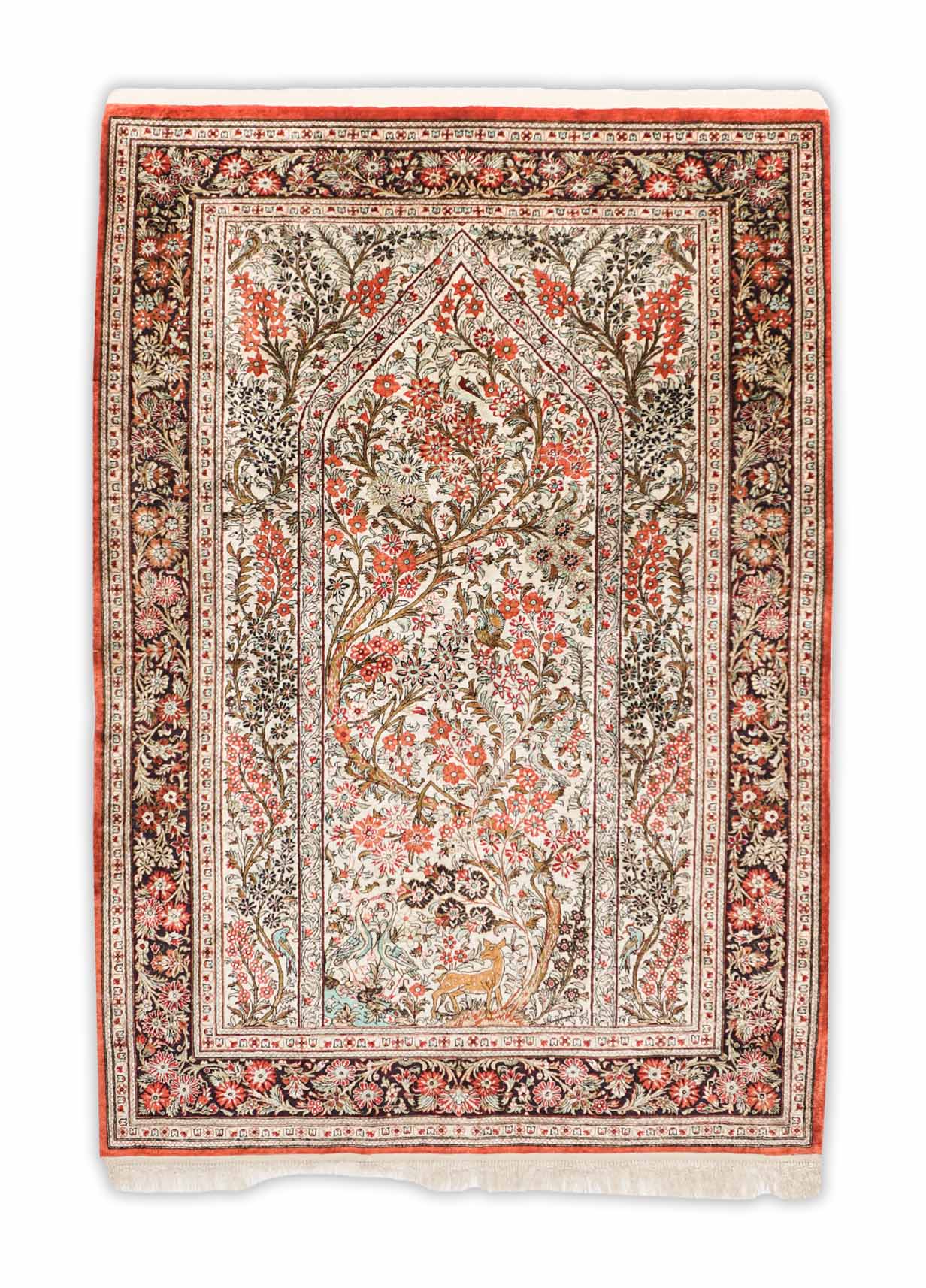
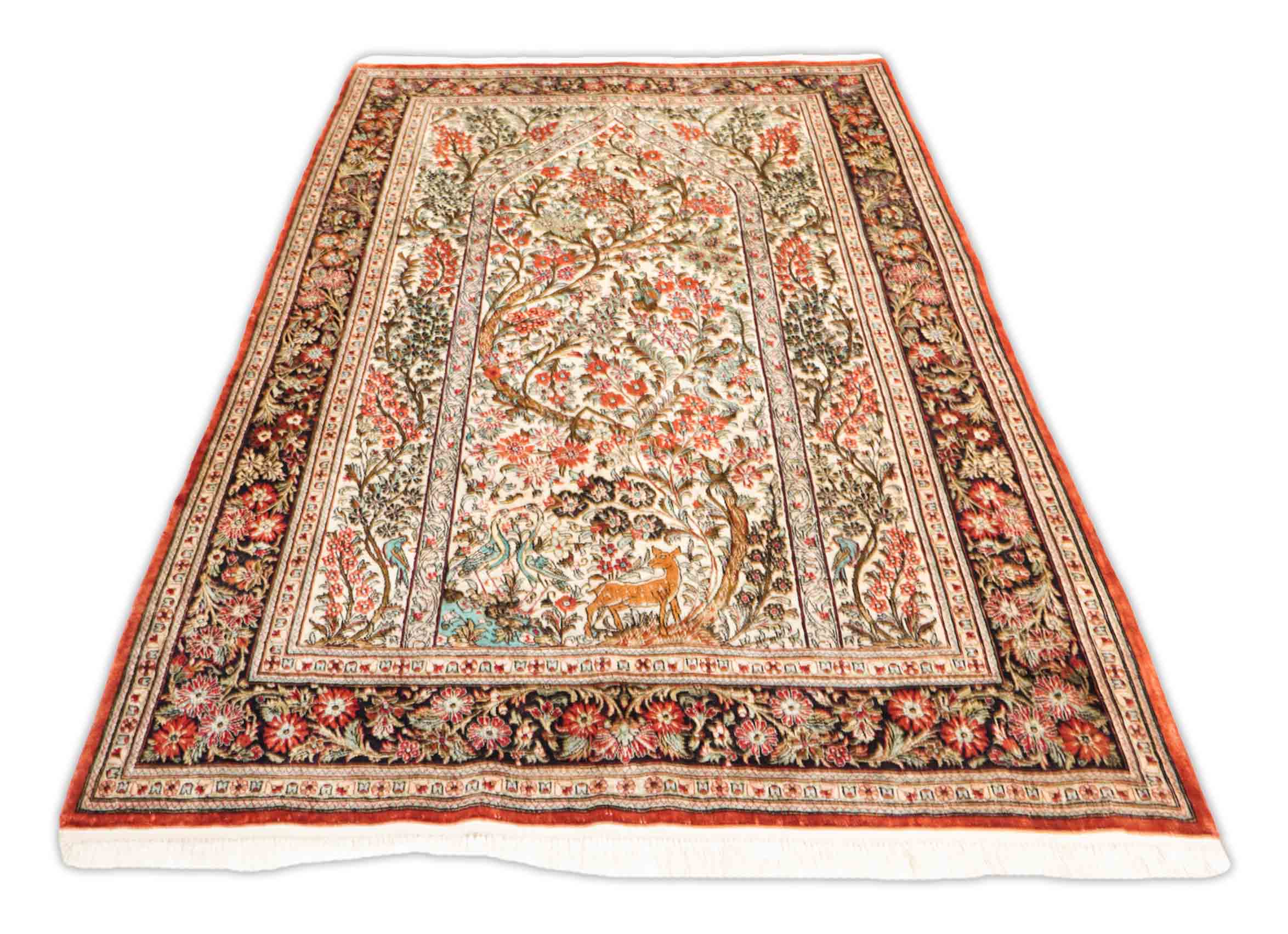

Qom in pure silk | 154 x 108 cm | Nr. 14057

|
1-3 Werktage Lieferzeit (deutschlandweit) |

|
14 Tage Probelegen |

|
Kostenlose Lieferung & Retoure innerhalb der EU |
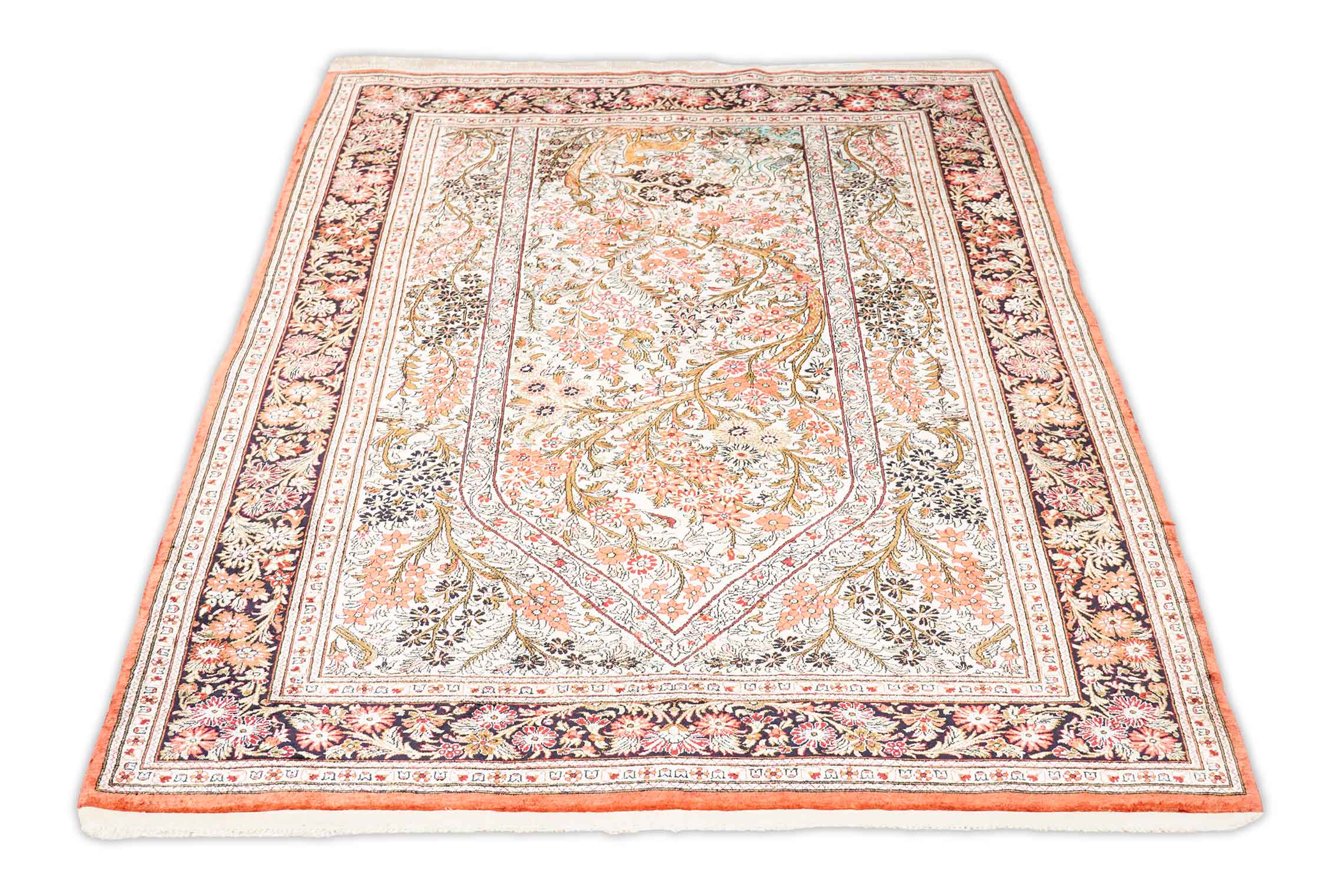
Floral Qom in pure silk, light red with border and paradise garden pattern
| Origin |
|
| Dimensions | 154 cm x 108 cm (= 1.66 m²) |
| Construction | hand-knotted |
| Material |
Pile: pure silk
|
| knots per m²2 | 1.000.000 |
| Pile height | 3mm |
| Condition | new |
| Colour | Light red, cream white |
| Edition | one-of-a-kind piece |

Origin
Qom is a relatively young provenance for Persian rugs. The city of Qom (also Ghom, Ghoum, Goum) lies in the centre of Iran, about 100 km south of the capital, Tehran. Since Qom had no long knotting tradition of its own to build on, patterns were – and still are – adopted from other weaving regions. Over time, however, a distinctive style grew out of this. Today the silk rugs from Qom are among the most celebrated and finest rugs in the world. The field of Qom rugs often has a light ground, decorated with finely drawn medallion patterns or all-over boteh or vase motifs.
Pattern
This Qom is graced by a wonderful paradise garden motif. The paradise garden motif is typical of the Safavid era. Paradise garden rugs show a stylised, geometricised depiction of a traditional Persian garden with delicate plants and trees. The Greek word "paradeisos" goes back to the Middle Persian word "pardēs". Originally the term referred to the Persian royal gardens; only in the biblical context did it acquire the connotation of the garden of God. The fertile, artfully laid out royal gardens were home to a wide variety of exotic plants and animals. They were enclosed by a wall, a symbol of the separation between heaven and earth. Traditional Persian paradise gardens were rectangular, with a river or another body of water running from north to south and from east to west, forming a cross that divides the garden into four sections. In rugs depicting paradise gardens, too, the portrayal of water – so precious in arid regions – plays a prominent role.
The background of this Qom is cream white. The overall impression is also dominated by light red and cream white. The border is worked in light red and dark brown.
Material
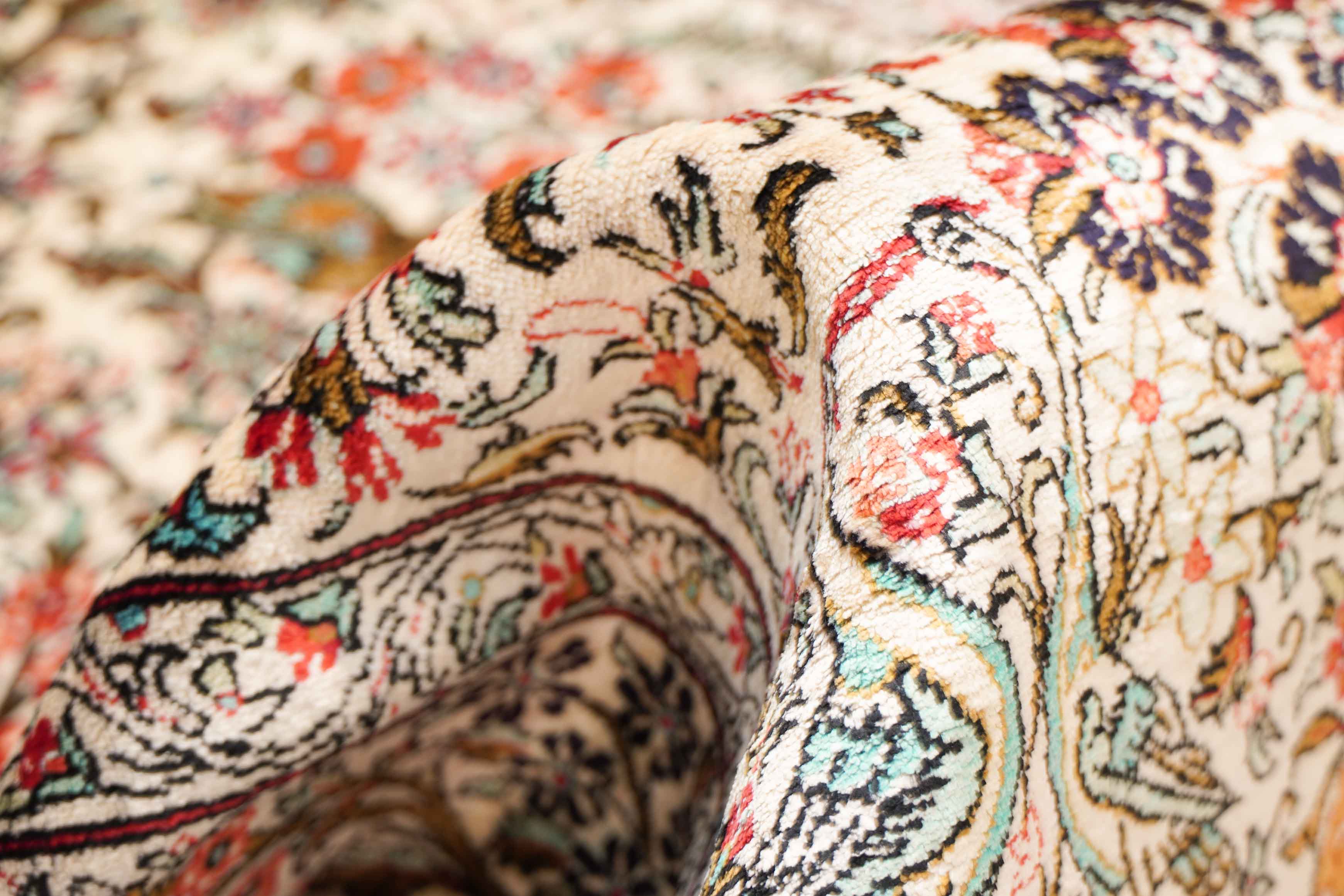
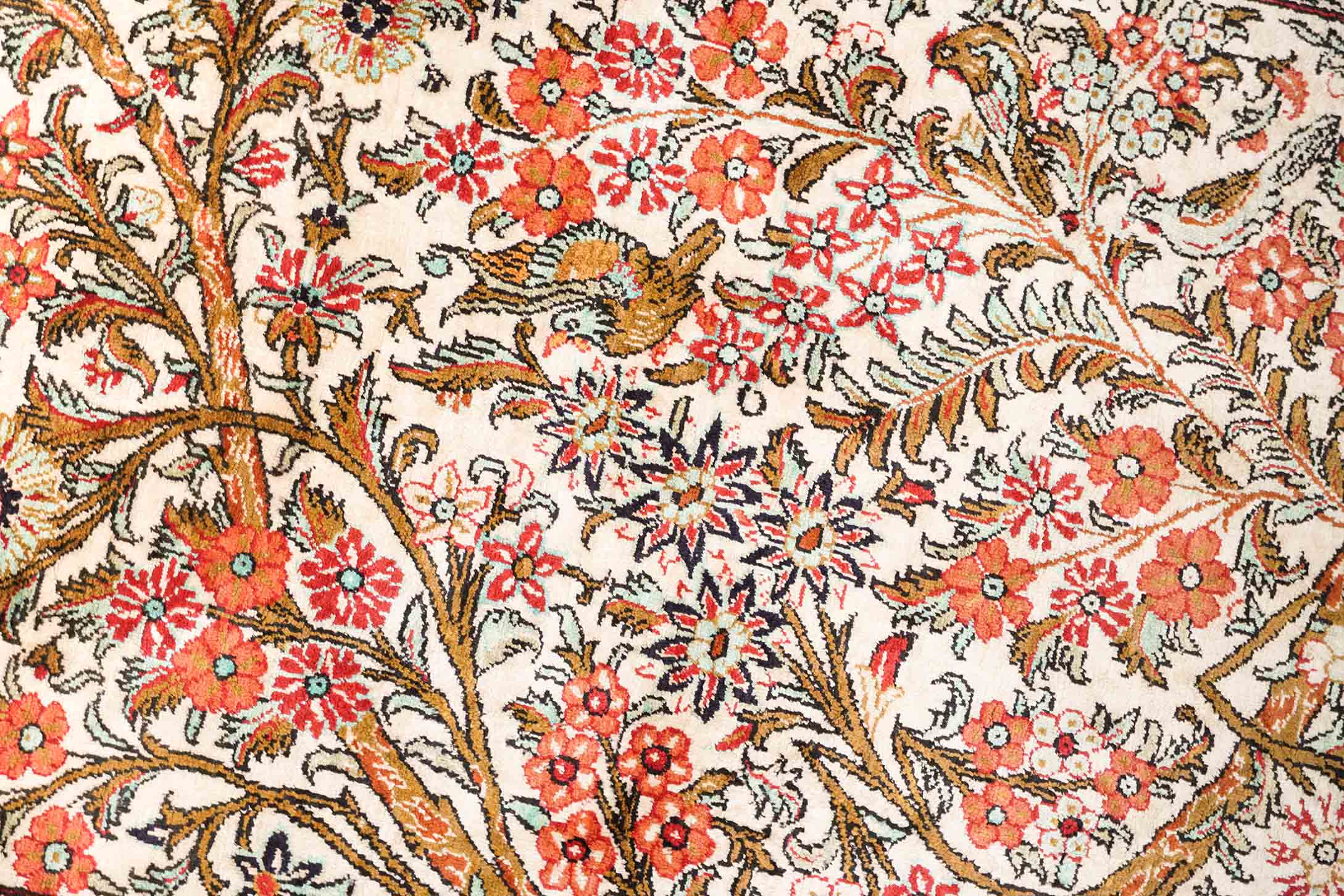
The silk pile of this Qom makes the colours of the pattern glow in different shades, depending on how the light falls. It turns this Qom into a real highlight and gives the room an atmosphere that is both cosy and thoroughly elegant and refined. Silk is gathered by hand from the cocoons of the silk moth. Because the individual silk filaments are extremely long, very fine yarns can be spun that are light in weight yet still tear-resistant. Fine yarn allows smaller knots to be tied and therefore more detailed patterns to be worked. This is why the finest rugs in the world are hand-knotted from pure silk. In this Qom, even the foundation is made of pure silk. Thanks to the thin but hard-wearing material of the weft and warp threads, a particularly fine knotting and therefore a particularly fine pattern are possible.
A note on the photos
Child labour? No thanks.
Child labour? No thanks. Children belong in school, not at a knotting frame or a loom. For us it therefore goes without saying that we only offer rugs made under fair conditions and without child labour.
We attach particular importance to humane working conditions and tolerate no child labour at any of our producers. Thank you for helping us to ensure fair conditions.
That is why we support the initiative Care & Fair against child labour in the rug trade.

Choose options
|
|
1-3 Werktage Lieferzeit (deutschlandweit) |
|
|
14 Tage Probelegen |
|
|
Kostenlose Lieferung & Retoure innerhalb der EU |