


Qom | 212 x 142 cm | Nr. Z-4242

|
14-day home trial |

|
Free delivery & returns within the EU |
All-over patterned Qom, dark red with border and paisley
| Origin |
|
| Dimensions | 212 cm x 142 cm (= 3.0104 m²) |
| Construction | hand-knotted |
| Material |
Pile: kurk wool
|
| knots per m²2 | 360.000 |
| Pile height | 5mm |
| Year of manufacture | 1975 |
| Colour | Dark red, Blue grey |
| Edition | one-of-a-kind piece |

Origin
Qom is a relatively young provenance for Persian rugs. The city of Qom (also Ghom, Gom, Ghoum, Goum) lies in central Iran, about 100 km south of the capital Tehran. As there was no old knotting tradition in Qom to build on, patterns were and still are adopted from other weaving regions. Over time, however, a style of its own has grown out of this. The silk rugs from Qom are today among the most famous and finest rugs in the world. The field of rugs from Qom often has a light ground decorated with finely drawn medallion patterns or all-over boteh or vase designs.
Pattern
The edge of the rug is framed by a decorative border. The border forms a beautiful contrast with the centre.
The repeating elements of this Qom rug have no specific centre. The recurring repeat pattern feels calming, yet never dull. Rugs with a repeat pattern are also described as all-over patterned.
The pattern of this Qom is adorned with wonderful paisley motifs. The paisley motif shows a leaf with a tapering, curved tip, rather like a large comma, and recalls the fish-bladder ornament of the Gothic period. Its origins lie with the Chaldeans, who evidently used the motif to depict the shoot of the date palm that was vital to their survival. The motif spread as far as the Celts, but there it was displaced once more by Greek and Roman ornament. Rug patterns containing paisley ornaments are also called boteh patterns, in Persian mir-e-butha or mir-i-bota.
The overall impression is dominated by dark red and blue-grey. The border is worked in dark red, blue-grey and cream white.
Condition
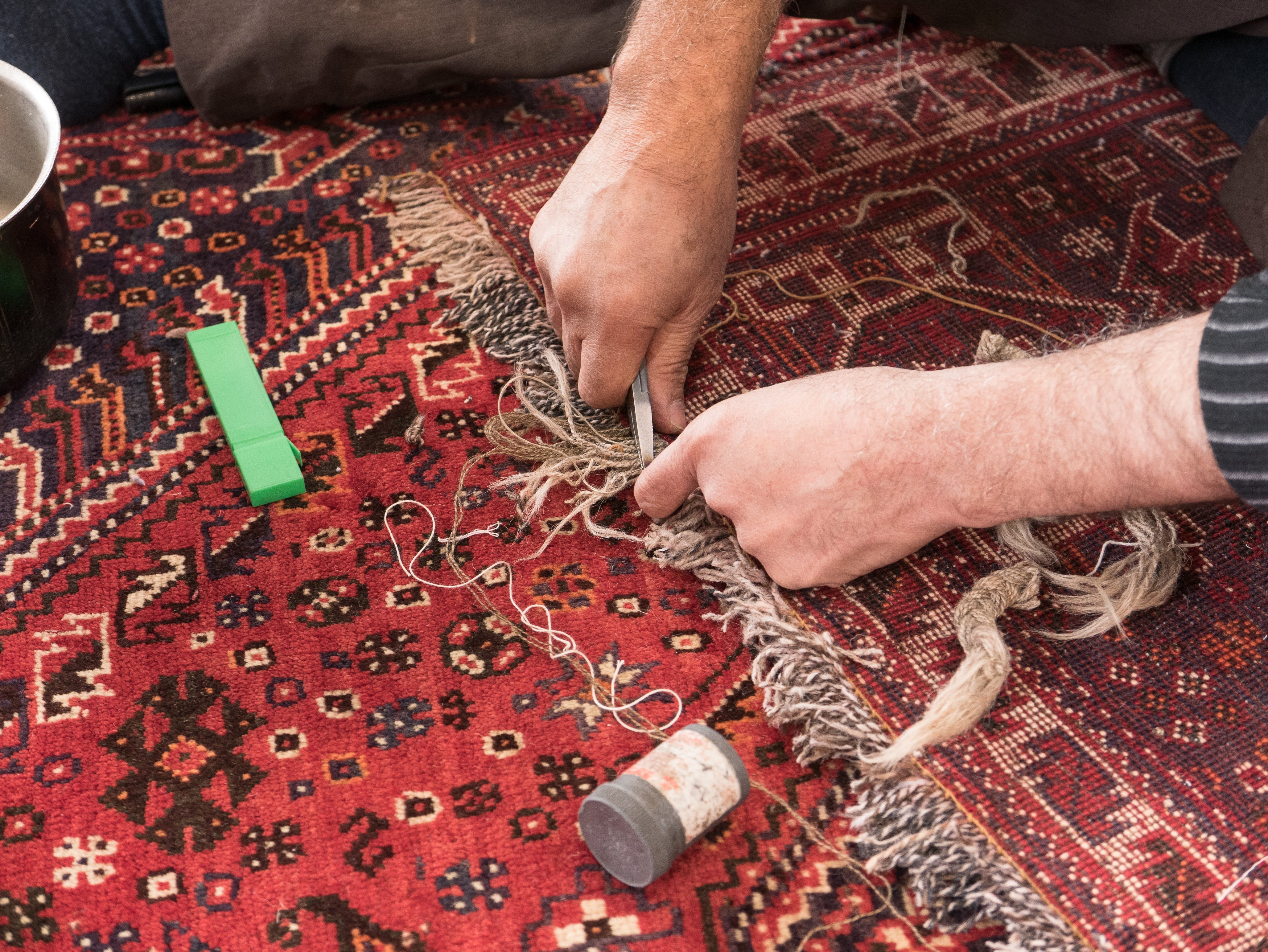
You're not the first to take a liking to this Qom. It had owners before you who valued it and put it to use. It was hand-knotted around 1975. It has been thoroughly cleaned and is in good but unrestored condition. The fringes could do with a repair. The pile has several bare patches. We have not restored this Qom because we feel it has a special presence just as it is. If that's what you'd like, we'll gladly restore the rug for you. Either way, this Qom will give you pleasure for decades to come.
Material
The pile of this Qom is knotted from what is known as kork wool. Kork — or kurk — wool is a particularly fine-threaded knotting yarn that feels almost velvety. It is taken from the neck, the belly and the inner legs of the sheep and is of especially high quality. The weft and warp threads of this Qom are made of cotton. This versatile material is tear-resistant and elastic, which makes it particularly well suited to a hard-wearing foundation.
A note on the photos
Child labour? No thanks.
Child labour? No thanks. Children belong in school, not at a knotting frame or a loom. For us it therefore goes without saying that we only offer rugs made under fair conditions and without child labour.
We attach particular importance to humane working conditions and tolerate no child labour at any of our producers. Thank you for helping us to ensure fair conditions.
That is why we support the initiative Care & Fair against child labour in the rug trade.

Choose options
|
|
14-day home trial |
|
|
Free delivery & returns within the EU |