


Kashmir rug | 210 x 140 cm | Nr. Z-574


|
1-3 working days delivery time (within Germany) |

|
14-day home trial |

|
Free delivery & returns within the EU |
Kashmir Rug
This one-of-a-kind piece in light brown and light blue brings together traditional craftsmanship and timeless elegance. At approx. 420,000 knots per m² the workmanship is correspondingly elaborate, as you can see in the precise drawing and the finely worked details. Its 210 × 140 cm make it a rug for the bedroom or study. It comes into its own just as well in a seating corner. The harmonious colouring and the characteristic structure give any room an exclusive, homely atmosphere. A rug of this quality is far more than a furnishing item – it is a piece of traditional textile art with individual character and lasting value.
| Delivery time | 2 days |
| Origin | Kashmir |
| Dimensions | 210 cm x 140 cm (= 2.94 m²) |
| Construction | hand-knotted |
| Material |
Pile: wool Weft & Warp: cotton |
| knots | 420.000 |
| Year of manufacture | 1990 |
| Condition | pre-owned and cleaned |
| Edition | one-of-a-kind piece |

Origin
The mountainous land of Kashmir in the Himalayas is divided: one third belongs to Pakistan as a province, while the other two thirds form the union state of "Jammu and Kashmir", which is part of India. The population of the larger union state is predominantly Muslim and seeks independence. The hand-knotted rugs come exclusively from the Indian part of Kashmir and are knotted mainly in the provincial capital Srinagar and the surrounding area. Kashmir's silk rugs are famous, and they are usually made on a cotton foundation.The colours of Kashmir rugs are rather restrained, and the patterns are influenced by traditional Persian designs. This goes back a long way, as the Mughal emperors (1526-1857) once brought Persian rug knotters to their court in India. That is why people also speak of the Indo-Persian style. Another legend, however, has it that in 1398 the tribute-paying Sultan of Kashmir had to send his son as a hostage to Timur Lenk (Tamerlane) in Samarkand. There the young prince came to know the craft of knotting and, on his return, introduced it in Kashmir together with knotters from Samarkand.
Material
The pile of this Kashmir rug was hand-knotted from high-quality new wool. New wool is obtained by gently shearing sheep. New wool is a renewable, natural raw material with a whole range of impressive properties: thanks to the natural lanolin content of the wool, the surface repels droplets of water and is therefore naturally protected against dirt. Wool also offers excellent thermal insulation, has a regulating effect on the indoor climate and dampens sound.The weft and warp threads of this Kashmir rug are made of cotton. This versatile material is tear-resistant and elastic, which makes it especially well suited to a hard-wearing foundation weave.
Condition
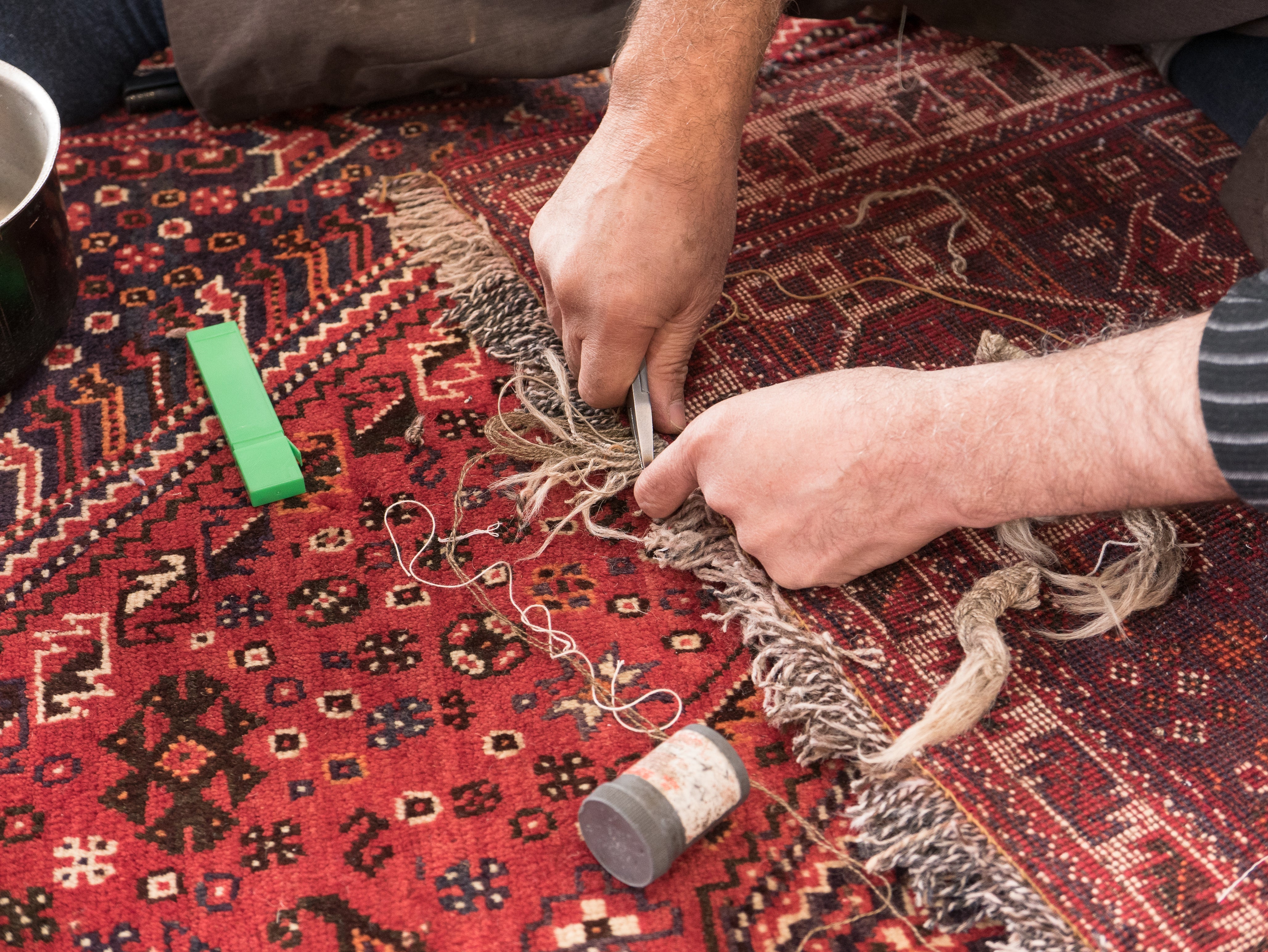
You are not the first to take a liking to this Kashmir rug. It has had owners before you who valued it and put it to use. It was knotted around 1990. It has been cleaned thoroughly and is in good but unrestored condition. The pile is slightly worn. The edges are damaged in places. We have not restored this Kashmir rug, because we feel it has a special presence just as it is. If you would like us to, we will of course restore it for you. Either way, this Kashmir rug will give you pleasure for decades to come.
A note on the photos
Child labour? No thanks.
Child labour? No thanks. Children belong in school, not at a knotting frame or a loom. For us it therefore goes without saying that we only offer rugs made under fair conditions and without child labour.
We attach particular importance to humane working conditions and tolerate no child labour at any of our producers. Thank you for helping us to ensure fair conditions.
That is why we support the initiative Care & Fair against child labour in the rug trade.

Choose options
|
|
1-3 working days delivery time (within Germany) |
|
|
14-day home trial |
|
|
Free delivery & returns within the EU |