
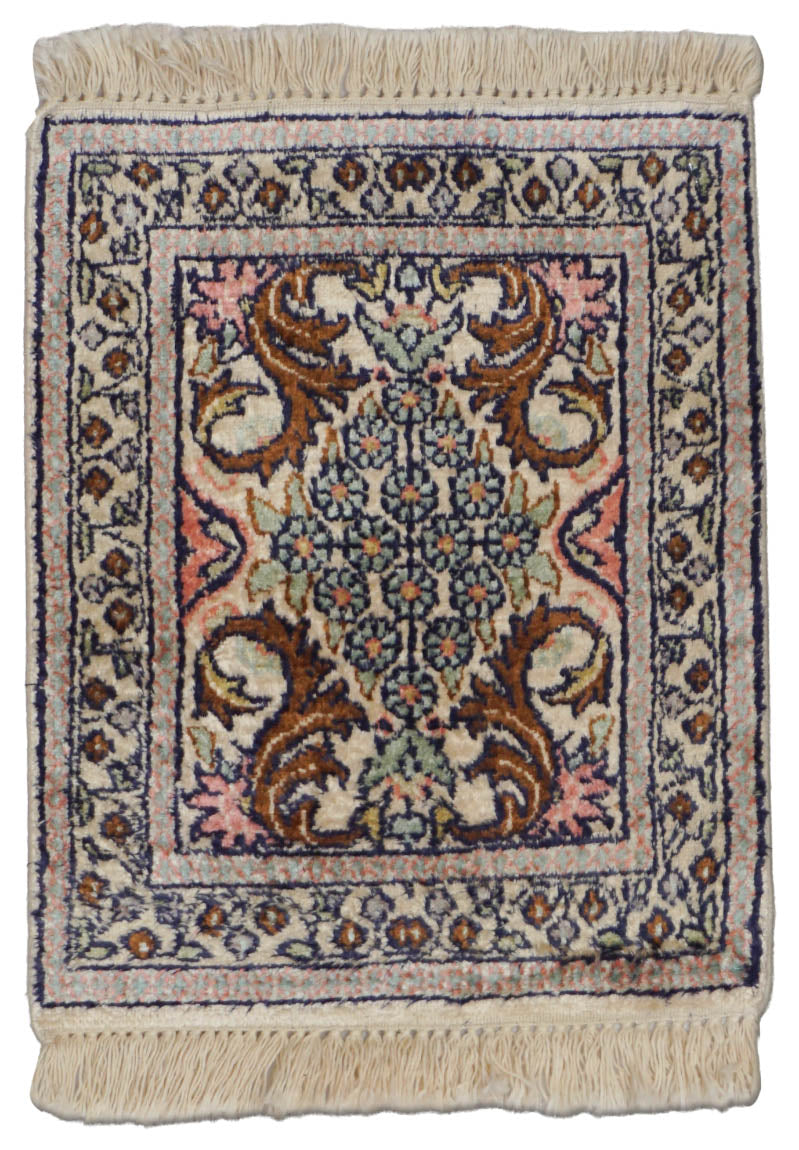
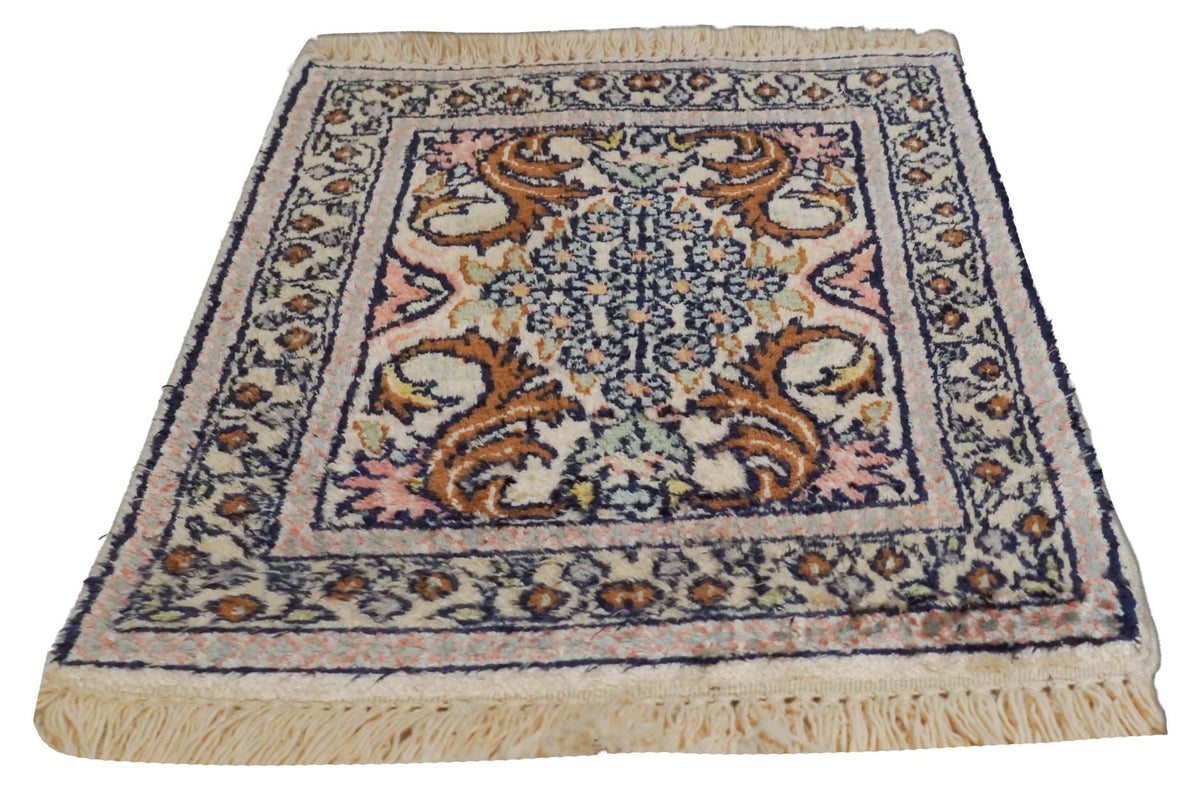
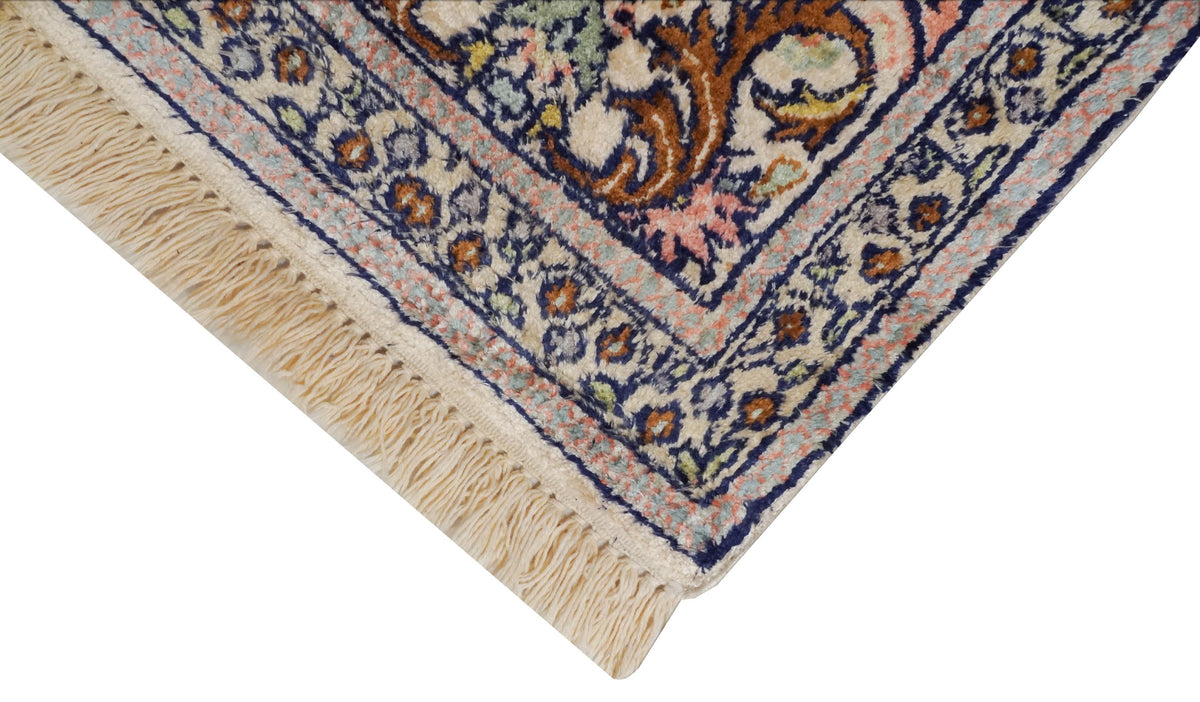
Kashmir rug in mercerised cotton | 38 x 30 cm | Nr. Z-4637

|
14 Tage Probelegen |

|
Kostenlose Lieferung & Retoure innerhalb der EU |
Floral Kashmir rug in mercerised cotton, golden beige with border
| Origin |
|
| Dimensions | 38 cm x 30 cm (= 0.11 m²) |
| Construction | hand-knotted |
| Material |
Pile: mercerised cotton
|
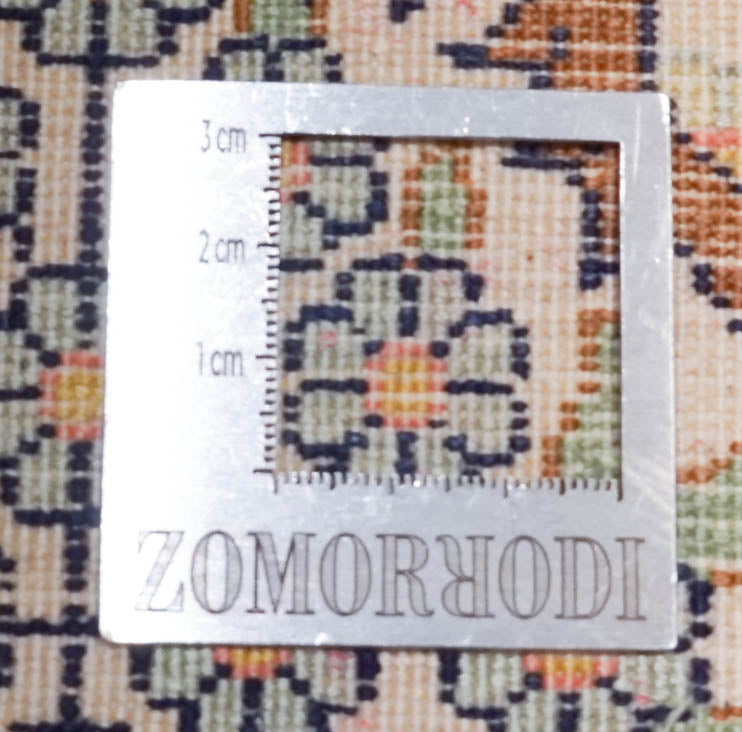
| knots per m²2 | 490.000 |
| Pile height | 4mm |
| Year of manufacture | 1995 |
| Colour | Golden beige, turquoise |
| Edition | one-of-a-kind piece |
Origin
The mountainous land of Kashmir in the Himalayas is divided: one third belongs to Pakistan as a province, while the other two thirds form the union state of "Jammu and Kashmir", which is part of India. The population of the larger union state is predominantly Muslim and seeks independence. The hand-knotted rugs come exclusively from the Indian part of Kashmir and are knotted mainly in the provincial capital Srinagar and the surrounding area. Kashmir's silk rugs are famous, and they are usually made on a cotton foundation.
The colours of Kashmir rugs are rather restrained, and the patterns are influenced by traditional Persian designs. This goes back a long way, as the Mughal emperors (1526-1857) once brought Persian rug knotters to their court in India. That is why people also speak of the Indo-Persian style. Another legend, however, has it that in 1398 the tribute-paying Sultan of Kashmir had to send his son as a hostage to Timur Lenk (Tamerlane) in Samarkand. There the young prince came to know the craft of knotting and, on his return, introduced it in Kashmir together with knotters from Samarkand.
Pattern
The edge of the rug is framed by a surround (border). The border forms a splendid contrast to the centre.
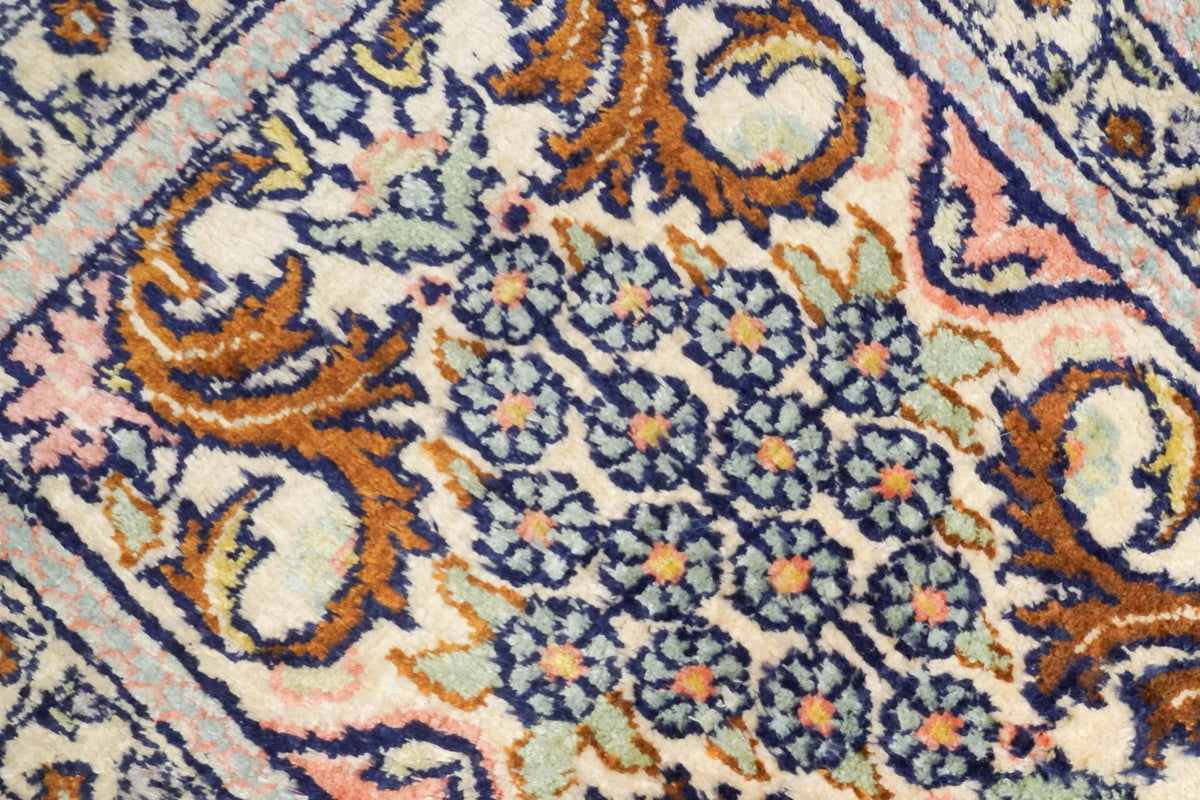
The lush floral motifs of this Kashmir rug are elegant and full of variety. The graceful plant symbols, depicting blossoms, leaves and branches, are artfully intertwined.
The background of this Kashmir rug is golden beige. The border is worked in golden beige and turquoise.
Material
The pile of this Kashmir rug is made of mercerised cotton. Cotton consists of lustrous fibres filled with cell sap. When the sap dries after the harvest, the surface of the fibre curls and loses its sheen because of the way light is then refracted. In the middle of the 19th century, John Mercer invented the process that bears his name: mercerisation. During mercerisation the cotton is held under tension in cold, concentrated caustic soda and takes on a new, higher-grade fibre structure. Mercerised cotton has shortened fibres with a round cross-section. The refined fabric no longer shrinks and holds its shape extremely well. Thanks to the altered refraction of light, the fibre gains a silky sheen. Mercerised cotton also takes up dye more readily and is considerably more tear-resistant than untreated cotton. Because mercerisation is elaborate and costly, only high-quality cotton fibres are refined in this way. Owing to the silky sheen of the yarn, mercerised cotton – like viscose – is often referred to as "artificial silk". However, the colloquial term "artificial silk" is not permitted under the German Textile Labelling Act (TKG). The weft and warp threads of this Kashmir rug are made of cotton. This versatile material is tear-resistant and elastic, which makes it particularly suitable for a hard-wearing foundation.
A note on the photos
Child labour? No thanks.
Child labour? No thanks. Children belong in school, not at a knotting frame or a loom. For us it therefore goes without saying that we only offer rugs made under fair conditions and without child labour.
We attach particular importance to humane working conditions and tolerate no child labour at any of our producers. Thank you for helping us to ensure fair conditions.
That is why we support the initiative Care & Fair against child labour in the rug trade.

Choose options
|
|
14 Tage Probelegen |
|
|
Kostenlose Lieferung & Retoure innerhalb der EU |