


Kashmir rug in pure silk | 138 x 136 cm | Nr. Z-2687

|
1-3 Werktage Lieferzeit (deutschlandweit) |

|
14 Tage Probelegen |

|
Kostenlose Lieferung & Retoure innerhalb der EU |
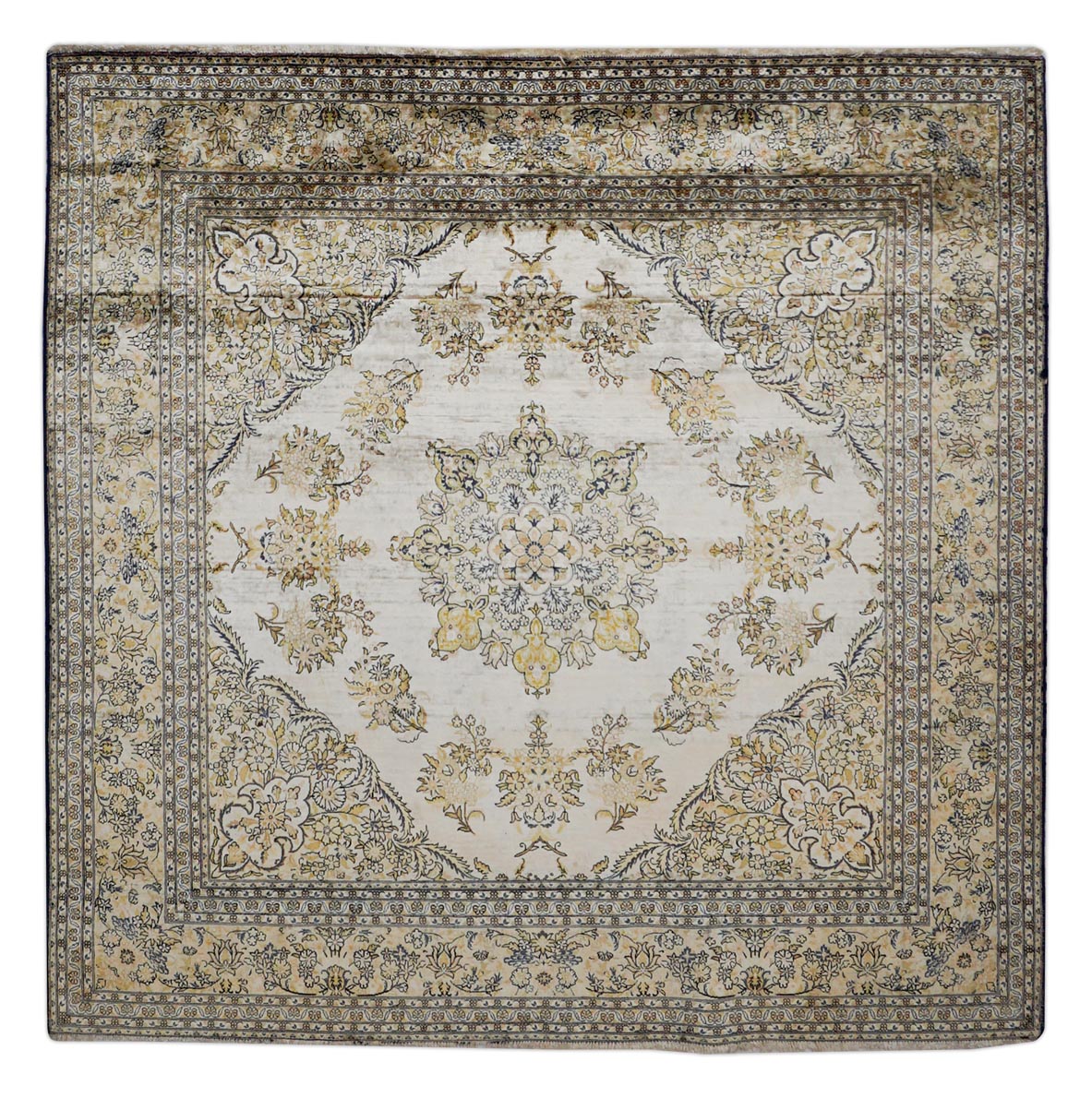
Floral Kashmir rug in pure silk, cream white with border and medallion
| Origin |
|
| Dimensions | 138 cm x 136 cm (= 1.8768 m²) |
| Construction | hand-knotted |
| Material |
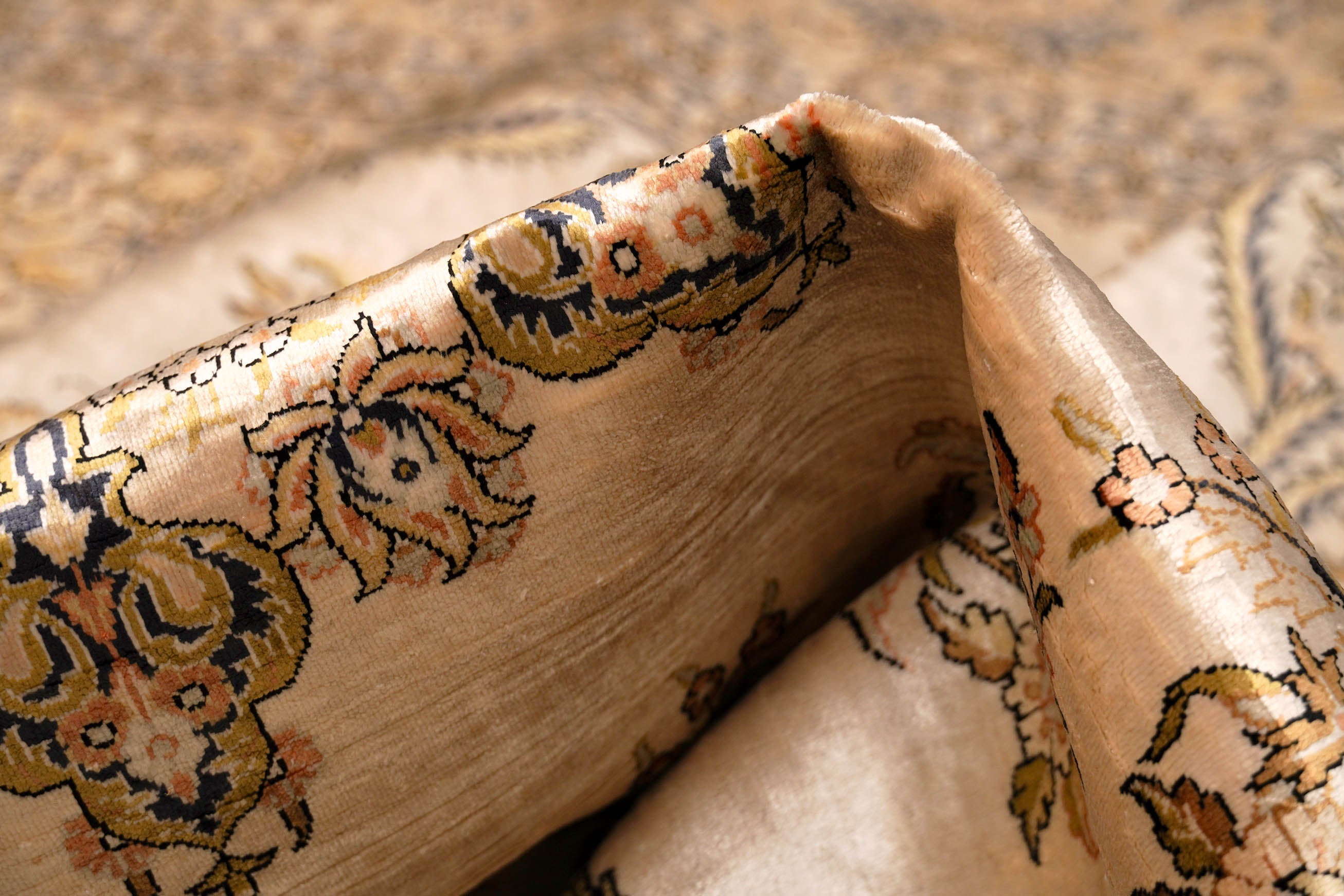
Pile: pure silk
|
| knots per m²2 | 1.000.000 |
| Pile height | 3mm |
| Year of manufacture | 2000 |
| Colour | Cream white, golden beige |
| Edition | one-of-a-kind piece |

Origin
The mountainous land of Kashmir in the Himalayas is divided: one third belongs to Pakistan as a province, while the other two thirds form the union state of "Jammu and Kashmir", which is part of India. The population of the larger union state is predominantly Muslim and seeks independence. The hand-knotted rugs come exclusively from the Indian part of Kashmir and are knotted mainly in the provincial capital Srinagar and the surrounding area. Kashmir's silk rugs are famous, and they are usually made on a cotton foundation.
The colours of Kashmir rugs are rather restrained, and the patterns are influenced by traditional Persian designs. This goes back a long way, as the Mughal emperors (1526-1857) once brought Persian rug knotters to their court in India. That is why people also speak of the Indo-Persian style. Another legend, however, has it that in 1398 the tribute-paying Sultan of Kashmir had to send his son as a hostage to Timur Lenk (Tamerlane) in Samarkand. There the young prince came to know the craft of knotting and, on his return, introduced it in Kashmir together with knotters from Samarkand.
Pattern
The edge of the rug is framed by a decorative border. The border forms a beautiful contrast with the centre.
The lush floral motifs of this Kashmir rug are elegant and full of variety. The graceful plant symbols, depicting blossoms, leaves and branches, are artfully intertwined.
At the heart of the central field of this Kashmir rug lies the symmetrical centre, also known as the medallion. The design of the field is subordinate to the medallion, so that the medallion seems to float on the field.
The background of this Kashmir rug is cream white. The border combines cream white and golden beige. In the centre, cream white and golden beige are combined.
Condition
You aren't the first to take a liking to this Kashmir rug. It had owners before you who valued and used it. It was hand-knotted around 2000. We have cleaned it thoroughly and restored it with care. That is why it is – despite its age – in very good condition.
Material
The silk of this Kashmir rug's pile makes the colours of the pattern glow in different shades, depending on how the light falls. It turns this Kashmir rug into a real highlight and creates an atmosphere in the room that is cosy and at the same time very elegant and refined. Silk is obtained by hand from the cocoons of the silkworm. Because the individual silk filaments are extremely long, very fine yarns can be spun that are light in weight yet still tear-resistant. Fine yarn allows smaller knots to be tied and therefore finer patterns to be created. That is why the finest rugs in the world are hand-knotted from pure silk. In this Kashmir rug, even the foundation was made from pure silk. The fine but hard-wearing material of the weft and warp threads makes a particularly fine knotting – and therefore a particularly fine pattern – possible.
A note on the photos
Child labour? No thanks.
Child labour? No thanks. Children belong in school, not at a knotting frame or a loom. For us it therefore goes without saying that we only offer rugs made under fair conditions and without child labour.
We attach particular importance to humane working conditions and tolerate no child labour at any of our producers. Thank you for helping us to ensure fair conditions.
That is why we support the initiative Care & Fair against child labour in the rug trade.

Choose options
|
|
1-3 Werktage Lieferzeit (deutschlandweit) |
|
|
14 Tage Probelegen |
|
|
Kostenlose Lieferung & Retoure innerhalb der EU |