


Kelim | 273 x 135 cm | Nr. Z-3013

|
14 Tage Probelegen |

|
Kostenlose Lieferung & Retoure innerhalb der EU |
Mottled Kelim, light red with stripes and diamonds
| Origin |
|
| Dimensions | 273 cm x 135 cm (= 3.6855 m²) |
| Construction | hand-woven |
| Material |
Weft (pile): wool
|
| Pile height | 3mm |
| Year of manufacture | 1940 |
| Colour | Light red, multicoloured |
| Edition | one-of-a-kind piece |

Origin
Glowing colours and simple, geometric patterns – that's why Kelims are loved all over the world. Kelims (also Kilim, Qilim) were traditionally made for the weavers' own use only. Nomads and farmers used, and still use, their Kelims as rugs on the floor, but also as tent or wall hangings, blankets, cushions or bags. Because Kelims were constant companions in everyday life, their patterns – however naive they may look – always carry a personal message and hold meaning for the weavers and their families.
Especially well known and loved in Europe are Kelims from Turkey, the Caucasus, Iran, Afghanistan and the Turkmen cultural sphere, where they are well known and much loved. In fact, rugs are hand-woven in every country in which rugs are knotted.
Pattern
The straight stripes of this Kelim order and structure the pattern.
In the pattern of this Kelim, it is above all the diamonds that catch the eye. A diamond is a rhombus standing on one of its points; in an Oriental rug its four equal sides can be serrated, outlined or set with hooks. The diamond is one of the oldest basic forms in Oriental rugs. In the Islamic world it carries a symbolic meaning: it stands for the immortality of the soul. That is why it appears so often as a filler motif.
The surface of this Kelim looks mottled. The shifts in tone and the light-and-dark shading of the pile yarn make the colours shimmer and keep the rug from showing dirt. These so-called colour shifts, known as abrash, give the rug a livelier look. The mottled effect comes about because the wool of this Kelim was hand-spun. During dyeing, the natural dyes are taken up to differing degrees.
The background of this Kelim is light red.
Condition
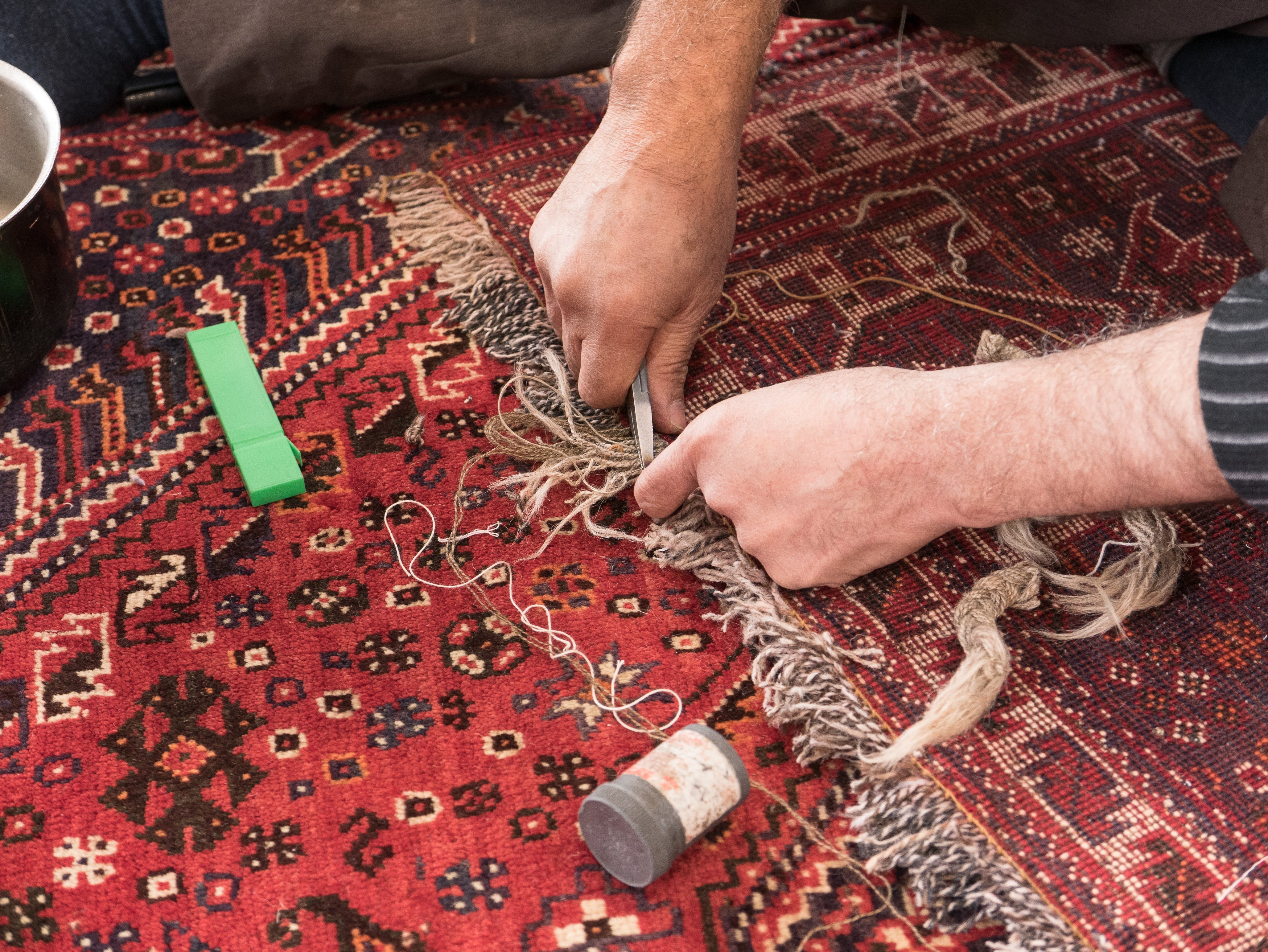
You aren't the first to take a liking to this Kelim. It has had owners before you who valued and used it. It was woven around 1940 by hand. It has been thoroughly cleaned and is in good but unrestored condition. The fringes could do with a repair. The rug has several holes with a diameter of 10 cm. We haven't restored this Kelim because we feel it has a special presence just as it is. If that's what you'd like, we'll of course gladly restore the rug for you. Either way, this Kelim will bring you pleasure for decades to come.
Material
Kelims are hand-woven and consist only of warp and weft threads, which means they have no thick, upward-facing pile. Kelims show the same pattern on both sides and are therefore usable on both sides. The pattern is created by the coloured weft threads that are woven into the warp threads. Every new colour calls for a new thread in each row. The thread ends are worked into the weave.
The weft threads of this Kelim rug are made of hand-spun sheep's wool dyed with plant dyes. Before the rug was woven, sheep were first shorn and the wool was then cleaned, combed and finally spun. After spinning, the wool for Kelim rugs is dyed with natural colours in an elaborate process. Because of this traditional method, the pile of Kelim rugs feels dry and slightly furry. The warp threads of this Kelim are made of cotton.
A note on the photos
Child labour? No thanks.
Child labour? No thanks. Children belong in school, not at a knotting frame or a loom. For us it therefore goes without saying that we only offer rugs made under fair conditions and without child labour.
We attach particular importance to humane working conditions and tolerate no child labour at any of our producers. Thank you for helping us to ensure fair conditions.
That is why we support the initiative Care & Fair against child labour in the rug trade.

Choose options
|
|
14 Tage Probelegen |
|
|
Kostenlose Lieferung & Retoure innerhalb der EU |