
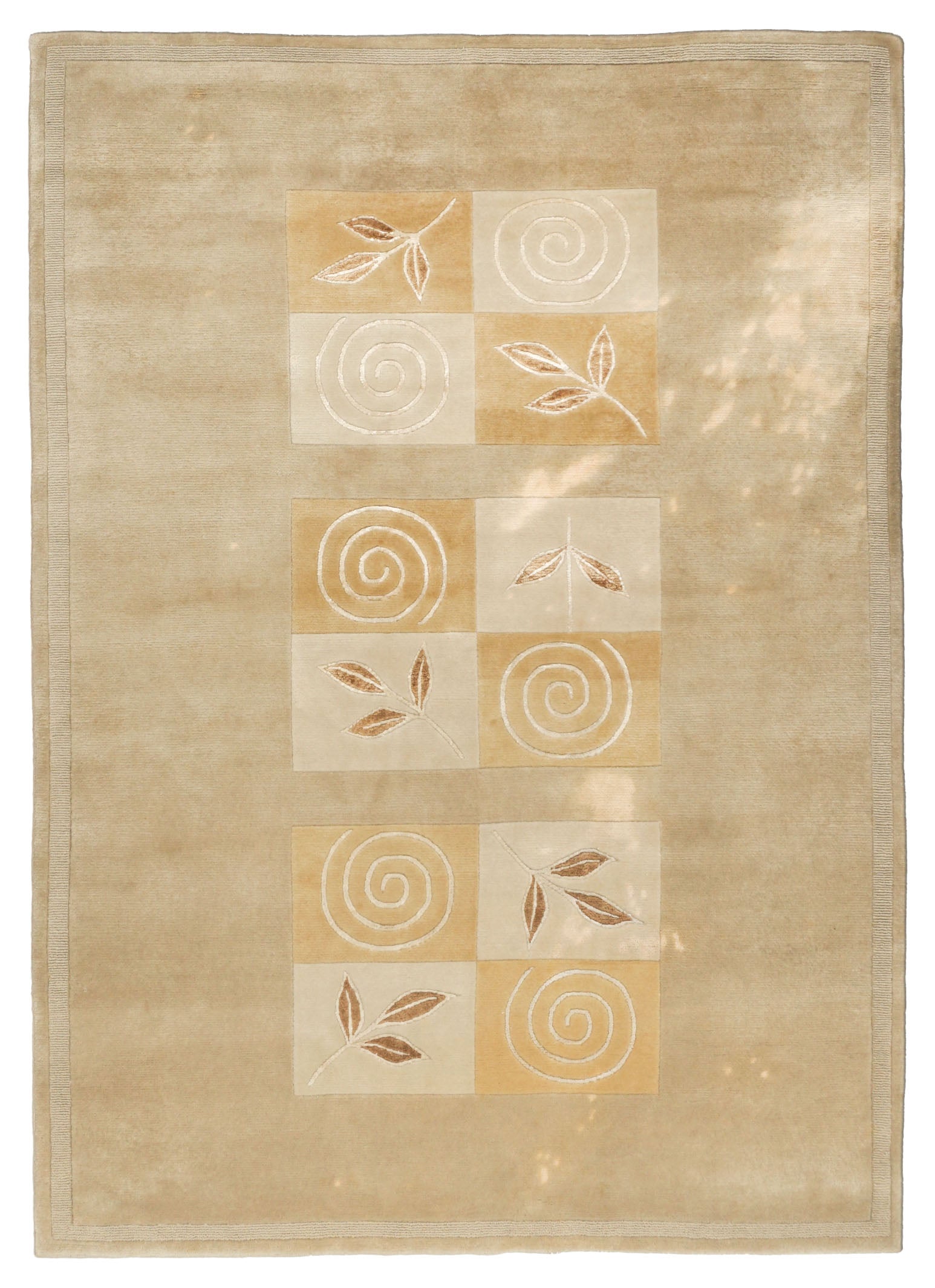


Nepal rug | 238 x 169 cm | Nr. Z-2473

|
14 Tage Probelegen |

|
Kostenlose Lieferung & Retoure innerhalb der EU |
Plain Nepal rug, gold beige
| Origin |
|
| Dimensions | 238 cm x 169 cm (= 4.0222 m²) |
| Construction | hand-knotted |
| Material |
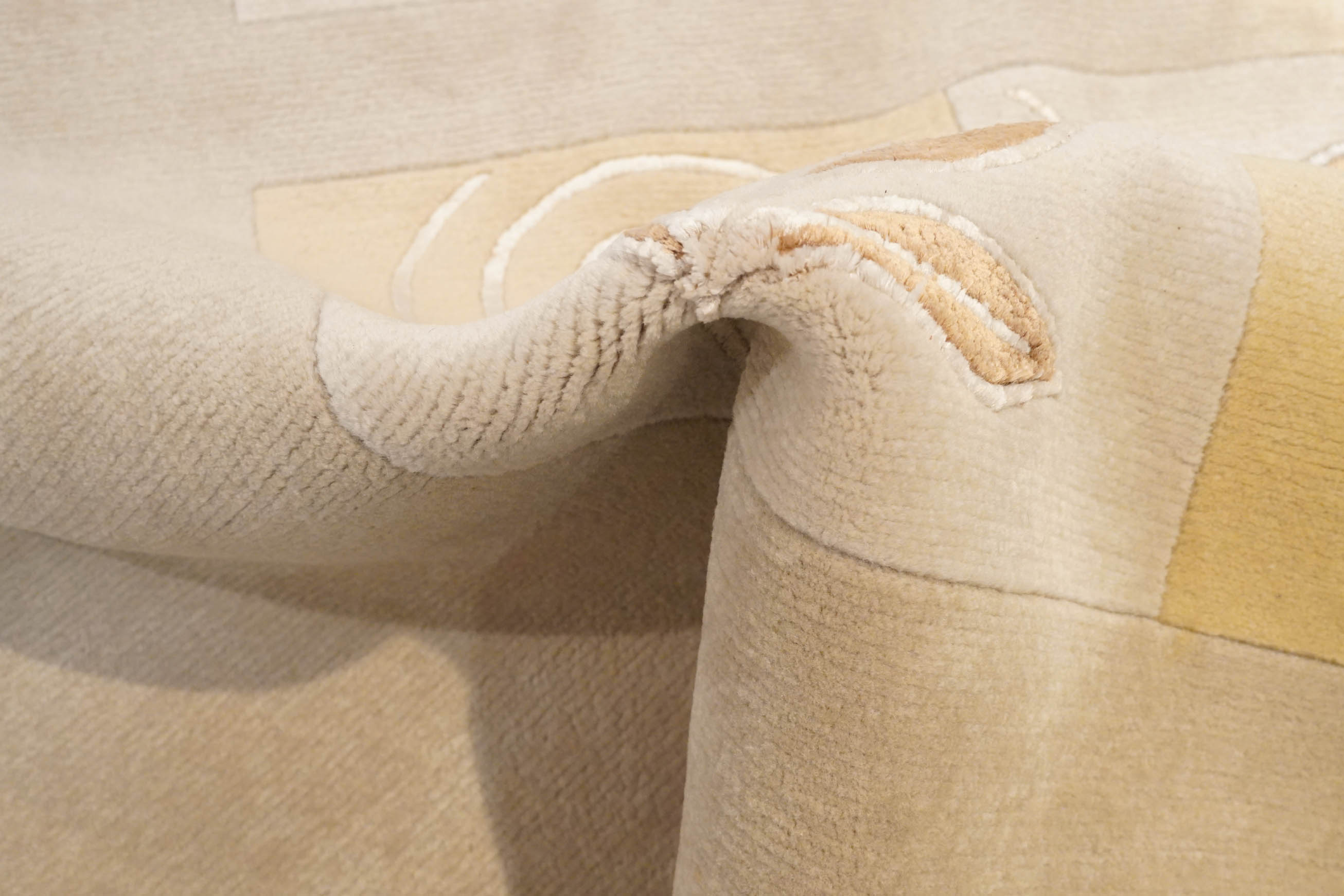
Pile: wool (hand-spun, natural dyes) & viscose
|
| knots per m²2 | 60.000 |
| Pile height | 10mm |
| Year of manufacture | 2015 |
| Colour | Gold-beige |
| Edition | one-of-a-kind piece |

Origin
Rugs have only been knotted in Nepal since 1959, following the flight of the Dalai Lama and the Tibetans who accompanied him. From 1966 onwards, under the guidance of the committed Zurich importer Jo Iten-Maritz, these displaced people were taught to knot rugs in the Tibetan tradition using the customary patterns. Once the rug designs were adapted to contemporary Western taste, Nepal's knotting output rose considerably. The central trading hub is the capital, Kathmandu. Most of the production workshops are based here as well.
Nepal rugs are knotted using a special technique. During knotting, a kind of continuous knot is looped in a line around a rod, so that a horizontal row of loops is formed. Once the rod is completely covered with these loops, they are cut open from above in that section, so that the pile fans out and a velour surface is created. In the end, the knot takes on the form of a Persian knot. This rapid method is only possible, however, because Nepalese-Tibetan rugs are largely plain and barely patterned over wide areas.
Pattern
The pile is a solid gold beige. The plain design is restrained, yet it can also set a wonderful decorative accent. The monochrome look of this rug fits beautifully into any setting.
The lavish floral motifs of this Nepal rug are elegant and full of variety. The graceful plant symbols, depicting blossoms, leaves and branches, are artfully intertwined.
Condition
This Nepal rug has had admirers before you. It was hand-knotted around 2015. It has been thoroughly cleaned and is in good, though only partly restored, condition. There are a few stains to report. We have not fully restored this Nepal rug because we feel it has a special presence just as it is. If you would like us to, we will of course happily carry on restoring the rug for you. We can bring almost any rug back to near-perfect condition.
Material
The pile of this Nepal rug is made from a hard-wearing blend of hand-spun wool and viscose.
Viscose – also known as acetate silk or rayon – is always made from cellulose, a natural product, and therefore from wood as its raw material. In India, the cellulose pulp is obtained from bamboo. In an elaborate process, the pulpy cellulose is drawn out into one continuous textile yarn. That is why viscose is also referred to as a continuous filament yarn. Because of the silky sheen of the yarn, viscose made from bamboo is also called "bamboo silk". The colloquial term "artificial silk" is not permitted under the German Textile Labelling Act (TKG).
The technique used to prepare the wool for the pile of this Nepal rug is over 200 years old. The wool was dyed with natural colours and spun by hand. Dyeing with natural or plant dyes is more complicated, more expensive and more time-consuming than dyeing with chemical colours. For a luminous red, for example, you need around one kilo of ground madder root as dyestuff per kilo of wool. For a strong yellow that isn't too pale you even need two kilograms of weld dye per kilo of wool. Spinning the wool is also time-consuming and labour-intensive. What is more, fewer and fewer people still master spinning wool by hand.
But the effort is worth it: dyeing with natural colours allows the high-quality wool to keep its natural oil content. Wool that has been dyed with natural colours and spun by hand creates fascinating, shimmering patterns. The charm of hand-spun wool, with its slight irregularities and natural shades, comes into its own as a contrast in modern interiors, but equally in rooms furnished in a more traditional or country style.
The weft and warp threads of this Nepal rug are made of cotton. This versatile material is tear-resistant and elastic, which makes it particularly well suited to a hard-wearing foundation.
A note on the photos
Child labour? No thanks.
Child labour? No thanks. Children belong in school, not at a knotting frame or a loom. For us it therefore goes without saying that we only offer rugs made under fair conditions and without child labour.
We attach particular importance to humane working conditions and tolerate no child labour at any of our producers. Thank you for helping us to ensure fair conditions.
That is why we support the initiative Care & Fair against child labour in the rug trade.

Choose options
|
|
14 Tage Probelegen |
|
|
Kostenlose Lieferung & Retoure innerhalb der EU |