


Nepal rug | 353 x 245 cm | Nr. 20584


|
1-3 working days delivery time (within Germany) |

|
14-day home trial |

|
Free delivery & returns within the EU |
Nepal rug
There is only one rug like this in sand yellow: it combines traditional craftsmanship with timeless elegance. A knot density of approx. 60,000 knots per m² makes the painstaking workmanship visible – right down to the finely worked details. At 353 × 245 cm it is well placed as a large living-room rug. It also cuts a fine figure in the dining room beneath a table for six to eight. Colouring and texture lend the room a homely atmosphere – with a character no other rug shares.
| Delivery time | 2 days |
| Origin | Nepal |
| Dimensions | 353 cm x 245 cm (= 8.65 m²) |
| Construction | hand-knotted |
| Material |
Pile: wool (hand-spun, natural dyes) Weft: wool Warp: cotton |
| knots | 60.000 |
| Year of manufacture | 2010 |
| Condition | pre-owned, but in very good condition (cleaned & restored) |
| Edition | one-of-a-kind piece |

Origin
Rugs have only been knotted in Nepal since 1959, following the flight of the Dalai Lama and the Tibetans who accompanied him. From 1966 onwards, under the guidance of the committed Zurich importer Jo Iten-Maritz, these displaced people were taught to knot rugs in the Tibetan tradition using the customary patterns. Once the rug designs were adapted to contemporary Western taste, Nepal's knotting output rose considerably. The central trading hub is the capital, Kathmandu. Most of the production workshops are based here as well.Nepal rugs are knotted using a special technique. During knotting, a kind of continuous knot is looped in a line around a rod, so that a horizontal row of loops is formed. Once the rod is completely covered with these loops, they are cut open from above in that section, so that the pile fans out and a velour surface is created. In the end, the knot takes on the form of a Persian knot. This rapid method is only possible, however, because Nepalese-Tibetan rugs are largely plain and barely patterned over wide areas.
Material
The technique used to make the materials for the pile of this Nepal rug is more than 200 years old. The wool was dyed with natural dyes and spun by hand. Dyeing with natural or plant dyes is more complicated, more expensive and more time-consuming than dyeing with chemical colours. For a luminous red, for instance, you need around one kilo of ground madder root as dyestuff per kilo of wool. For a strong yellow that is not too pale, you even need two kilograms of the dyestuff weld per kilo of wool. Spinning the wool is time- and labour-intensive too. And fewer and fewer people still know how to spin wool by hand.But the effort is worth it: dyeing with natural colours allows the high-quality wool to keep its natural oil content. Wool that has been dyed with natural colours and spun by hand creates fascinating, shimmering patterns. The charm of hand-spun wool, with its slight irregularities and natural shades, comes into its own as a contrast in modern interiors, but equally in rooms furnished in a more traditional or country style.
The weft threads of this Nepal rug are made of wool. Cotton was used for the warp threads.
Condition
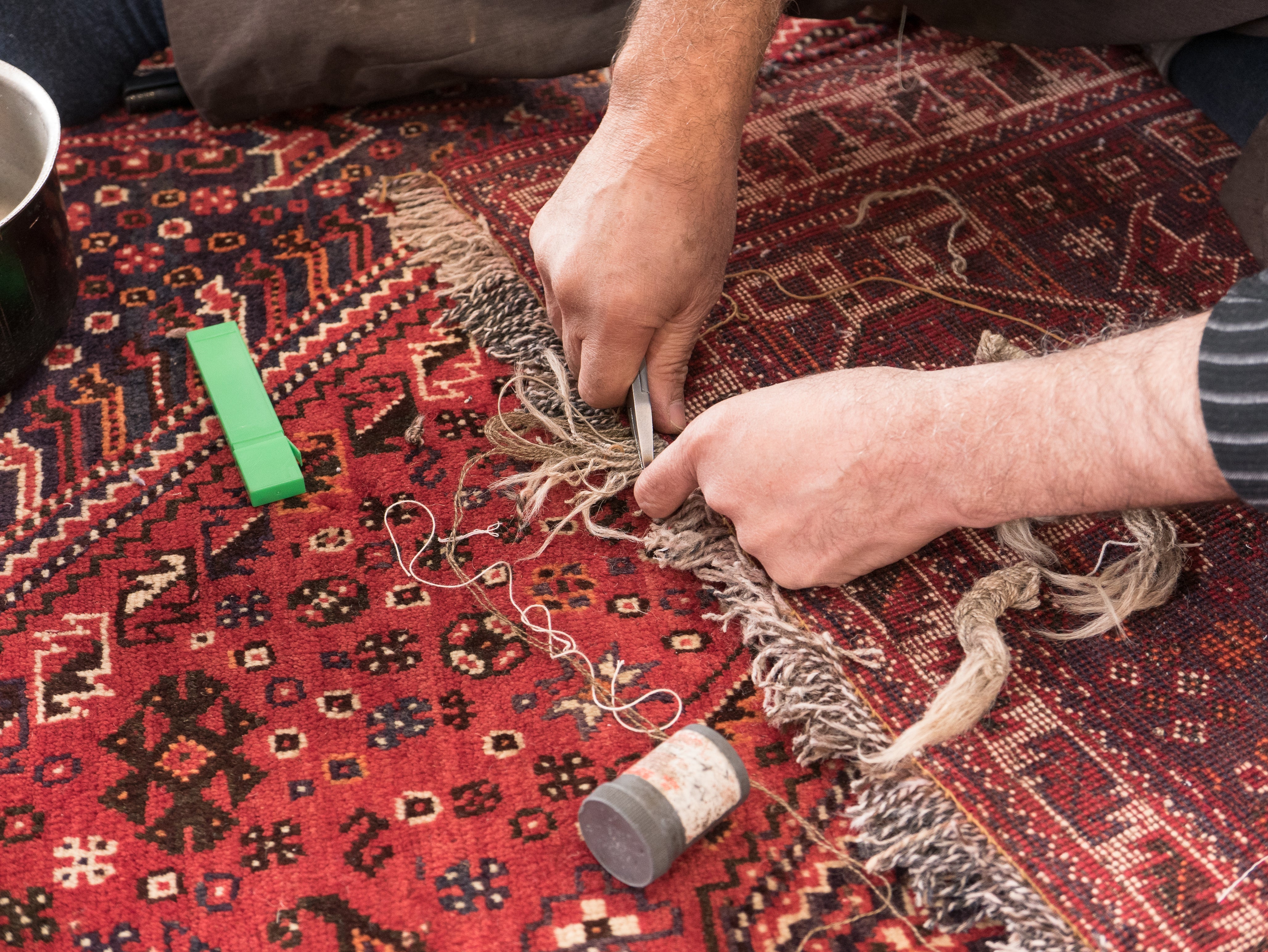
This Nepal rug has a story to tell. The rug has a few small stains. It was knotted around 2010. We have cleaned it thoroughly and restored it with care. That is why it is in very good condition – despite its age.
A note on the photos
The colours of this rug change depending on which side you look at it from. It all depends on whether the light falls with the nap of the pile or against it. That is why we have photographed the rug from several angles.
Child labour? No thanks.
Share some content to your customers about your products.
Choose options
Nepal rug | 353 x 245 cm | Nr. 20584
Sale price2.300,00 €
|
|
1-3 working days delivery time (within Germany) |
|
|
14-day home trial |
|
|
Free delivery & returns within the EU |