

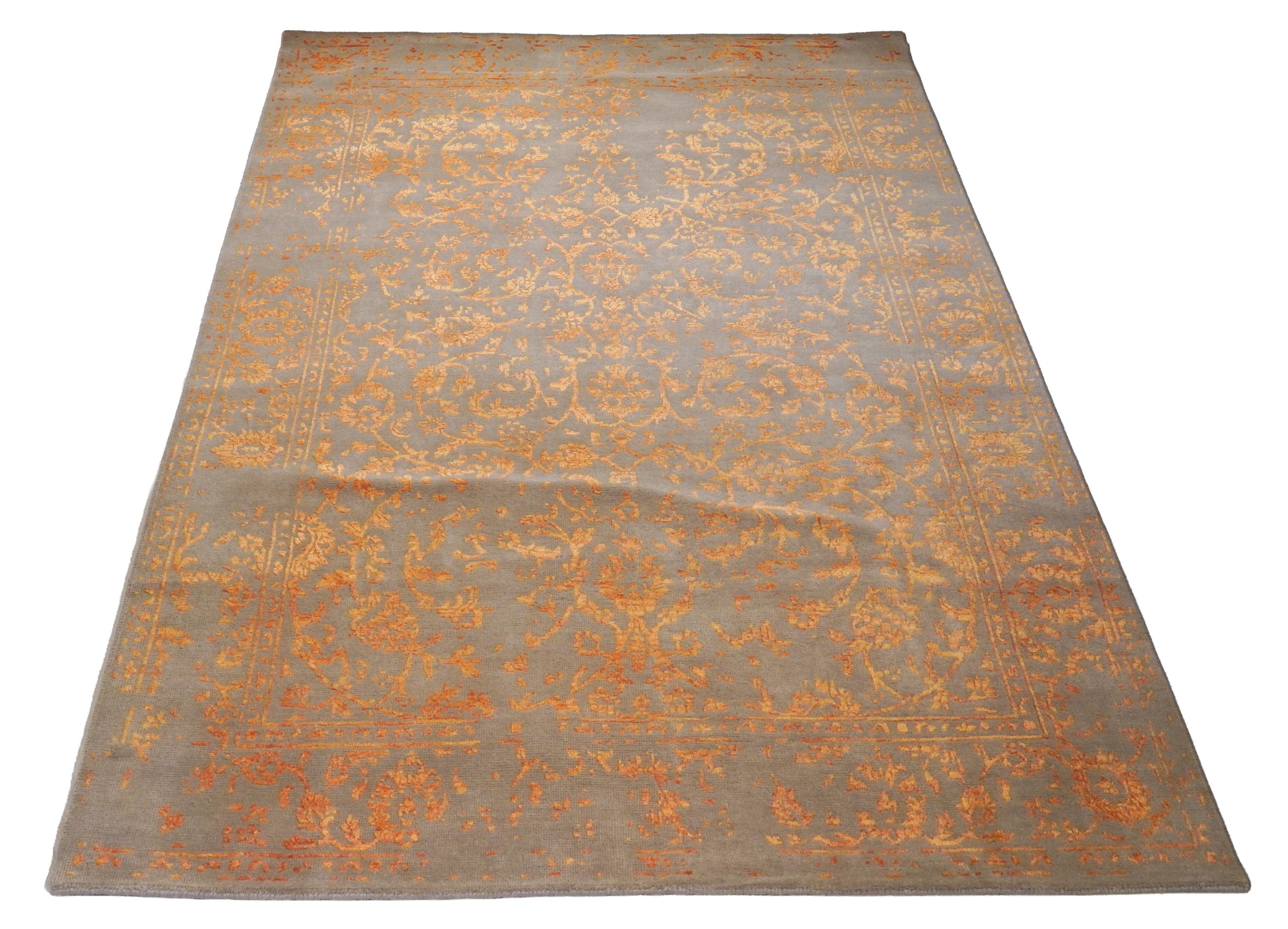
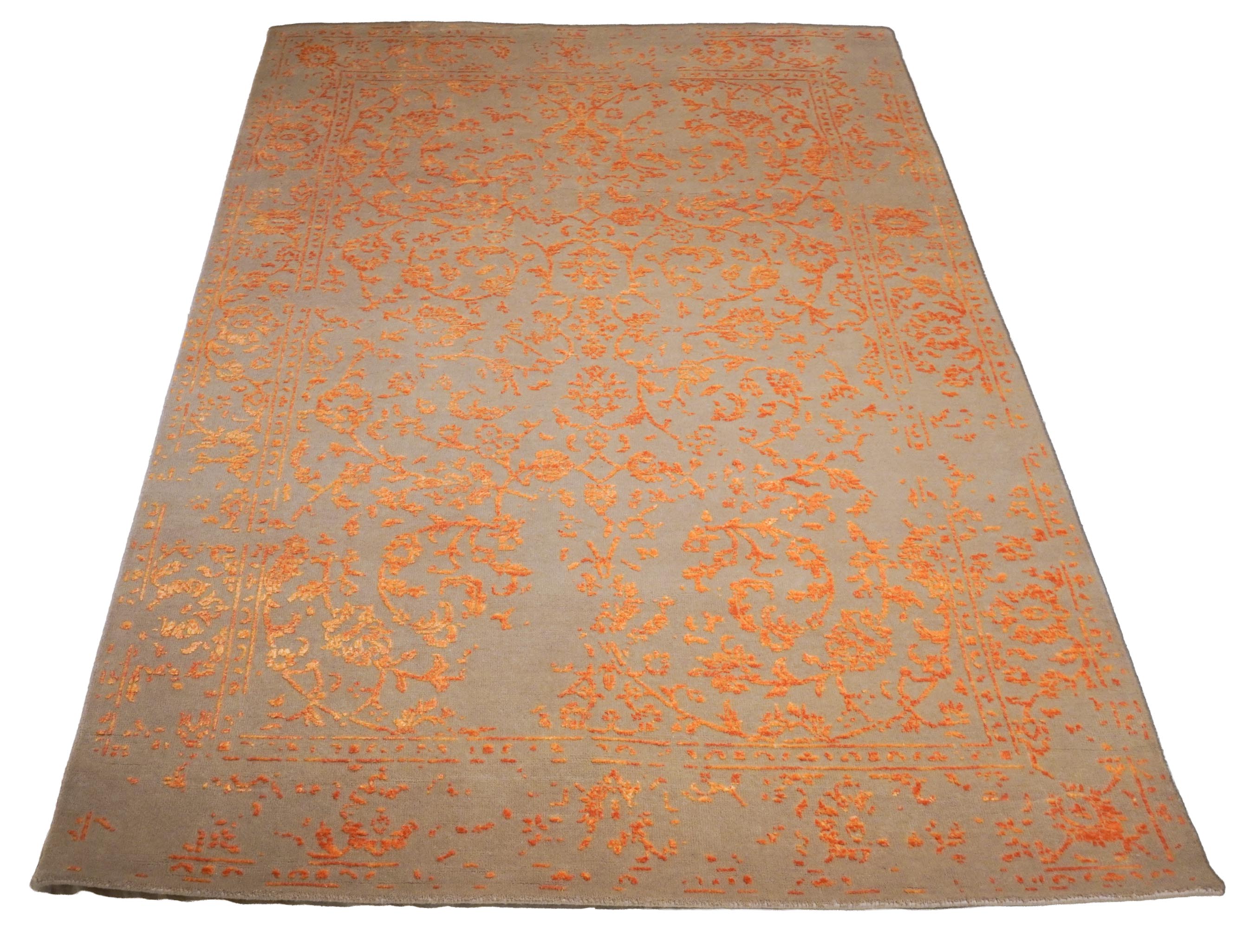
New Teheran | 214 x 148 cm | Nr. Z-4228

|
14 Tage Probelegen |

|
Kostenlose Lieferung & Retoure innerhalb der EU |
Lightly framed New Teheran, grey
| Origin |
|
| Dimensions | 214 cm x 148 cm (= 3.1672 m²) |
| Construction | hand-knotted |
| Material |
Pile: wool & viscose
|
| knots per m²2 | 160.000 |
| Pile height | 8mm |
| Year of manufacture | 2025 |
| Colour | Grey, Terracotta |
| Edition | one-of-a-kind piece |

Origin
Contemporary aesthetics meet Oriental tradition – for this New Teheran rug we drew our inspiration from the traditional patterns of Persian Sarough rugs.
Sarough is one of Iran's best-known rug-knotting regions. Saroughs are famous for their floral Sultanabad designs. The delicate tendrils seem to branch out almost endlessly and are held in check only by the surrounding border.
We have reworked the traditional pattern templates and, above all, arranged the colours in a completely new way. The result is a fusion of traditional Oriental rug design and modern European aesthetics. With our New Teheran rugs we set out to meet the trends of European interior design, playing freely with the conventions of traditional rug knotting.
Pattern
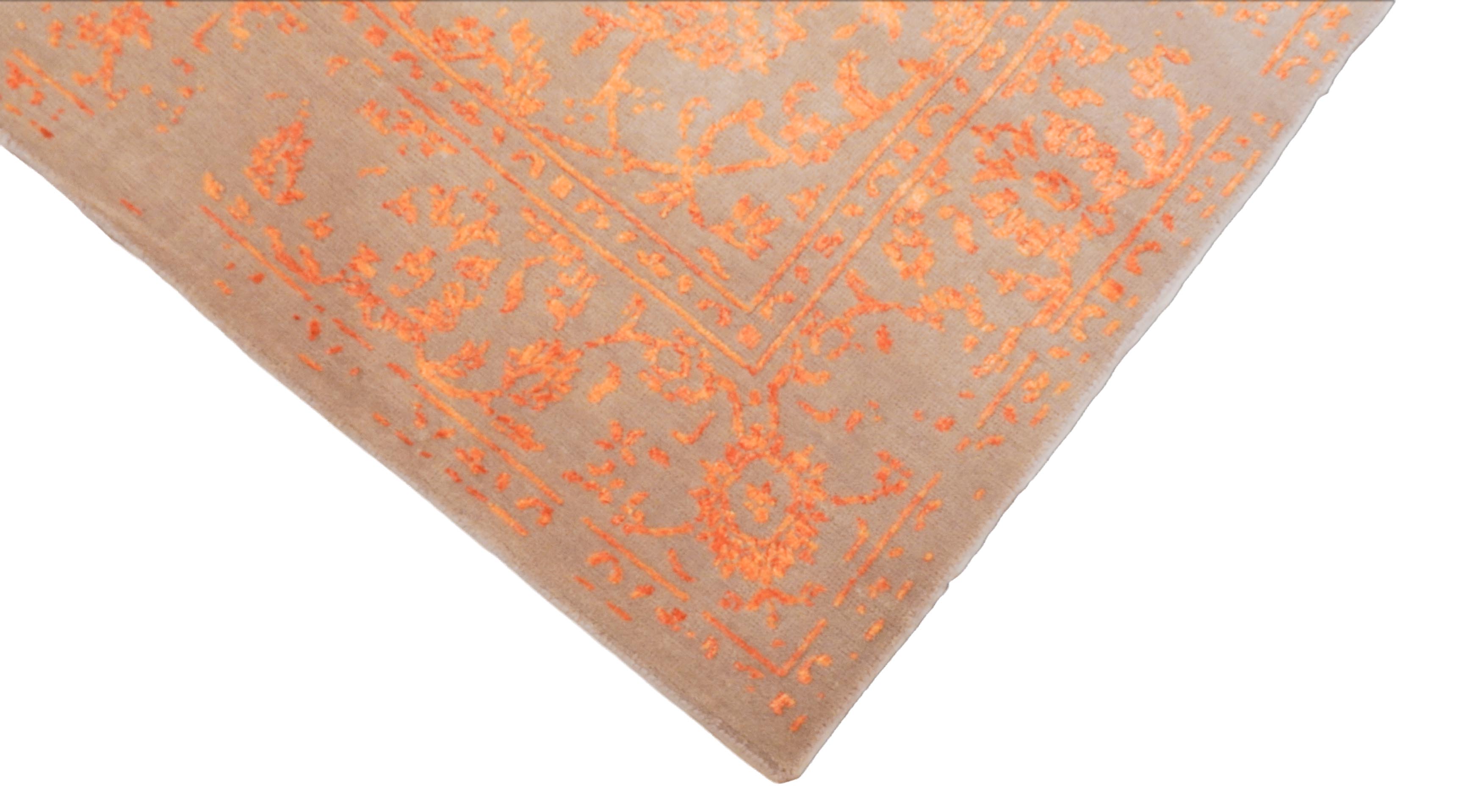
A lightly suggested border frames the edge of this rug.
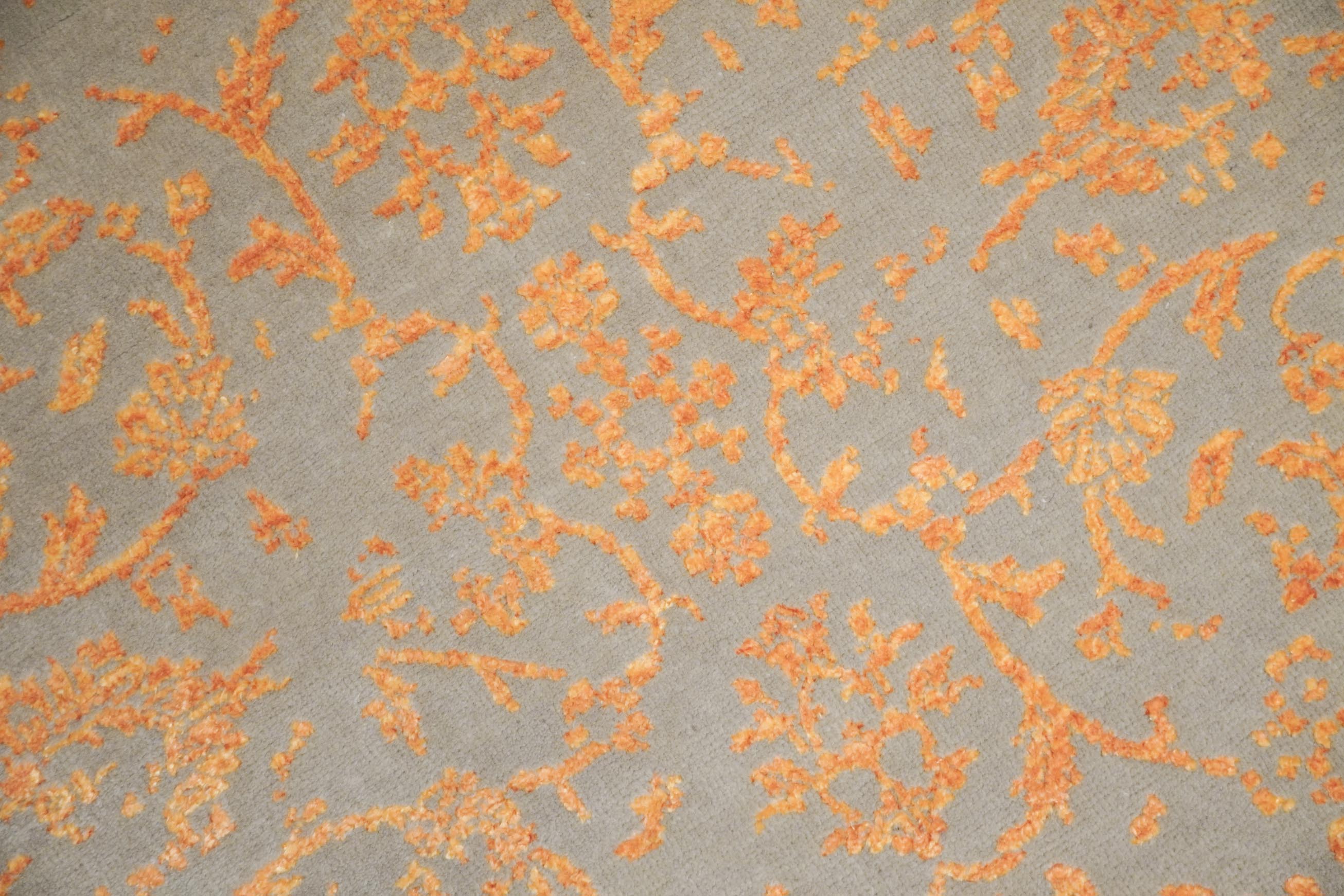
The lavish floral motifs of this New Teheran are elegantly drawn and full of variety. The graceful plant symbols – blossoms, leaves and branches – are artfully intertwined.
The pattern, inspired by classic Oriental ornamentation, gives the impression that this hand-knotted rug already has a long history behind it. It looks as though it were washed out or faded, which makes it appear almost abstract. In reality, of course, this New Teheran is new and belongs to the youngest generation of contemporary rug designs. It builds a bridge between modern designs and interiors and classic Oriental motifs. The pattern is restrained and yet clearly present.
The background of this New Teheran is grey. The border is worked in grey and terracotta.
Material
The pile of this New Teheran is made from a hard-wearing blend of wool and viscose. Viscose – also known as acetate silk or rayon – is always obtained from cellulose, a natural product, and thus from the raw material wood. In India the cellulose pulp is obtained from bamboo. In an elaborate process the pulpy cellulose is drawn into a continuous textile yarn. That is why viscose is also referred to as endless filament yarn. Because of the silky sheen of the yarn, viscose obtained from bamboo is also called "Bamboo Silk". The colloquial term "artificial silk" is not permitted under the German Textile Labelling Act (TKG). The weft and warp threads of this New Teheran are made of cotton. This versatile material is tear-resistant and elastic, which makes it particularly well suited to a hard-wearing foundation.
A note on the photos
Child labour? No thanks.
Child labour? No thanks. Children belong in school, not at a knotting frame or a loom. For us it therefore goes without saying that we only offer rugs made under fair conditions and without child labour.
We attach particular importance to humane working conditions and tolerate no child labour at any of our producers. Thank you for helping us to ensure fair conditions.
That is why we support the initiative Care & Fair against child labour in the rug trade.

Choose options
|
|
14 Tage Probelegen |
|
|
Kostenlose Lieferung & Retoure innerhalb der EU |