

silk rugs
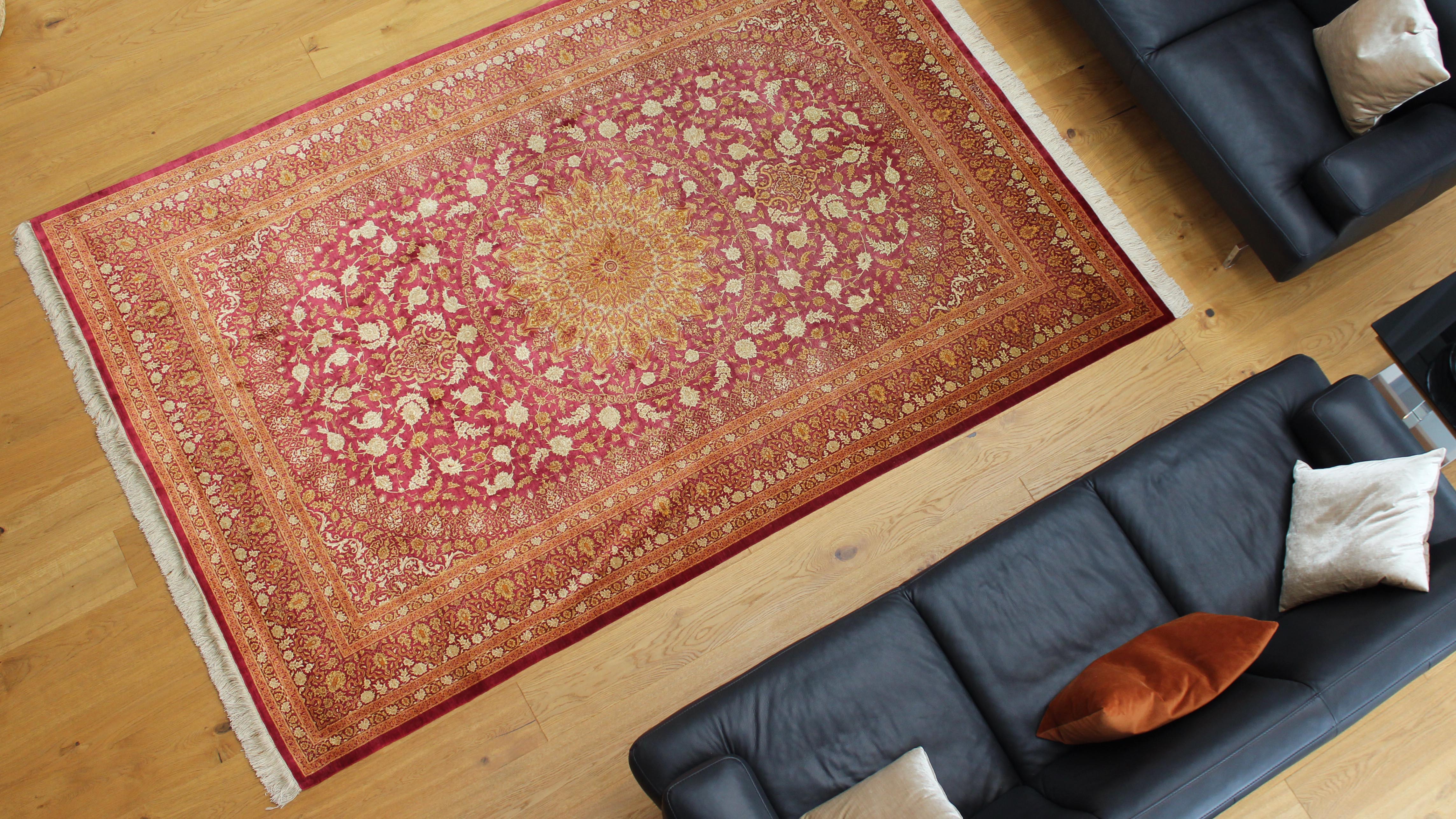
A silk rug is a hand-knotted rug whose pile is made entirely or largely of natural silk. Silk allows for an extremely fine knotting, luminous colours and that characteristic sheen which shifts as the light falls on it. At Zomorrodi you will find silk rugs in pure silk from Qom and, occasionally, from Keshan or Tabriz (Persia), Hereke and Kayseri (Turkey), and Kashmir and China – new and old, from wall hangings to living-room sizes.
The Silk Road of our collection: here you'll find exclusive hand-knotted silk rugs from a range of countries of origin – luxurious and timeless. The silk rug is among the finest rugs there are. But don't let that put you off: prices vary depending on fineness, the quality of the silk and the origin.

hand-knotted silk rugs
A work of art for your floor
Silk rugs at a glance
- Origin: Qom, occasionally also Keshan or Tabriz (Iran), Hereke and Kayseri (Turkey), China; occasionally Kashmir
- Material: pure natural silk (mulberry silk) in the pile; weft and warp of silk
- Knot density: very high – often 500,000 to more than 4,500.000 knots per m² in exceptional pieces
- Pile: short (approx. 2–5 mm), lustrous; colour and sheen shift with the viewing angle
- Typical sizes: small mats such as 90 × 60 and 120 x 80 or 150 x 100, but also larger formats such as 180 × 120, 200 x 150, 300 x 200, 350 x 250 and oversized pieces in pure silk such as 400 x 300 cm. The range also includes square and round formats and wall hangings
- Price: from around 350 € for small pieces; fine Qom silk in the mid four-figure range and above
Qom, Hereke, China: the three great silk provenances
Qom (also spelled Ghom or Kum) is the best-known Persian silk provenance: knotted extremely finely, with floral medallion and garden patterns, often signed. Occasionally there is also a Keshan or Tabriz in pure silk. Hereke near Istanbul was the sultan's court manufactory; Hereke silk rugs are the finest in Turkey and are often knotted with prayer-rug or flower-vase patterns. Silk rugs from Kayseri in Turkey are equally well known and sought after. Chinese silk rugs take up Persian and Turkish models, are cleanly worked and usually far more affordable – a good way to start.
Honestly speaking: which sort of household is a silk rug right for?
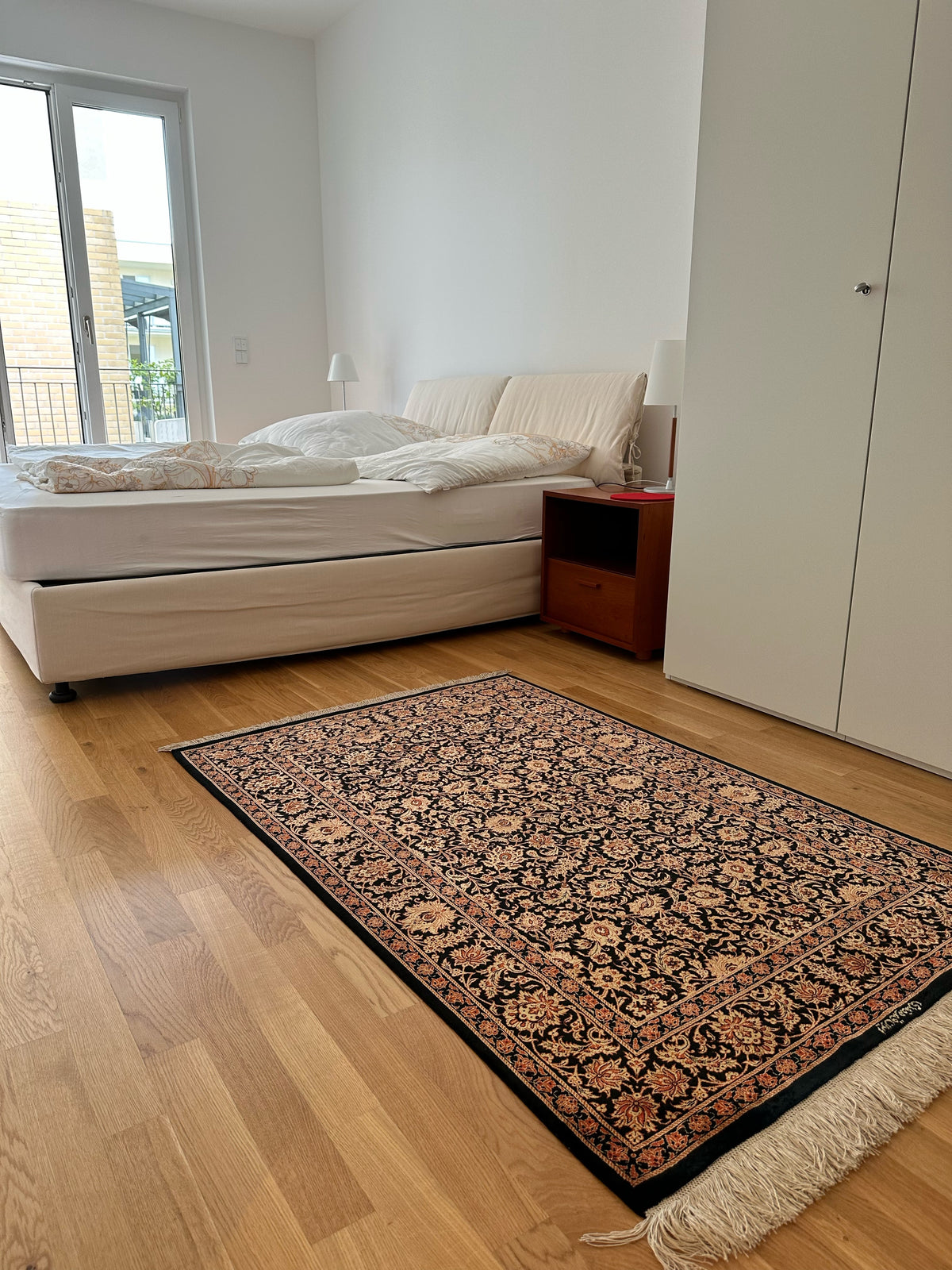
A silk rug is ideal in the living room or bedroom, in a study, as a wall hanging, or anywhere it is seen but not put under heavy strain every day. If you are looking for a rug for everyday life with family and pets, you are better served with wool or a wool-silk blend – and we will tell you so in a consultation.
Silk is finer and a little more delicate than wool. So a silk rug does not necessarily belong right inside the front door, or in a kitchen where there is a lot going on. It is also less suited as a play area for small children or pets, even though it is very soft and invites exactly that.
Recognising real silk
A genuine silk rug feels cool and smooth, shimmers differently depending on the viewing angle, and shows the pattern pin-sharp on the back. Be wary of terms such as “art silk”, “bamboo silk” or “viscose”: these are plant-based cellulose fibres whose quality varies greatly by origin. At Zomorrodi, silk rugs are made exclusively from pure natural silk – and that is stated in the description of every piece.
A silk rug is not only a luxurious accessory for your home, but also an investment in timeless elegance.
Frequently asked questions
What does a silk rug cost?
Small silk rugs from China or older small-format Hereke pieces start at around 350 € at Zomorrodi. Finely knotted Persian Qom silk in a living-room size sits in the mid to high four-figure range. What matters is knot density, origin, age, condition and size – and the price is shown with every rug.
Is a silk rug suitable for everyday use?
In many households yes, though in some cases we would advise against it.
Pure silk, properly worked as it is in our fine rugs, is very robust, but it is simply more delicate than wool and is better kept out of extremely busy areas such as the space just inside the front door. Of course, much depends on the individual case. How many people live in the household? Are there pets that are perhaps not yet house-trained?
In a well-kept household, though, a silk rug can perfectly well lie under the dining table.
In quiet rooms – living room, bedroom, study – or on the wall, a silk rug will last for generations with good care.
Table or sofa legs, incidentally, are no problem for silk rugs, as long as they do not taper to an extremely sharp point.
Just as with our wool rugs, the fibres simply spring back up again once the furniture has been moved.
If in doubt, it helps to dampen the spot very lightly and lift the pile back up. An iron can also give it a gentle nudge if needed – but always use something like a cotton cloth as protection, so the iron does not pass its full heat straight into the rug.
How do I tell whether a rug is made of real silk?
Real silk is cool and smooth, its sheen changes with the direction you look from, and the back shows a very fine, sharp pattern. Viscose or “bamboo silk” shimmer more evenly, feel warmer and quickly turn dull when damp. If in doubt, a look at our product description helps, or a consultation in our rug showroom in Düsseldorf or over the phone.
What is the difference between Qom and Hereke?
Qom is a Persian silk provenance with floral medallion and garden patterns, often signed. Hereke is the former Ottoman court manufactory near Istanbul; Hereke silk rugs often show prayer-niche and flower patterns and, alongside silk rugs from Kayseri, rank among the finest rugs in Turkey.
How do I care for a silk rug?
Vacuum only on low suction and without a rotating brush, avoid direct sunlight, and blot stains immediately with a dry cloth – no water, no rubbing. Cleaning belongs in expert hands; in Düsseldorf we offer professional hand washing for silk rugs.
Can I try a silk rug out at home?
Yes. As with every rug at Zomorrodi, you can try silk rugs at home for 14 days; the rug must not be soiled or damaged while it is with you. In and around Düsseldorf and the Rhine and Ruhr region we will also bring selected pieces to you with no obligation. For very high-value pieces we offer this service throughout Germany as well.