
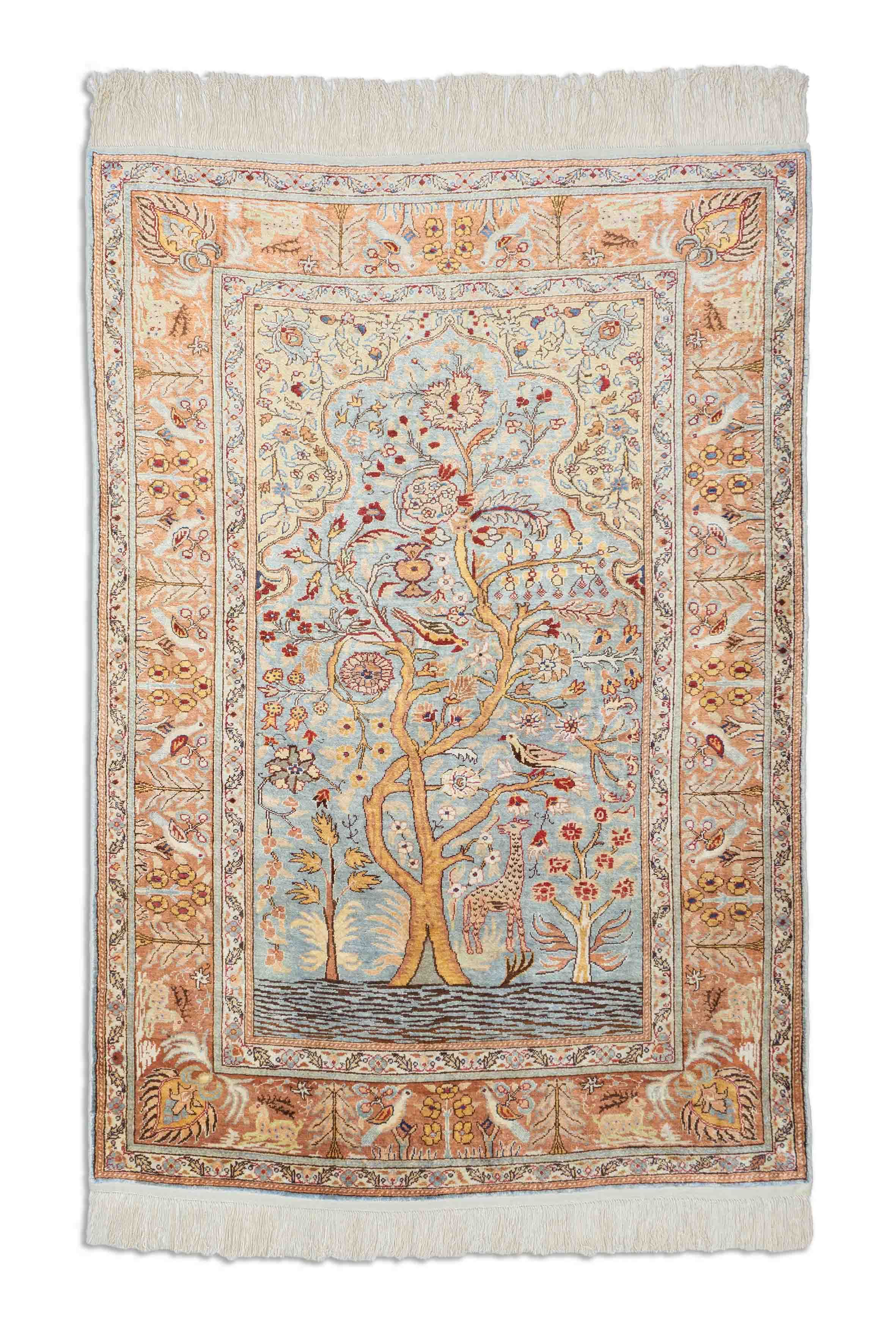
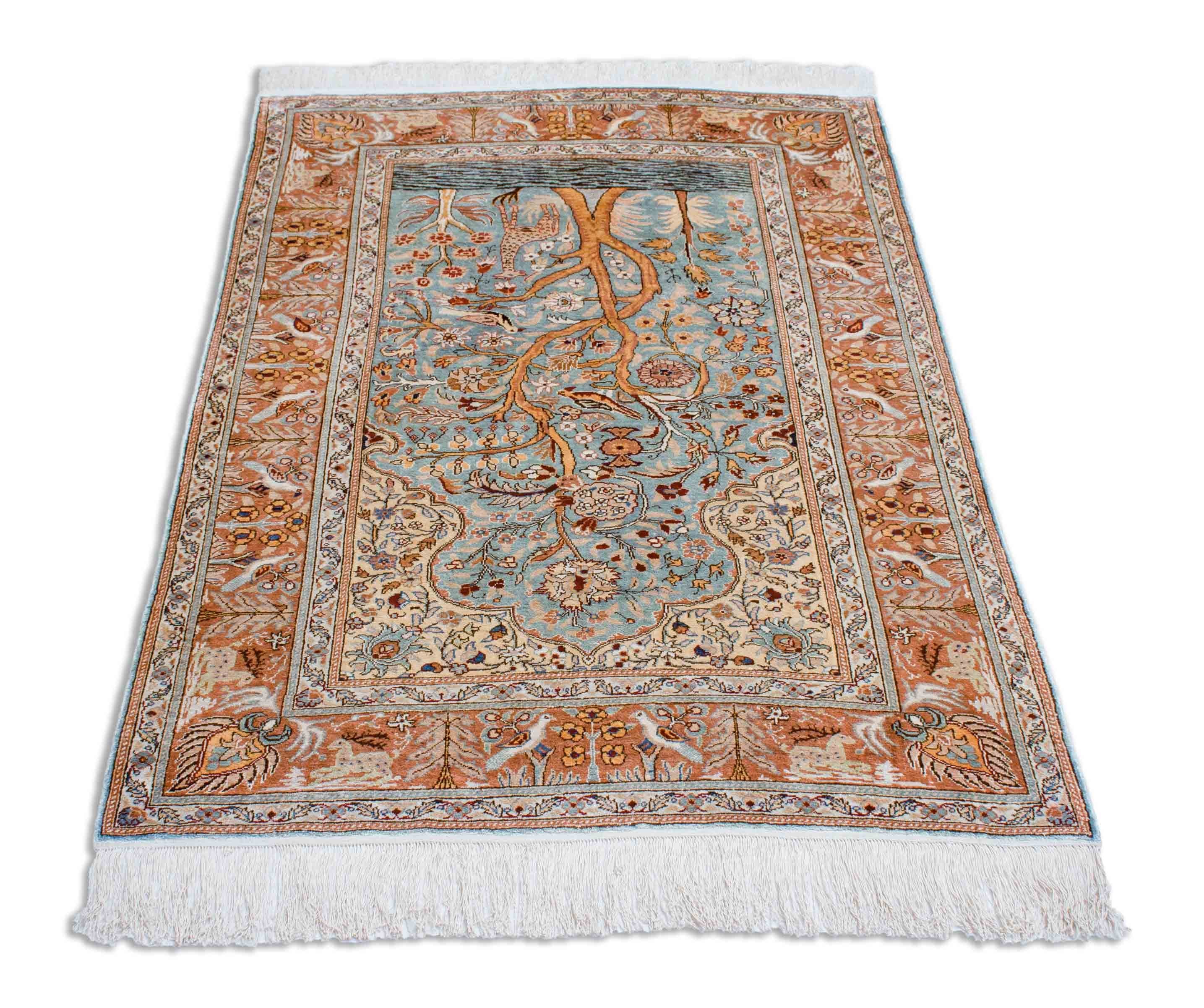
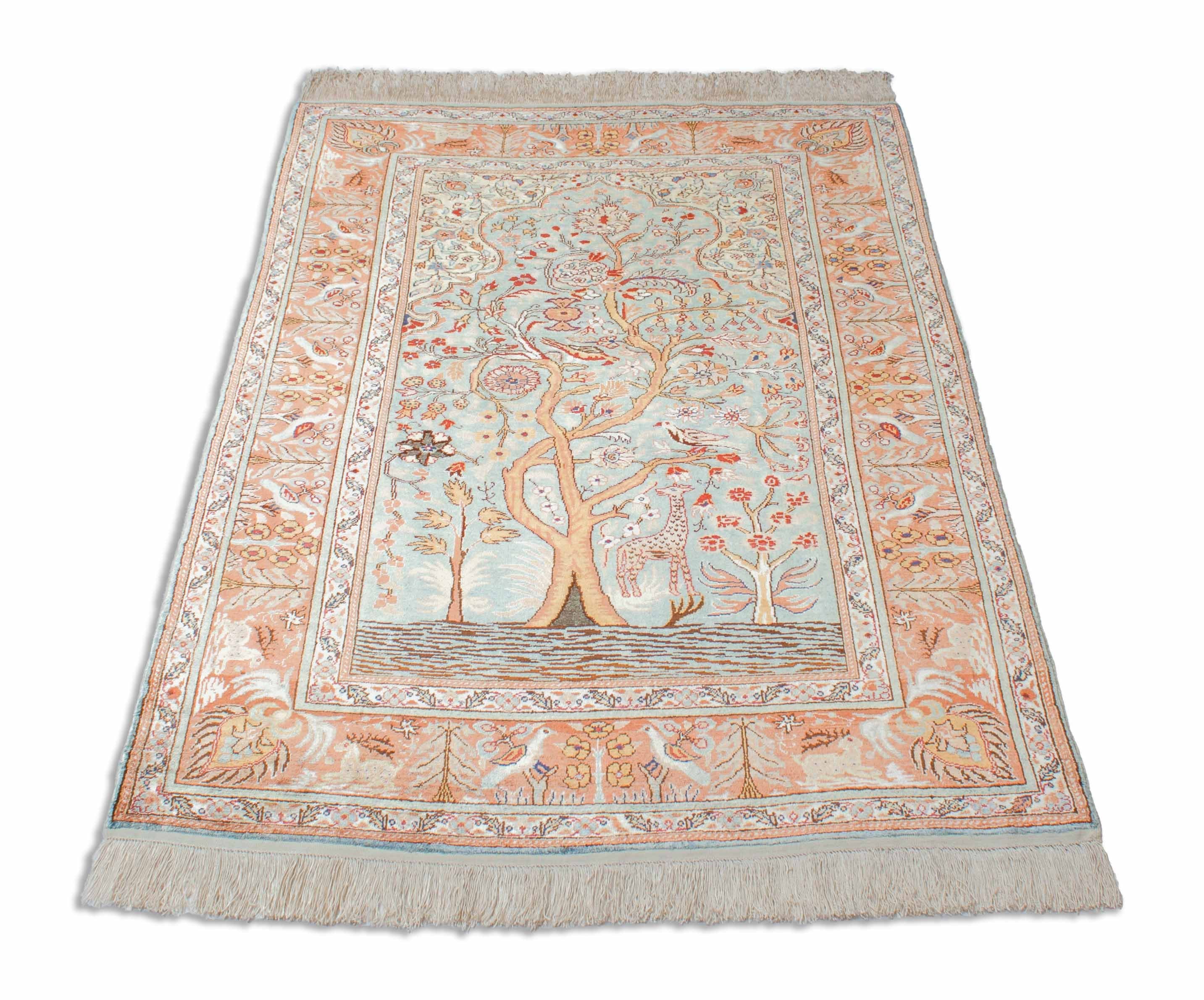
Hereke in pure silk with gold threads | 140 x 98 cm | Nr. 17451

|
1-3 Werktage Lieferzeit (deutschlandweit) |

|
14 Tage Probelegen |

|
Kostenlose Lieferung & Retoure innerhalb der EU |
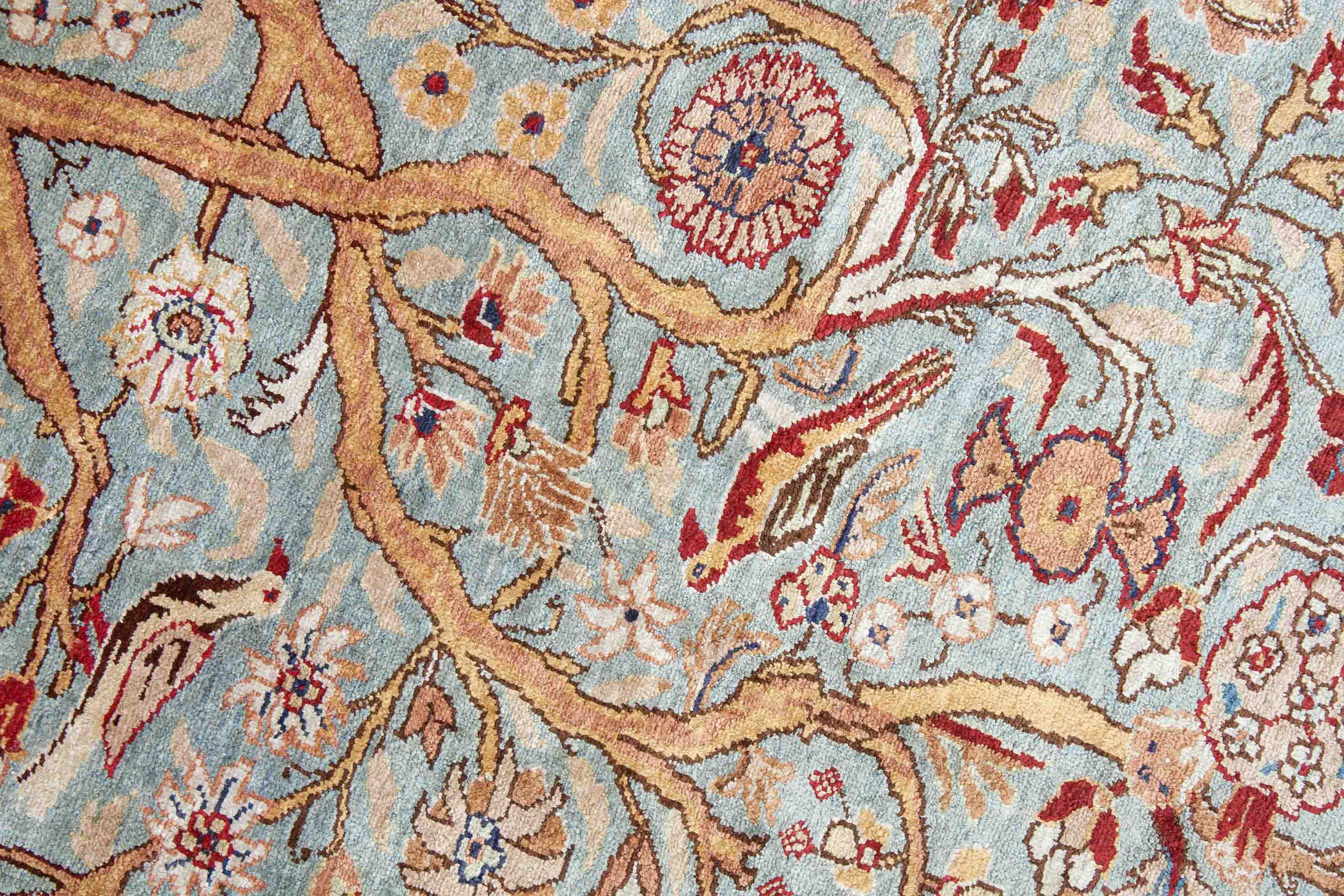
Floral old Hereke in pure silk with gold threads, blue-grey with border and paradise garden pattern
| Origin | Turkey |
| Dimensions | 140 cm x 98 cm (= 1.37 m²) |
| Construction | hand-knotted |
| Material | Pile: pure silk with gold threads Weft & Warp: pure silk |
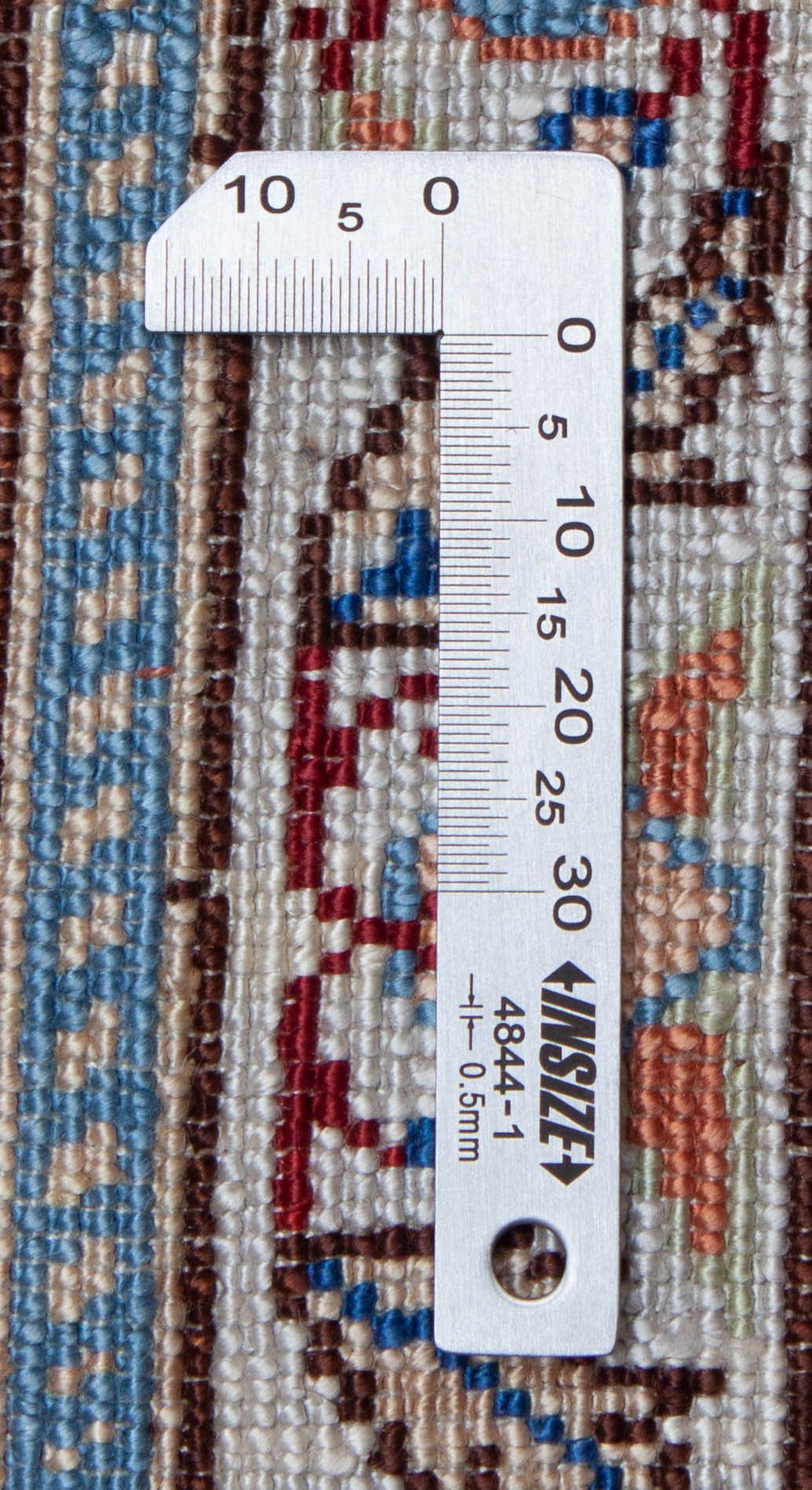
| knots per m²2 | 480.000 |
| Pile height | 3mm |
| Year of manufacture | 1980 |
| Colour | Blue-grey, Terracotta |
| Edition | one-of-a-kind piece |

Origin
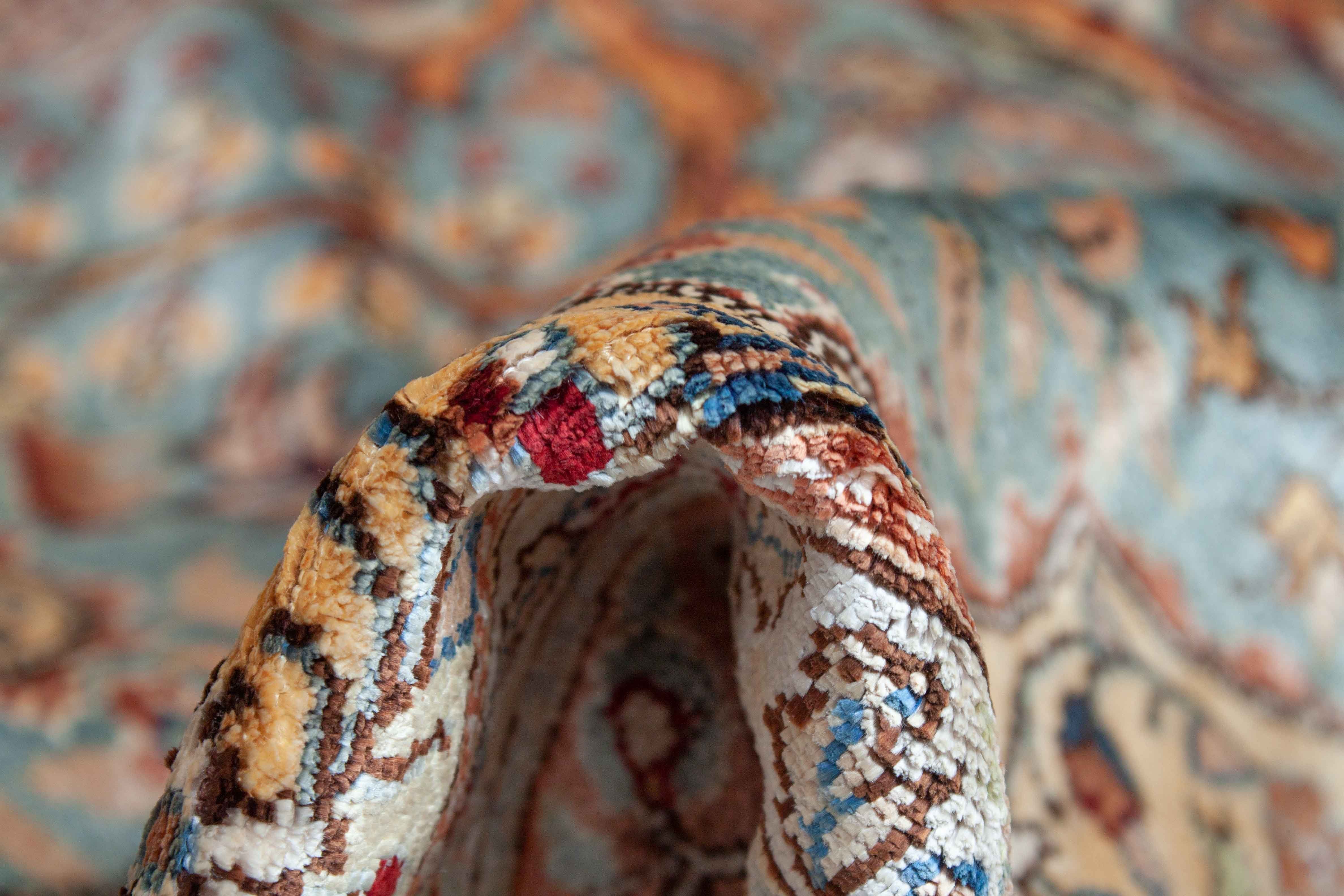
Very valuable silk rugs come from the Turkish town of Hereke. The tradition was fostered by the art-loving Sultan Abd-ul-Medjid (reigned 1839 - 1861). In 1844 he had the court workshops moved back from Cairo to Hereke. Hand-knotted Hereke silk rugs are among the finest rugs in the world and are knotted at densities of up to 6 million knots per m². Thanks to the knotting technique, incidentally, the pattern is just as clearly visible on the back as it is on the front. At renowned art auction houses, antique Turkish rugs fetch top prices.
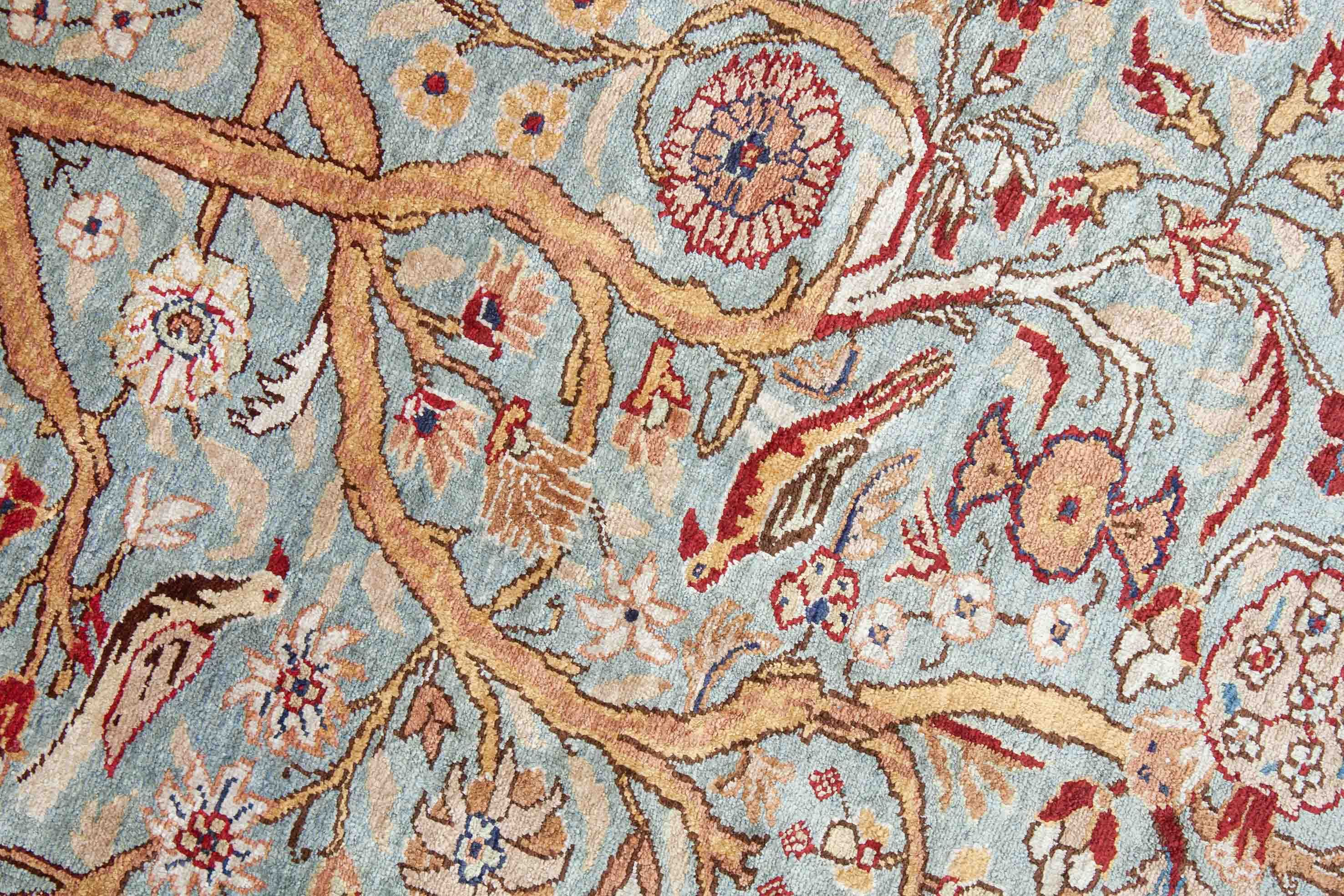
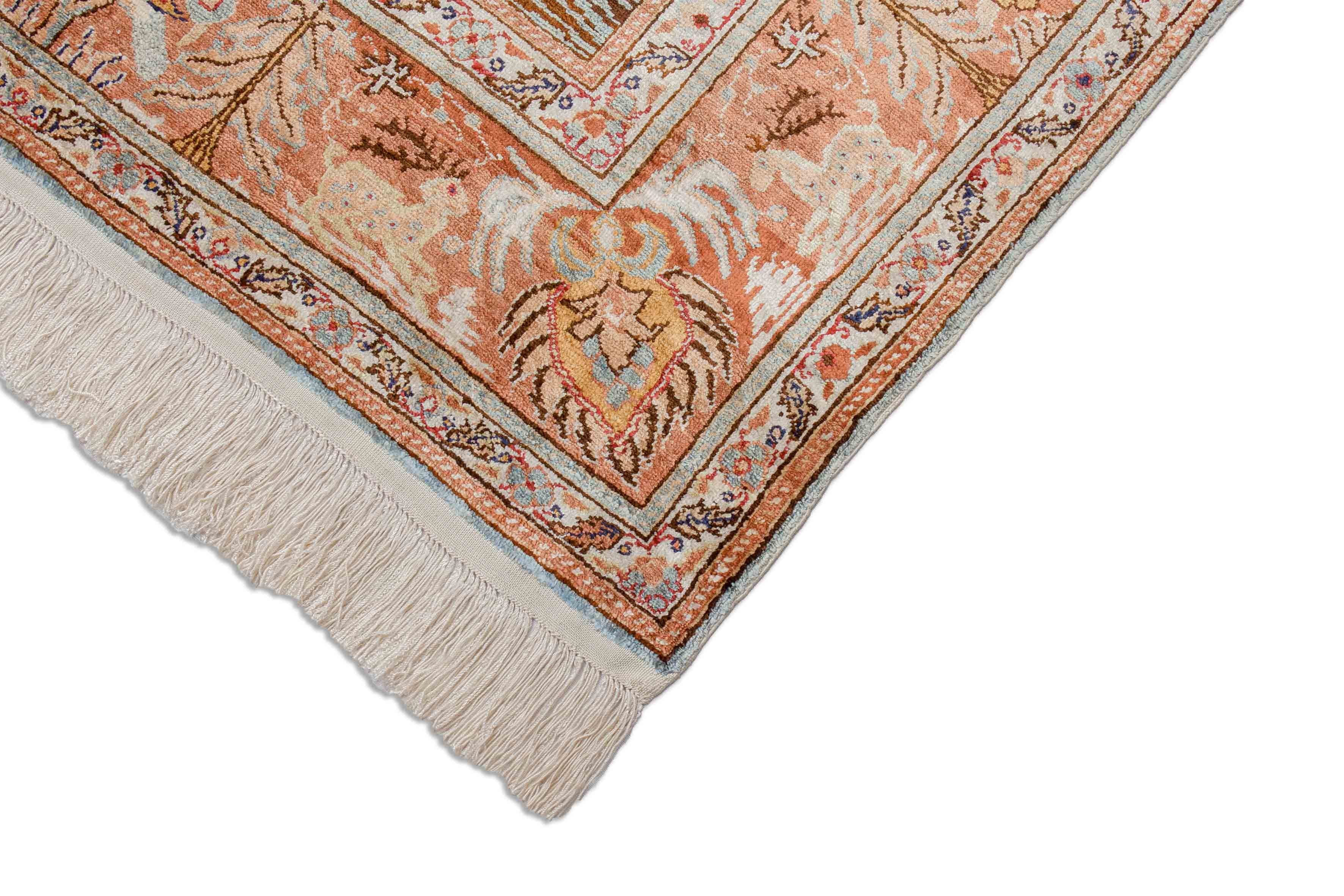
Typical motifs on Hereke rugs are flowers, twigs and leaves as well as birds, the tree of life and the so-called Mehrab or Mihrab pattern, a prayer niche shown together with oil lamps. Alongside traditional motifs and typically Ottoman or Turkish patterns, Hereke silk rugs are today also knotted with more modern designs suited to contemporary taste. Typical colours for Hereke silk rugs are a deep dark blue, a radiant red, a lively green, a luminous yellow and various natural tones in every shade. This old Hereke is around 40 years old and a true collector's piece. The pattern of this refined Hereke is accentuated by the use of gold threads. The gold threads create a shimmering, lustrous contrast and — depending on how the light falls — make the colours glow in warm shades. The fine gold threads are not only precious but also extremely difficult to work with, and they underline the craftsmanship of the weavers.
Pattern
The paradise garden design is a stylised depiction of a traditional Persian garden. The Greek word "paradeisos" goes back to the Middle Persian word "pardēs". Originally the word referred to the Persian royal gardens, and only in the biblical context did it take on the connotation of the garden of God. The fertile, artfully laid-out royal gardens were home to a wide variety of exotic plants and animals. They are enclosed by a wall, symbolic of the separation between heaven and earth. Paradise gardens are places of veneration and symbols of status. Traditional Persian gardens were rectangular, with a river or body of water running from north to south and from east to west, forming a cross that divides the garden into four sections. Roofed pavilions or structures and raised walkways for viewing the garden from above were just as common as fountains and waterfalls symbolising eternal life. In rugs with a paradise garden motif – like this one – the depiction of water, so precious in arid regions, plays a prominent role.
The background of this Hereke is blue-grey. The border is worked in terracotta, blue-grey and cream white.
Condition
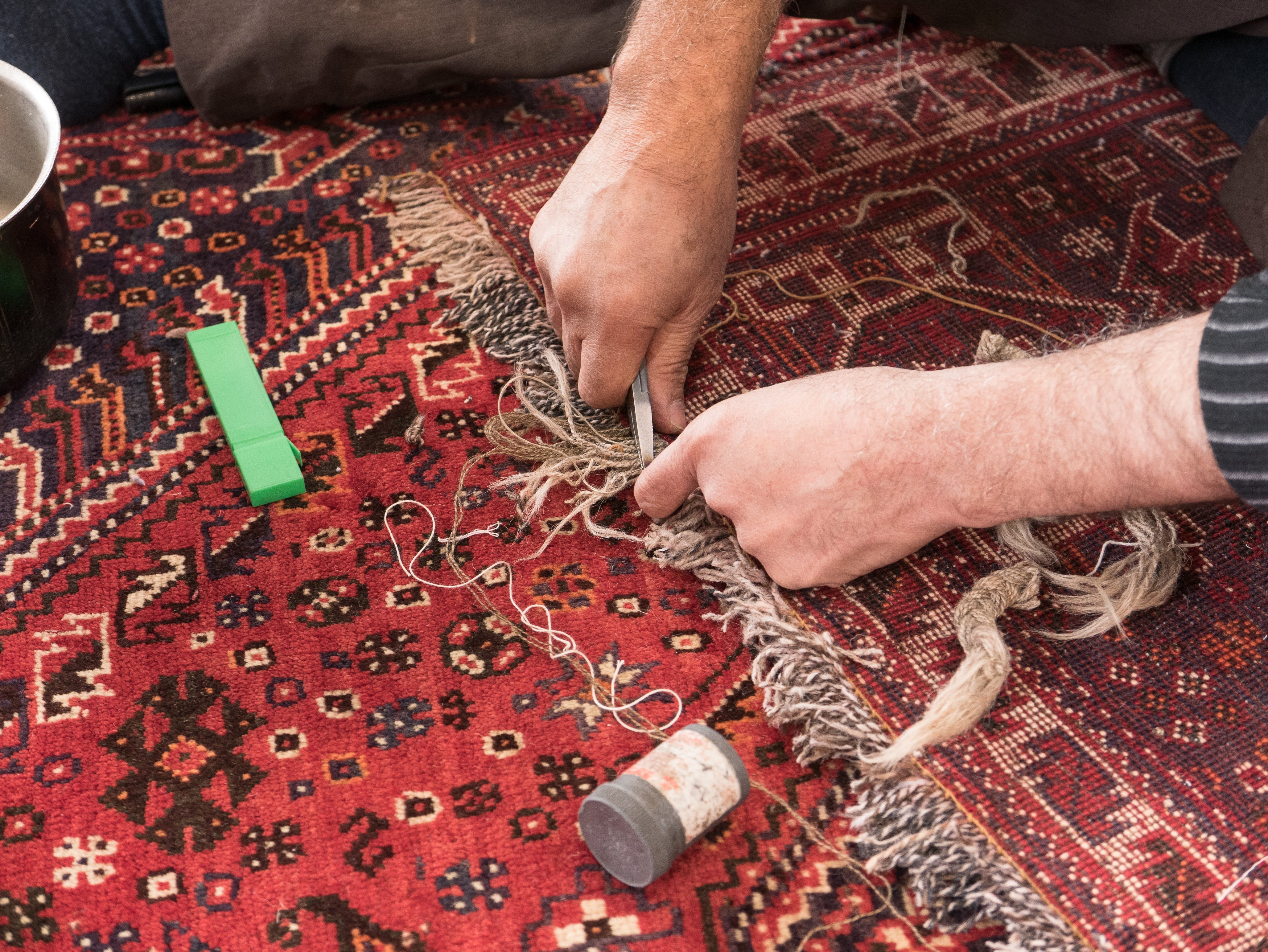
This Hereke has a story to tell. It was hand-knotted around 1980. We have cleaned it thoroughly and lovingly restored it. Despite its age, it is therefore in very good condition.
Material
The silk pile of this Hereke makes the colours of the pattern glow in different shades, depending on how the light falls. It turns this Hereke into a real highlight and creates an atmosphere in the room that is cosy and at the same time very elegant and refined. Silk is obtained by hand from the cocoons of the silk moth. Because the individual silk filaments are extremely long, they can be spun into very fine yarns that are light in weight yet still tear-resistant. Fine yarn allows smaller knots to be tied, and with them more intricate patterns. That is why the finest rugs in the world are hand-knotted from pure silk.
The pattern of this noble Hereke is also accented by the use of gold threads. The gold threads create a shimmering, lustrous contrast. The fine gold threads are not only precious but also extremely difficult to work with, and they underline the craftsmanship of the weavers. In this Hereke even the foundation is made of pure silk. Thanks to the thin but hard-wearing material of the weft and warp threads, a particularly fine knotting — and therefore a particularly fine pattern — is possible.
A note on the photos
Child labour? No thanks.
Child labour? No thanks. Children belong in school, not at a knotting frame or a loom. For us it therefore goes without saying that we only offer rugs made under fair conditions and without child labour.
We attach particular importance to humane working conditions and tolerate no child labour at any of our producers. Thank you for helping us to ensure fair conditions.
That is why we support the initiative Care & Fair against child labour in the rug trade.

Choose options
|
|
1-3 Werktage Lieferzeit (deutschlandweit) |
|
|
14 Tage Probelegen |
|
|
Kostenlose Lieferung & Retoure innerhalb der EU |