


Farahan | 91 x 61 cm | Nr. Z-4075


|
14-day home trial |

|
Free delivery & returns within the EU |
Farahan
This one-of-a-kind piece in beige brings together traditional craftsmanship and timeless elegance. With a knot density of approx. 120,000 knots per m², the elaborate workmanship shows above all in the precise drawing of the design and the fine execution of the details. At 91 × 61 cm it suits a small living-room rug. The harmonious colouring and the characteristic texture lend any room an exclusive, homely atmosphere. A rug of this quality is far more than a piece of furnishing – it is a piece of traditional textile art with individual character and lasting value.
| Delivery time | 2 days |
| Origin | India |
| Dimensions | 91 cm x 61 cm (= 0.56 m²) |
| Construction | hand-knotted |
| Material | Pile: viscose |
| knots | 120.000 |
| Edition | one-of-a-kind piece |

Origin
Farahan is a district in the central Iranian province of Markazi. It gave its name to a classic floral pattern found on rugs from the Mahallat region around the town of Sultanabad.From the 1870s onwards, the Mahallat region around the town of Sultanabad (formerly Arak) grew into an important centre for knotting Persian rugs for export. A key role in this was played by the English import house Messrs. Ziegler & Co. Ltd., run by a Swiss merchant, which opened a branch in Mahallat in 1883.
These rugs — also called Mahal, Ziegler-Mahal or simply Ziegler — were knotted in the surrounding villages to Western colour and pattern specifications. The blend of European design briefs in lighter, calmer colouring with classic patterns in the style of Farahan and Sultanabad rugs was very well received in Europe.
The success was enormous, and Ziegler rugs became an international mark of quality. The exquisite flow of the many-petalled flowers is particularly impressive in Ziegler rugs. Well-preserved antique Ziegler rugs fetch record prices today – above all in the USA. For some years now, these antique Ziegler designs have been re-knotted in high quality in Pakistan and India.
The newly issued Ziegler rugs, made from hand-spun wool dyed with natural colours, are part of a revival of hand-knotted rugs. This return to traditional techniques began in the early 1980s, driven not least by the so-called DOBAG initiative. At first the reproductions focused on the Ziegler rugs described above. In time, almost every traditional Persian pattern was being reproduced. The result: adaptations of antique rugs alongside contemporary designs with the charm of an antique piece.
Material
The pile of this Farahan is made of hard-wearing viscose. The colloquial term "artificial silk" is not permitted under the German Textile Labelling Act (TKG). Viscose (also called rayon or acetate silk) is generally derived from cellulose, a natural product, and therefore from the raw material wood. In India, however, the cellulose pulp is also obtained from bamboo. In an elaborate process, the pulpy cellulose is drawn into one continuous textile yarn. This is why viscose is also known as continuous filament yarn. Because of the silky sheen of the yarn, viscose made from bamboo is also called "bamboo silk".The weft and warp threads of this Farahan are made of cotton. This versatile material is tear-resistant and elastic, which makes it particularly well suited to a hard-wearing foundation.
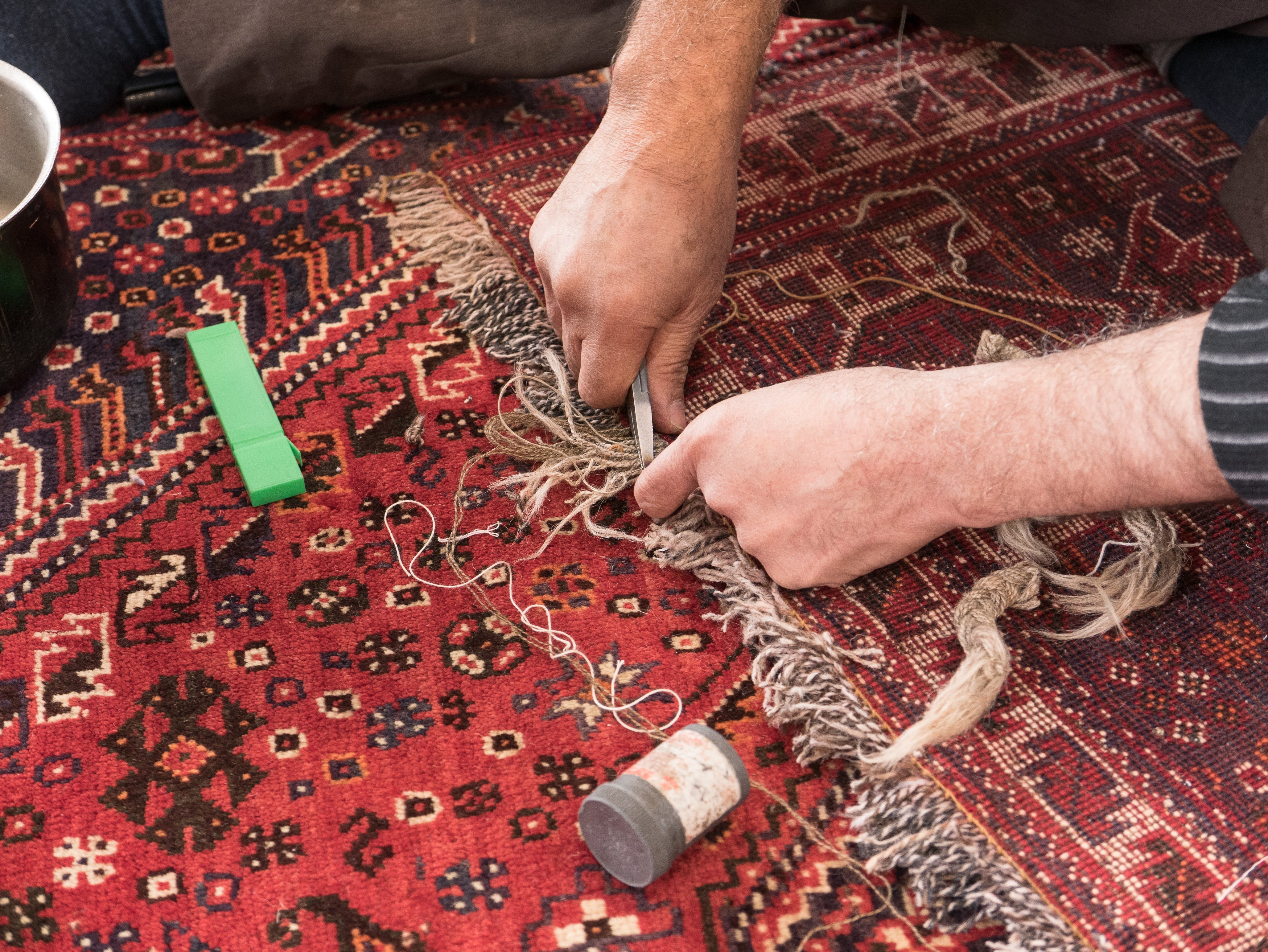
A note on the photos
Child labour? No thanks.
Child labour? No thanks. Children belong in school, not at a knotting frame or a loom. For us it therefore goes without saying that we only offer rugs made under fair conditions and without child labour.
We attach particular importance to humane working conditions and tolerate no child labour at any of our producers. Thank you for helping us to ensure fair conditions.
That is why we support the initiative Care & Fair against child labour in the rug trade.

Choose options
|
|
14-day home trial |
|
|
Free delivery & returns within the EU |