
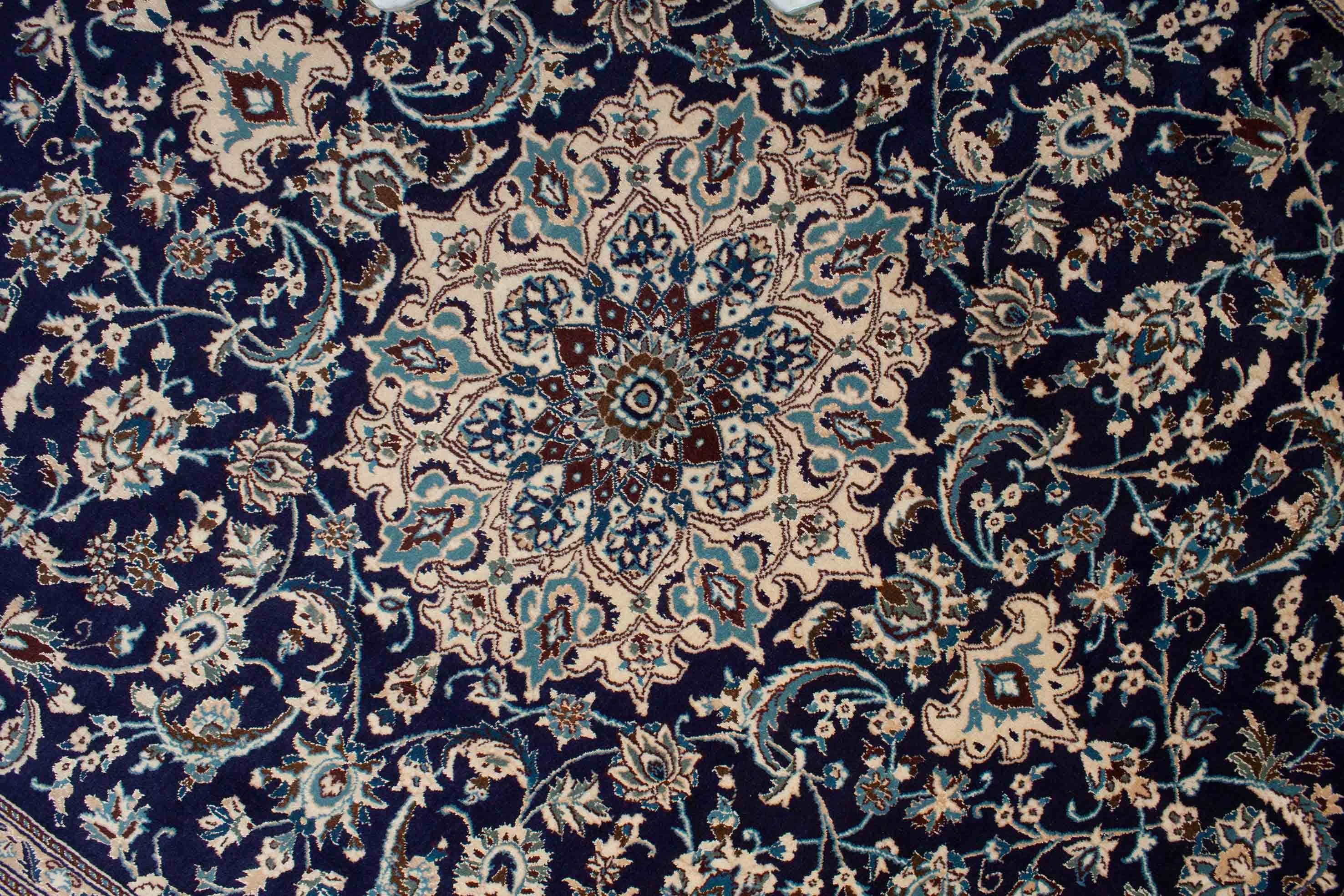
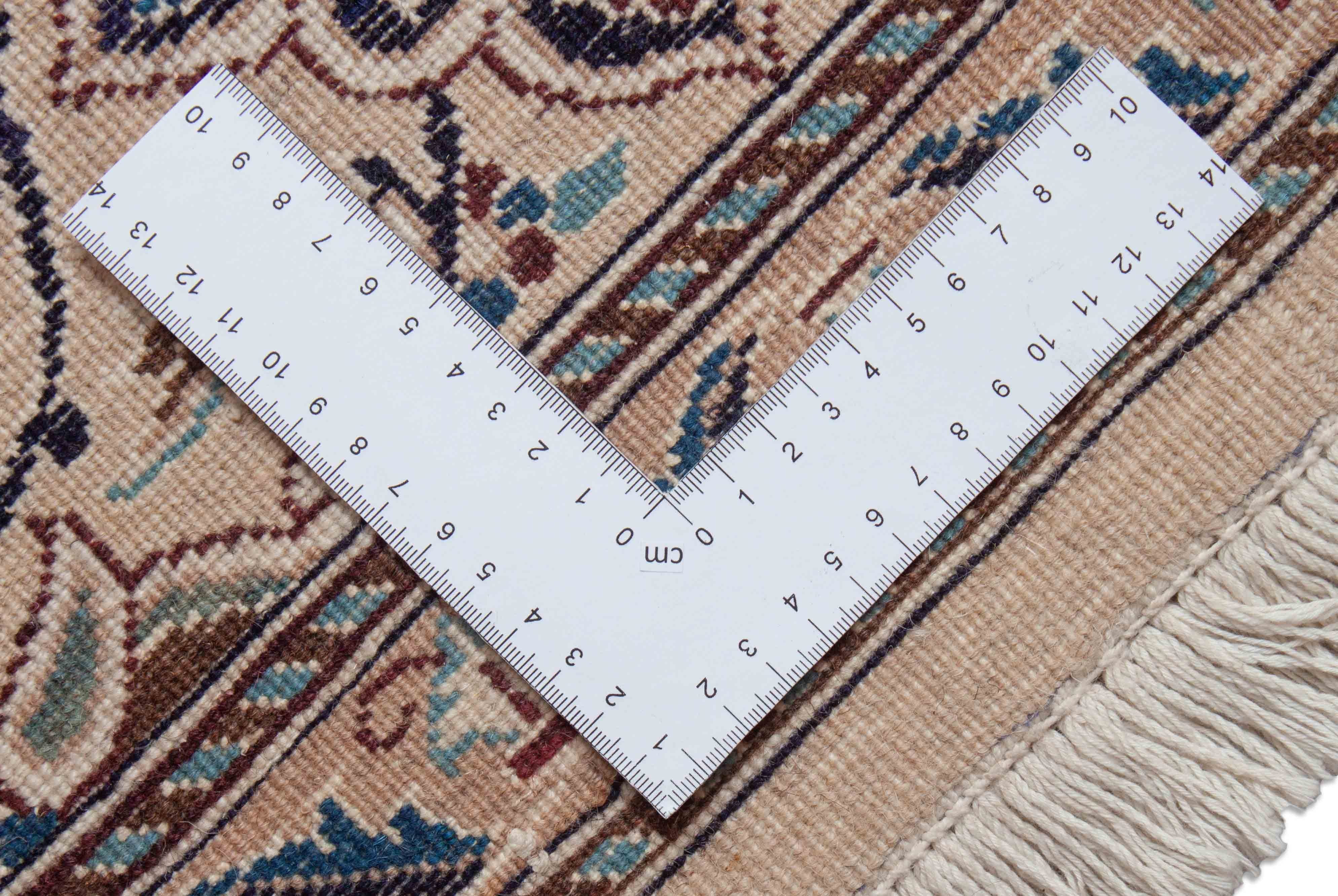
Kaschmar | 297 x 247 cm | Nr. 6965

|
1-3 Werktage Lieferzeit (deutschlandweit) |

|
14 Tage Probelegen |

|
Kostenlose Lieferung & Retoure innerhalb der EU |
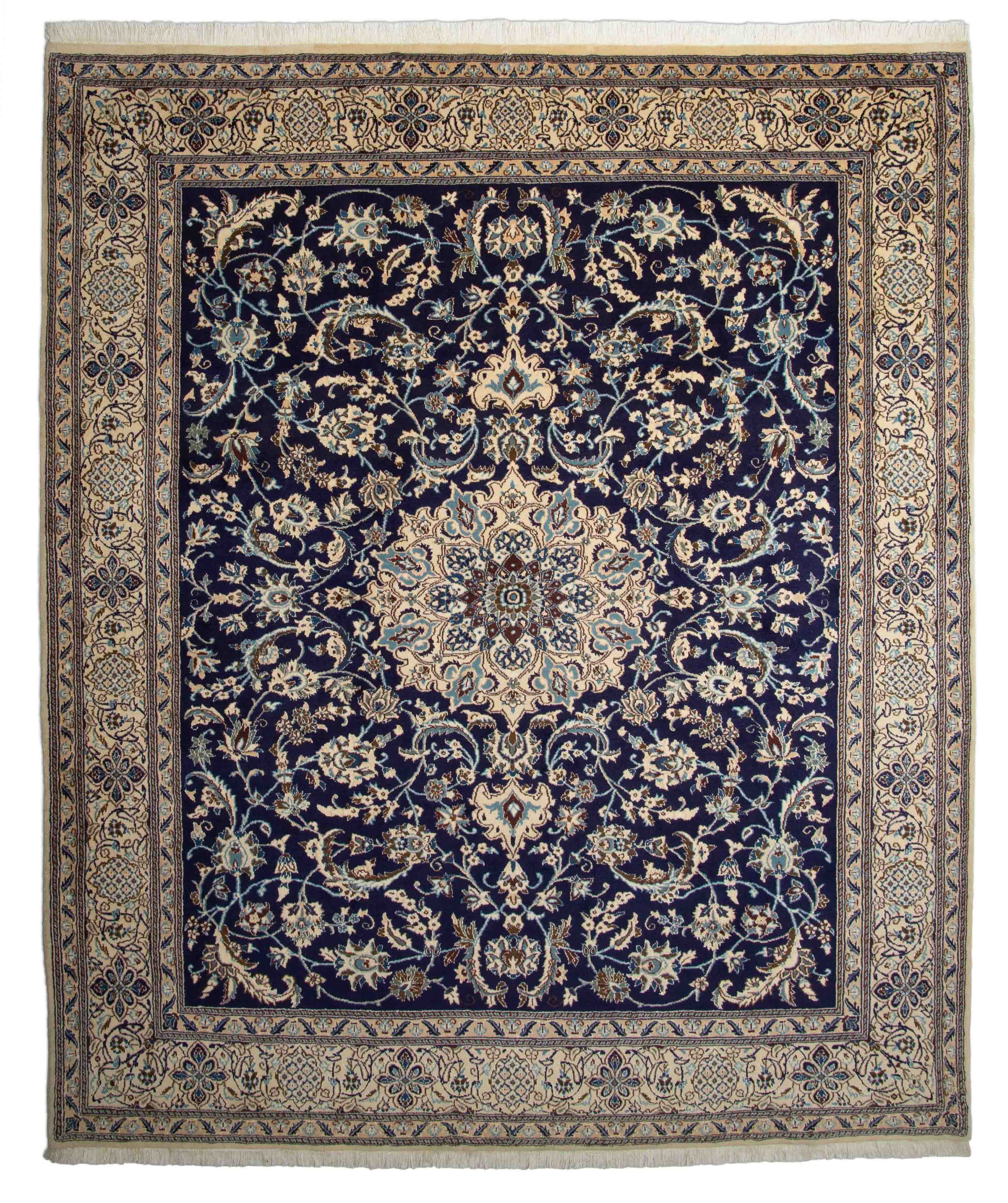
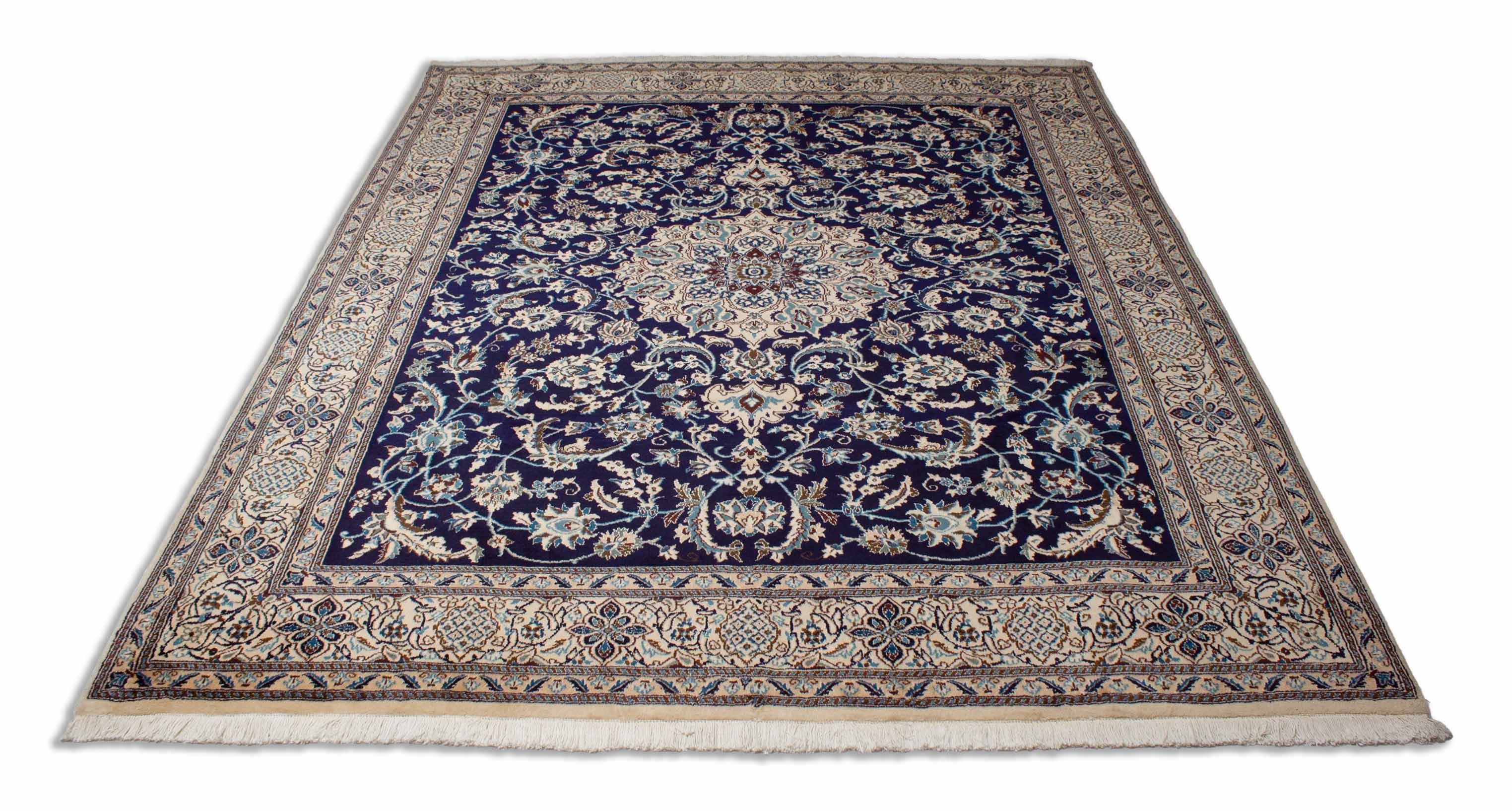
Floral Kaschmar, dark blue with medallion and border
| Origin |
|
| Dimensions | 297 cm x 247 cm (= 7.34 m²) |
| Construction | hand-knotted |
| Material |
Pile: wool & viscose
|
| knots per m²2 | 250.000 |
| Pile height | 20mm |
| Year of manufacture | 1990 |
| Colour | Dark blue, Beige |
| Edition | one-of-a-kind piece |

Origin
The town of Kaschmar lies in eastern Persia in the province of Khorasan and is the capital of the district of the same name. It was originally called Turschis and was renamed Kaschmar in the time of Reza Shah. That is why Kaschmar rugs are sometimes still traded under their old name, Turschis.
Until a good twenty years ago, it was mainly the Herati pattern that was knotted here, which was then taken up above all by the nearby provenances (source, origin) of Mood and Birjand. Today the so-called Sirchaki pattern prevails. The Sirchaki pattern depicts antique excavation finds such as vases, weapons, jugs, bowls and the like, usually on a blue or beige ground. The arrangement is almost always four-fold symmetrical with a central medallion that is occasionally adorned with a small scene. All of this is framed by a very pronounced main border. The medallions are sometimes asymmetrical and depict landscapes.
In more recent times, however, rugs with all-over patterns and rugs with the Nain pattern have also been knotted in Kaschmar, in the beige-and-blue colour combinations typical of the provenance. You can recognise these Kaschmar Nains by their deep pile. Kaschmar rugs have a fairly coarse knot density, look somewhat coarse-grained and the pile is relatively long.
Pattern
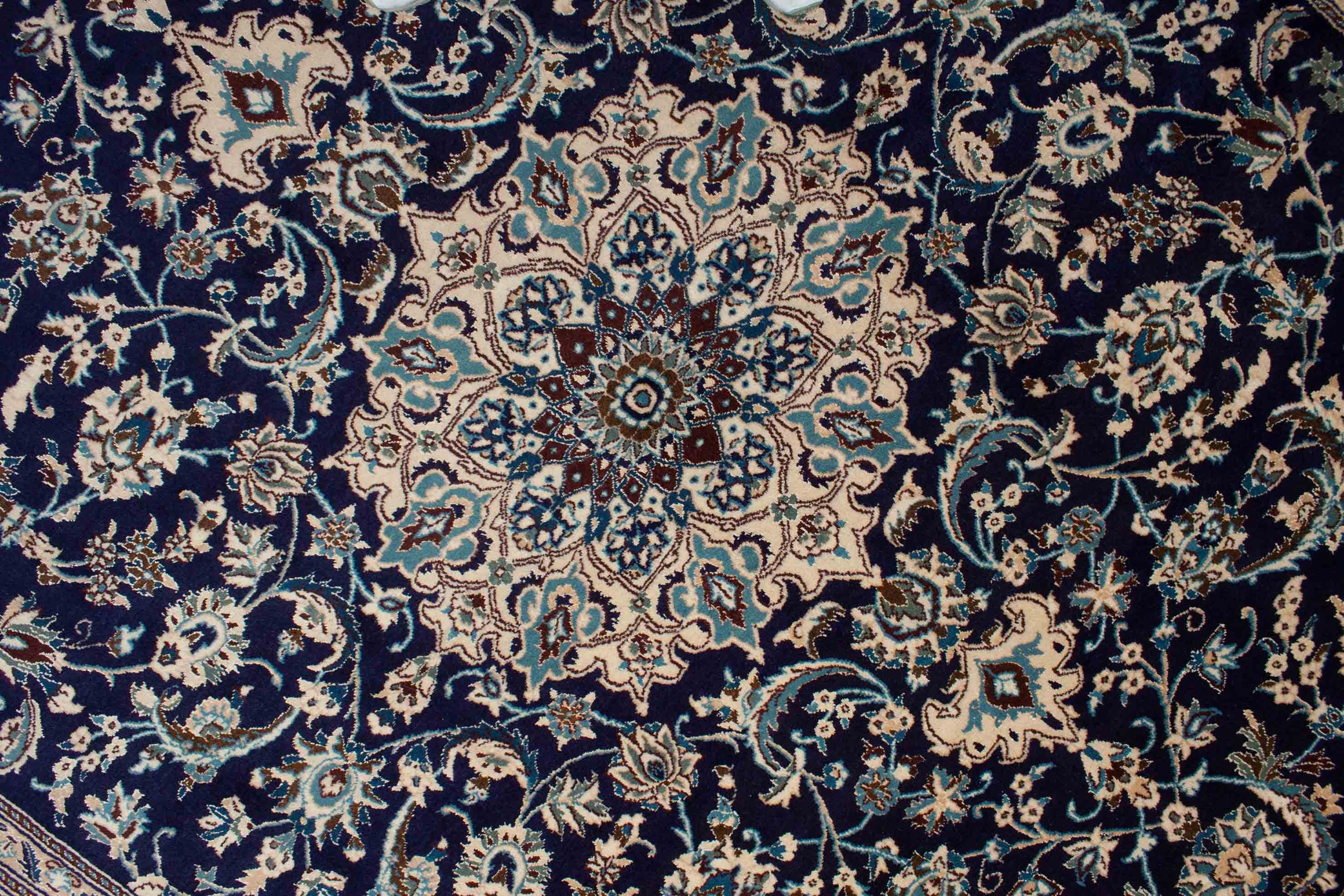
The lush floral motifs of this Kaschmar are elegant and full of variety. The graceful vegetal symbols, depicting blossoms, leaves and branches, are artfully intertwined.
In the middle of the central field of this Kaschmar lies the symmetrical centre, also known as the medallion. The design of the field is subordinate to the medallion, giving the impression that the medallion is floating on the field.
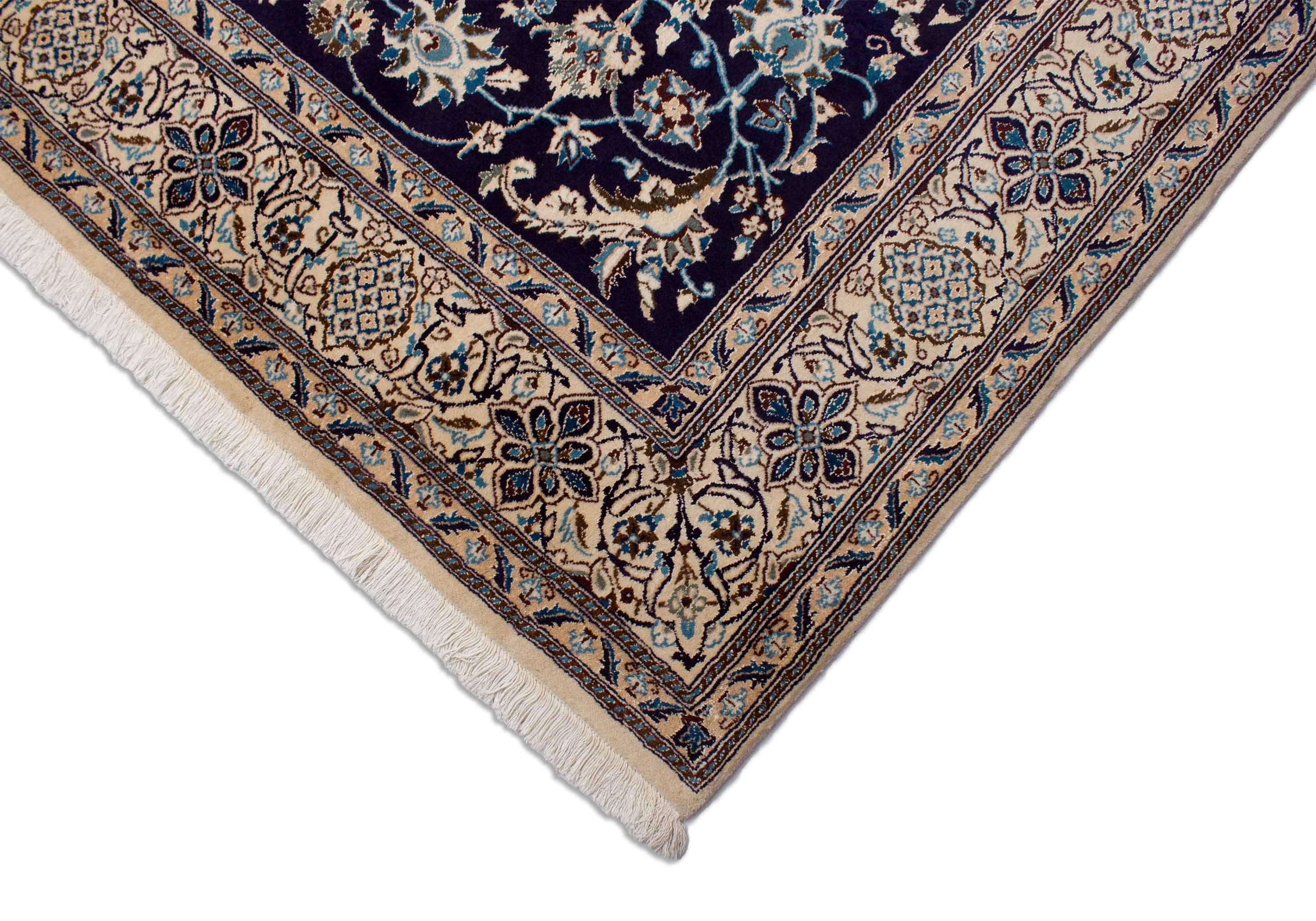
The ornate border forms a wonderful contrast with the centre and shapes the transition at the edge of the rug.
The background of this Kaschmar is dark blue. The border is worked in beige and dark blue. In the beige centre, dark brown and light blue are combined.
Material
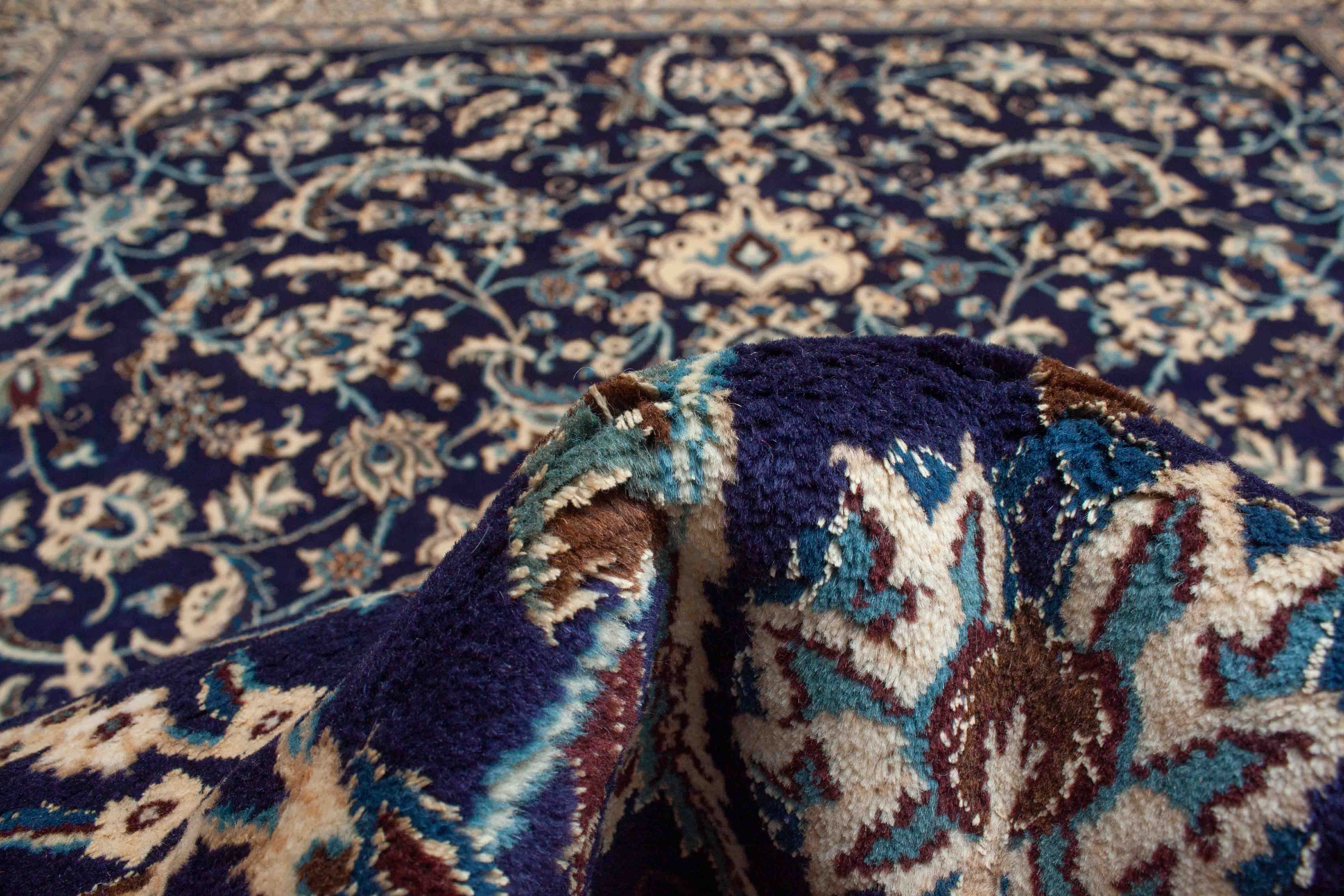
The pile of this Kaschmar is made from a hard-wearing blend of wool and viscose. Viscose, also known as acetate silk or rayon, is generally obtained from cellulose, a natural product, and therefore from the raw material wood. In India the cellulose pulp is obtained from bamboo. In an elaborate process the pulpy cellulose is drawn into a continuous textile yarn. That is why viscose is also referred to as continuous filament yarn. Because of the silky sheen of the yarn, viscose obtained from bamboo is also called "Bamboo Silk". The colloquial term "artificial silk" is not permitted under the German Textile Labelling Act (TKG). The weft and warp threads of this Kaschmar are made of cotton. This versatile material is tear-resistant and elastic, which makes it particularly well suited to a hard-wearing foundation weave.
A note on the photos
Child labour? No thanks.
Child labour? No thanks. Children belong in school, not at a knotting frame or a loom. For us it therefore goes without saying that we only offer rugs made under fair conditions and without child labour.
We attach particular importance to humane working conditions and tolerate no child labour at any of our producers. Thank you for helping us to ensure fair conditions.
That is why we support the initiative Care & Fair against child labour in the rug trade.

Choose options
|
|
1-3 Werktage Lieferzeit (deutschlandweit) |
|
|
14 Tage Probelegen |
|
|
Kostenlose Lieferung & Retoure innerhalb der EU |