
Rug Glossary
Kette, Lah, Boteh or stripe: In the world of hand-knotted rugs, you will encounter many terms. Here we explain the most important ones briefly and clearly. You can find more detailed information in our guide and in the frequently asked questions.
We also explain the regions of origin, weaving areas, and rug types after which our rugs are named – from Abadeh to Ziegler. At the very bottom, you will also find our own design lines.
A · B · C · D · E · G · H · I · J · K · L · M · N · O · P · R · S · T · U · V · W · Y · Z · Design lines
A
Abadeh
Abadeh rugs are hand-knotted in the Persian knot in the small town of Abadeh or the surrounding villages. Abadeh is located between Isfahan and Shiraz. The typical color scheme of Abadeh rugs is brick red.
Afghan
Rugs made in Afghanistan – so-called Afghan rugs or Afghans – are unmistakable. In the cultural melting pot of Afghanistan, weavers from Baluch, Turkmen, Kazakh, and Uzbek tribes met, bringing influences from their countries of origin. During the 19th century, Turkmen tribes settled villages in Afghanistan, which led to the influence of Turkmen weaving styles in the region. The designs of the different tribal groups, including Ersari, Salor, Tekke, and Yomut, are diverse. However, the use of elephant foot patterns (so-called guls), vibrant red tones, decorative borders, and decorative endpieces ensures stylistic continuity.
Tribal weavers used natural dyes to create an enormous variety of red tones, ranging from deep aubergine brown to warm burnt orange. These colors are traditionally combined with clear blue and ivory accents. While the tribes of Afghanistan frequently use guls and serrated stars, the borders and endpieces are the areas in which weavers traditionally incorporate a little of themselves and their culture into the design. The gul pattern is used as a medallion or for repeating patterns, set against a monochrome field, or combined into a tile pattern.
Due to the political situation in Afghanistan, very few Afghan rugs are still produced today. To the collection
Afshari
The Afshar (also Afschar) or Afsharen were an important Oghus tribe. The “i” in the designation Afshari corresponds to our preposition “from”: Afshari therefore means rug of the Afshar. Originally, the Persian Afshar lived in northwestern Iran. Part of the tribe was forcibly resettled to southeastern Iran near the city of Kerman on the Silk Road. Here, rug weaving became an important source of income. The rugs of the Afshar are also partly traded as Sirjan rugs.
Afshari rugs have red and blue tones and mostly geometric patterns. The most widespread pattern has a field in the center containing one or more square rosettes. It is believed that the central field represents a stretched animal skin.
See also: Sirjan
All-Over Design
Rugs with a continuously repeating motif are also referred to as all-over rugs or all-over designs. The counterpart is a pattern arranged around a central medallion. More in the patterns guide.
Old
We consider rugs that are 40 to 99 years old to be old. See the old and antique rugs.
Anatolian Rugs
In Anatolia (Asia Minor) and the adjacent areas, rugs are traditionally hand-knotted for personal use, local trade, and partly for export. Anatolian rugs are an important part of the cultural heritage of modern-day Turkey. Many influences have shaped their design: Byzantine ornaments as well as the patterns of the Turkic peoples who immigrated from Central Asia, plus patterns from Greek, Armenian, Caucasian, and Kurdish tribes, as well as Islamic art. The political and ethnic history and diversity of Asia Minor can thus be read from the patterns. To the collection
See also: Hereke, Milas, Ladik, Kayseri, Oushak
Antique
Rugs that are at least 100 years old are considered antique and are collector's items. See the old and antique rugs.
Ardebil
Ardebil is the place of origin and burial site of the Safavid dynasty (1501 to 1722), which was important for Persia and the art of rug weaving. The now rather insignificant provincial town became famous through the so-called Ardebil rug from the Mosque of Ardebil, which was knotted in the 16th century and purchased in the second half of the 19th century on behalf of the Ziegler company by the German Oscar Strauß.
Traditional Ardebil rugs are predominantly geometric in design and Caucasian-influenced, but can be easily distinguished from Caucasian rugs: The pile wool is less shiny and drier, and most Ardebils have a cotton foundation (weft and warp). Floral patterns occur only in exceptional cases and are then mostly geometrized.
Armenibaft
Armenian rugs from the vicinity of Isfahan are referred to as Armenibaft (or Armanibaf). The Armenian colony located in the vicinity of Isfahan, centered in Djulfa, predominantly knottess rugs at home. Djulfa has a Christian church and a small museum dedicated to Armenian culture. Armenibaft rugs are typically adorned with a refined Bakhtiari pattern. The strikingly rich Turkish knot is the sure identifying feature. They are knotted from high-quality, shiny wool and are very rare.
See also: Lilian
Aubusson, Tapisserie & Needlepoint
Flat wool rugs without pile, woven like a wall hanging (Aubusson, Tapisserie) or embroidered by hand (Needlepoint). Typical are floral patterns, medallions, and pastel colors based on French models. To the collection
Aubusson is a French commune in the Nouvelle-Aquitaine region in the Creuse department and is world-famous for its rug and tapisserie manufactories. Rugs in the style of the Savonnerie manufactory were produced in Aubusson, although often of slightly lower quality and knot density. However, some weavers in Aubusson had such a good reputation that they received commissions from the French royal court.
Very few people think of France when it comes to the classic countries of origin for rugs. In fact, rugs have been made there for centuries: Gobelins have been produced since 1607, and in 1627 the cloth manufacturers in Aubusson received the privilege from Louis XIII to produce rugs with the seal “façon de Turquie”.
Tapisserie is the French word for rug. In Germany, strictly speaking, tapisserie rugs refer only to hand-woven or hand-knotted textiles with a motif, which is why they are colloquially also called wall rugs or picture rugs, or, after the most famous manufactory, Gobelins. They are to be distinguished from Aubusson and Savonnerie rugs – a distinction that is frequently made incorrectly.
Needlepoint is an English term for embroidery that has become established in Germany as a designation for embroidered rugs. There are many embroidery techniques. Kelim stitch and stem stitch create patterns that look knitted: the kelim stitch has horizontal ribs, while the stem stitch has vertical ribs. Gobelin embroidery imitates pictorial weaving: instead of forming color fields with weft threads, the thread crosses of the carrier material are embroidered diagonally with colored embroidery thread. Needle painting is used when color transitions are created like in painted pictures; for this, flat stitches are placed densely and overlapping, and nuanced in fine color shades.
The needlepoint rugs at Zomorrodi are embroidered in China; their pattern is inspired by the floral ornaments of classic French Aubusson and Gobelin rugs.
See also: Savonnerie, Gobelin, Tapis
Azeri
The Azerbaijanis are also referred to as Azeris or Azeris in Europe. Their settlement area extends from northwestern Iran to the Republic of Azerbaijan. In the past, the designation Tatar was also common.
In the 1950s, George Jevremovic, an American of Yugoslav descent, helped traditional Azeri rugs gain new attention in Europe and America. He marketed them especially in America and had new Azeri rugs made according to his own specifications. The models were Azerbaijani rugs, such as those knotted at the beginning of the 20th century. High-quality materials, careful knotting, and natural dyes were and are the success factors.
For the knotting templates, the historical patterns are transferred to millimeter paper. The knotters should not create flat imitations, which is why not every detail was adopted, and in some areas no pattern was provided at all. These rugs are also known as Folklife rugs and stand for hand-spun wool, natural dyes, knotting quality, and the revival of an old rug culture with historical patterns.
B
Bakhtiari
Hand-knotted rugs with characteristic field patterns. They are also knotted today in the same traditional technique as Ziegler and Mamlouk. To the collection
The Bakhtiar (also Bachtiar) are an old, widely branched people who live in southwestern Iran. The collective designation for their rugs is Bakhtiar or Bakhtiari, where the “i” corresponds to our preposition “from”. Bakhtiari rugs include numerous sub-proveniences with different pattern types. Despite their extensive palette, they resemble each other in their color compositions, their craftsmanship, and their style, which is always floral.
Natural dyes are preferred for Bakhtiari rugs, which, despite their intensity, appear pleasant and develop a beautiful patina over time. Brown is frequently used for the outlines, while red, bottle green, yellow, and white are used as brighteners.
Bakhtiari field-pattern rugs take up the classic pattern elements but arrange them in fields that appear to float on a contrasting, monochrome background. They are not knotted in Iran, but in Pakistan, like the classic models with natural dyes and hand-spun wool.
See also: Neo Bakhtiari
Belutsch
Belutsch is a rug provenance between Afghanistan, Iran, and Pakistan. Belutsch rugs (also Beloutch, Beluch, Baluch, Belutch, Balouch, Baloutche, or Balúchi) are made by semi-nomads or nomads. Originally, they were knotted exclusively by the Baluch, but today some other tribes also knot Belutsch rugs. The patterns tend to be geometric, and the color palette is in red and brown tones. Mostly, bridges and smaller rugs are produced, because these are also used by the nomads themselves and are easier to transport.
Beni Ourain
Particularly popular Moroccan Berber rugs that were traditionally handmade by Berber tribes in the Atlas Mountains. To the Beni Berber rugs
Beni Ourain is a Berber tribe from the Atlas Mountains. The weaving began with this North African tribe, which settled in Morocco, as early as the 7th century. As semi-nomads, the Beni Ourain are primarily shepherds who in the past kept their livestock high in the mountains and moved from one pasture to the next.
For centuries, the women of the tribe have knotted wool rugs characterized by tribal ritual and seemingly naive symbolism. The tribe still lives in the Atlas Mountains today, where the old knotting techniques are passed down from mother to daughter. The traditional pattern of the Beni-Ourain rugs consists mainly of geometric black or brown lines that form abstract and diamond-shaped forms on a cream-colored or whitish background.
See also: Berber rug
Berber rug
The Berber are a nomadic people who have lived in North Africa for several millennia. Moroccan Berber rugs are hand-knotted from natural sheep's wool and are unusually soft due to their long pile. They are knotted without an industrial template; the typical basic patterns have been passed down from family to family for generations. To the collection
Moroccan Berber tribes were generally semi-nomads who, as shepherds, kept their livestock high in the mountains and moved with their herds from one pasture to the next. The old knotting techniques have been preserved in the Berber tribes for centuries and are passed down from mother to daughter.
Moroccan Berber rugs were traditionally knotted for domestic use. The predominantly female knotters played freely and spontaneously – without pattern templates – with shapes and colors, following their personal ideas. The traditional pattern therefore consists of geometric, partly colorful, abstract shapes and lines on a monochrome background. Architects and designers such as Alvar Aalto, Le Corbusier, Charles and Ray Eames, Frank Lloyd Wright, Marcel Breuer, and Arne Jacobsen appreciated the naive and clear design of the high-pile Moroccan nomad rugs. The powerful, artistic expression makes Berber rugs unique – apart from their fluffy texture.
See also: Beni Ourain, Boucherouite, Beni Berber
Bidgene
The rug provenance Bidgene is located in the province of South Azerbaijan in northwestern Iran. Rugs from Bidgene resemble Sarough rugs and are frequently confused with them. Differences: Bidgene rugs tend to have a stiffer, rather board-like feel and a darker color scheme. In addition to the dark, subdued color palette, they are distinguished by the four-way symmetrical arrangement of the geometrized, floral pattern.
See also: Sarough
Bidjar
Bidjar is located in the province of Kermanshah in northwestern Iran. In Kurdish Bidjar, a particularly thick, hard weft yarn is used. This creates a board-hard, particularly durable rug. Younger Bidjar rugs often feature the Herati pattern. To the collection
The full name of the city is “Bidjar Garrus”, which is why some Bidjar rugs are also traded as Bidjar Garrus. Bidjar rugs are among the sturdiest and highest-quality Oriental rugs; the majority of the population in Bidjar are Kurds. The Herati pattern is also called the fish pattern.
Boteh
A curved, almond-shaped motif that stands upright and is recognizable by its bent tip. The most common Oriental rug pattern besides the Herati pattern, especially in Caucasian and Persian rugs. In Europe, this gave rise to the paisley pattern.
In the rug, the Mir-i-Boteh pattern forms a repeating motif, depicted either naturalistically or abstractly. The shape has often been interpreted as a flame – associated with the fire worship of the Persians, followers of Zoroaster's teachings – or as a bent palm leaf. The pattern was probably inspired by cypress trees. It is knotted with particular preference in Sarough, for example (Sarough Mir).
See also: Sarough
Boucherouite
Boucherouite rugs are made from recycled clothing, blankets, yarns, old rugs, and other textiles. The name is derived from the Arabic word “Shraouite”, which refers to the recycled fabric scraps.
The tradition is the result of changes in the countryside in Morocco: nomadic culture has given way to settled agriculture and other forms of livelihood. As a result, shorn wool – the material of the Beni-Ourain and Azilal rugs – has become rarer and comparatively expensive. Therefore, Berber families began to knot old clothing into Boucherouite rugs. The improvised material creates colorful, unique pieces. Once a rug of the common people, it is now a design classic worldwide.
See also: Berber rug
Bukhara
Bukhara (also Bochara) is an oasis city in Uzbekistan on the former Silk Road. Although hardly any rugs were knotted in Bukhara itself, the city is the namesake for many Oriental rugs because they were exported from there to the West. They were knotted by various Turkmen tribes such as the Tekke and Yomoudh, mainly in the Caucasus, Persia, and Afghanistan.
Bukhara rugs are among the finest and most popular Central Asian rugs. That is why the pattern was also copied in many countries, especially in Pakistan. These rugs are traded as Pakistan-Bukhara.
See also: Tekke, Yomoudh, Turkmen rugs
C
CARE & FAIR
The industry-wide aid campaign "CARE & FAIR – Carpet Trade Against Child Labor" was founded in 1994. Zomorrodi Teppiche is a member. Learn more
Chenar
Chenar (also Chenār) is a small village with just under 300 inhabitants in the Iranian province of Lorestan.
China Carpet
Hand-knotted carpets from China with a few, clearly defined motifs such as dragons, vases, peonies or lotuses on calm color fields, inspired by Ming and Qing dynasty porcelain. Go to the collection
Carpets were probably known in China very early on. The Mongol invasion around 1279, which brought Central Asian carpets with it and used them as tents and saddle covers, stimulated the local production that probably already existed at the time. An exhibition in Saint Louis (USA) in 1903 awakened the interest of the Western world. Soon after, carpets were produced in China solely for export to Europe and North America.
A special case are the so-called American China carpets, which were knotted specifically for the American market from 1900 to 1940. Their colors and patterns are more restrained than those of traditional China carpets and were tailored to the American interior design style of the time. Because only a few pieces reached Europe from the USA, they are particularly rare here.
See also: Khotan, Tibetan Carpet
D
Djosan
Djosan carpets are hand-knotted near the city of Djosan (also Jozan or Josan) in western Iran. Their motifs are inspired by Sarough carpets: delicate vase motifs, climbing flowers or medallions with or without corner motifs. They are also characterized by very strong basic colors in red and blue and their very good quality. Djosan carpets are knotted – like Sarough carpets – with a robust double knot. This, along with the high-quality wool, makes them feel very durable.
See also: Sarough
Duschelmat
Duschelmat carpets belong to the group of Caucasian carpets. Their characteristic features are abstract, geometric tribal patterns in muted ochre tones.
See also: Caucasian Carpets
E
Ersari
Ersari carpets are hand-knotted by members of the Turkmen Ersari tribe. Unlike most other Turkmen tribes, the Ersari have no specific gul or tribal motif. Typical patterns instead feature grids of stylized diamonds, diagonal rows of small motifs, distorted Chinese cloud bands, palms or variations of the Persian Herati pattern.
Ersari carpets are preferably knotted in yellow tones, with the background often in two different shades of blue. Ersari prayer rugs have open prayer niches, where the arch – indicating the direction of Mecca – tapers to a point at the top. With softer wool and somewhat coarser knots, Ersari carpets are often knotted more loosely than other Turkmen carpets.
See also: Turkmen Carpets, Herati
G
Gabbeh and Lori
Hand-knotted nomadic carpets from southern Iran with a high, soft wool pile and deliberately simple patterns: color fields, stripes, small animals or people. Go to the collection
Gabbeh carpets are knotted by nomads living in the Fars province near the city of Shiraz. In Persian, Gabbeh is the name for high-pile carpets that were slept on. Classic Gabbeh have imaginative, naive geometric patterns and are very colorful. Today, modern Gabbeh are mostly available in solid and monochrome designs. Even today, however, stylized motifs from the daily life of the nomads, such as goats, camels, dogs, plants or people, can still be found. Gabbeh carpets usually have natural cream, brown and gray tones, but they are also available in vibrant yellow, red or blue.
Lori carpets are a finer variant of the Gabbeh and were traditionally knotted by the Luren, an ethnic group in southwestern Persia (Loristan). Lori (also Luri) are also referred to as Loribaft; the syllable "baft" means something like "knotted", so Loribaft means Luren knotting.
Traditional Lori have imaginative, colorful geometric patterns. Modern Lori are usually simpler and monochrome, but often still feature stylized motifs from the daily life of the nomads, such as goats, camels, dogs, plants or people.
See also: Kashghuli, Schulibaft, Schlingel
Prayer Niche (Mihrab)
The mihrab or Mihrab pattern depicts the Islamic prayer niche, which in mosques indicates the direction of prayer towards Mecca. Carpets with this pattern are traditionally used for prayer.
Because carpets with a mihrab pattern are used by Muslims for prayer, they are particularly precious. This motif is typical of Ladik, Milas and Hereke carpets.
See also: Ladik, Milas, Hereke
Gharabagh
Gharabagh carpets are hand-knotted in the Karabagh (or Gharabagh) region in Azerbaijan. Typical is the floral motif on a dark background, which is widespread in the Caucasus. However, other geometric patterns are also knotted. Kelims from the region also typically feature this floral motif on a dark background.
See also: Caucasian Carpets
Gharadjeh
Gharadjeh (also Garadje) is located in the province of Azerbaijan. The pattern of Gharadjeh carpets is geometric and highly branched. The field is decorated with an octagonal central medallion on a red background, while the rest is filled with stylized flowers and leaves. The border is always dark blue.
Ghashghai
The Ghashghai are a major Persian nomadic people who have settled in southern Iran in the Fars province for centuries. They consist of seven tribes; the most important for carpet production are the Kashghuli. Old and antique Ghashghai carpets and kelims are highly sought-after collector's items today and are considered the king among Persian nomadic carpets.
A large part of Ghashghai carpets feature the geometric Heibathlou pattern: a diamond-shaped central field with a rather simple medallion that is repeated in the corners. The inner field is filled with an unusually large number of ornaments, from stars, lions and camels to trees, flowers and boteh or paisley symbols, some stylized and some naturalistic. The repeating motifs never completely match and differ in color. The arrangement is rarely symmetrical, and the elements of the borders also change their colors. Small rows of boxes at the ends are typical. The variety arises from the fact that there were no knotting templates and all carpets were knotted from memory.
By now, most Ghashghai have settled down – only then can they also produce large-format carpets. The few clans still living as nomads move twice a year to the summer pastures in the Zagros Mountains and return in autumn to the milder winter quarters in the valley.
See also: Kashghuli, Gabbeh and Lori, Boteh
Ghom
A relatively young provenance in central Iran, about 100 km south of Tehran. Because there was no old knotting tradition there, patterns from other knotting areas were adopted. The silk carpets from Ghom are now among the most famous carpets in the world. Go to the collection
Over time, a distinctive style developed in Ghom. The field is often light-colored and decorated with finely drawn medallions or continuous boteh or vase patterns.
Gobelin
The Gobelin Manufactory (Manufacture nationale des Gobelins) is a traditional tapestry manufactory on the Avenue des Gobelins in the 13th arrondissement of Paris. It was founded in 1607 as a private company, continued as the Royal Tapestry Manufactory from 1667, and has belonged to the French state since 1792. Today it is a museum, workshop, and training center.
The name is derived from the former scarlet dye works of the Gobelin family, who founded the company. Strictly speaking, Gobelins are only the works produced in the Paris manufactory; however, the name is often used as a synonym for high-quality tapestry carpets. Colloquially, Gobelins are also called wall or picture carpets.
See also: Aubusson, Tapisserie & Needlepoint, Savonnerie
Goltogh
Goltogh carpets (also Gholtogh, Goltog, Gholtog, Gholtug) are knotted by settled Kurds. They resemble the Bidjar in quality and construction: The firm, hard feel is created by the special base fabric, the cotton warp is stretched very tightly, and the weft is extremely tightly beaten. They are knotted with the Turkish knot.
Goltogh carpets are usually in dark colors. Almost always, a slender hexagon dominates the inner field, whose points are sometimes broken by floral decorations. The filling motifs – flowers, leaves, and occasionally animals – are highly stylized.
See also: Bidjar
H
Hamadan
Hamadan carpets (also Hamedan) are knotted in the vicinity of the city of Hamadan in northwestern Iran. Hamadan is one of the oldest cities in Persia and is located in a well-irrigated fruit-growing area on the banks of the Qareh at the foot of the Zagros foothills. Carpet knotting has a centuries-old tradition here. Hamadan is a collective name, as farmer and nomadic carpets from many surrounding areas come to market here, such as from Angelas, Musel, Tajabad, or Hosseinabad.
Typical of the carpets from the Hamadan region is that they are knotted single-wefted with the Turkish knot: After each row of knots, a weft thread is inserted. Normally, Persian carpets are knotted two- or three-wefted.
See also: Hosseinabad, Tafresh, Sanjan, Malayer
Hemp Carpet
Hand-knotted hemp carpets have a subtle pattern and natural color nuances and suit any living and interior style. Hemp is a plant that requires little water and no pesticides. Hemp carpets are particularly durable and dirt-resistant. Through a special natural washing, they shine silkily.
Harshang
Also called the crab pattern. It was first used in the Khorasan district in Persia and consists of crab-like palmettes with open claws.
Herati
One of the first carpet patterns: a diamond shape with floral motifs at the corners, surrounded by lanceolate leaves, also partly called Mahi (Persian for fish). It is still knotted today in almost all Persian knotting centers.
Herati is derived from Herat, a city in northwestern Afghanistan. The Herati pattern is a very traditional repeating pattern of hand-knotted carpets. The ensemble consists of several parts: In the middle of an upright rhombus is a flower (according to one common interpretation, a daisy), which is entwined by four acanthus leaves. At the upper and lower points are stylized lotus flowers – a hint at a connection to China. The side points end in peonies; this flower, also called the peony rose, is considered the queen of flowers in China and reached the West via the Silk Road.
All four sides are flanked by crescent-shaped, lanceolate leaves, which are also interpreted as fish (Persian "Mahi"). Hence comes the Persian designation Mahi-to-hos, which means "Fish in the pond" in German.
See also: Bidjar, Hosseinabad, Rudbar
Hereke
Very valuable silk carpets come from the Turkish city of Hereke. The tradition was promoted by Sultan Abd-ul-Medjid (reign 1839–1861), who had the court knotting workshops moved from Cairo to Hereke in 1844. Hand-knotted Hereke silk carpets belong to the finest carpets in the world and are knotted with up to 6 million knots per square meter. Due to the knotting technique, the pattern is just as clearly visible on the back as on the front.
Typical motifs are flowers, branches and leaves, birds, the tree of life and the mihrab pattern, a prayer niche depicted together with oil lamps. In addition to traditional Ottoman patterns, more modern designs are also knotted today. Typical colors are a deep dark blue, a radiant red, a vibrant green, a bright yellow and various natural tones.
See also: Prayer Niche (Mihrab)
Heriz
Heriz (also Heris) is an important place of origin for hand-knotted carpets in the far west of Iran on the border with Azerbaijan. Heriz carpets are famous for their geometricized design. Typical is the shiny wool with a fantastic color palette.
High Pile
Carpets with a pile height of more than 15 millimeters. They are particularly soft.
Hosseinabad
Hosseinabad (also Hossenabad) is a city in northwestern Iran. However, Hosseinabad carpets – unlike almost all other Persian carpets – are not knotted in the eponymous place, but in the Tuserkan area. They belong to the Hamadan carpet family and are very popular because of their durable material and relatively affordable price. The pattern resembles the Herati pattern; often a diamond-shaped medallion interrupts the continuous pattern. The basic color of the field is almost always a deep red.
I
Ikat
Ikat is a weaving technique in which the yarn is dyed in sections before processing. For this, the thread is wound around a drum and dyed across the warp direction with different colors or using the batik technique. This creates geometric patterns and structures in the fabric that always appear slightly irregular.
See also: Neo Ikat
Indian Oriental Carpet
Indian Oriental carpets feature patterns inspired by classic Persian carpet patterns, but are knotted in India. The exact beginning of Indian carpet production is unknown. Presumably, the first carpets emerged with the cultural rise of the Mughal dynasty in the mid-16th century. With the decline of the Mughals in the mid-19th century, production fell into crisis: European companies, whose goal was export to the West, replaced the court manufactories, and a strong standardization began.
Today, the designs can hardly be attributed to individual regions anymore. The workshops have specialized in European and traditional Iranian designs that are adapted to Western taste. In terms of quality, carpets from India benefit from the long craft tradition and the high quality of Indian materials.
See also: Kashmir Carpet
Isfahan
The city of Isfahan belongs to the architectural gems of the Islamic world. It owes its artistic tradition and historic cityscape to the Safavid dynasty and especially Shah Abbas. Typical of Isfahan carpets are floral motifs, and four- or longitudinally symmetrical designs with a medallion in the center, surrounded by arabesques, flowers or birds, are widespread. The basic color is usually classic red, while a radiant blue and a light beige are also typical; with usually more than 15 color shades, the Isfahan is exceptionally colorful. The borders are often blue-green and decorated with flower vines and palmettes.
The fineness of the knotting is indicated in Iran by the "cheft": fine, mostly blue vertical lines at the lower weft edges. The closer the lines, the finer the knotting. Many Isfahan carpets feature a subtly knotted signature in Persian script at the lower edge, with the manufacturer's name, the place of origin Isfahan, and often the national identifier – either the word Iran or the Iranian flag in green, white and red.
Carpets from the Seirafian manufactory are particularly popular. Knotting master Haj Agha Reza Seirafian (1881–1975) was a private banker in Isfahan before turning to carpet production. The Seirafian family still produces carpets according to his templates and designs today.
J
Jajim
Jajim kelims are somewhat thinner than regular kelims and are therefore also used as a bedspread or throw.
See also: Kelim
Japanese Kelim
Japanese kelims are handwoven in Japan and have so far been used exclusively as wall carpets. They are extremely rare and have collector's value.
See also: Kelim
Josheghan
Josheghan carpets have been knotted for centuries in the Persian village of Joshaghan (also Joshigan, Joshegan-e-Qali, Djaushegen). It is located in northern Central Iran, north of Isfahan, and was an important market center due to its location on the trade route from Kashan to Isfahan. When Tehran became the capital in 1788, the road from Tehran to Isfahan gained importance; it passes through nearby Meymeh, which replaced Joshaghan as a trade center.
The design has remained almost unchanged for centuries and is easily recognizable: usually a diamond-shaped central medallion on a deep red field, filled with geometrically shaped floral motifs that can resemble snowflakes or pebbles. Four-petaled flowers are often found in the medallion.
See also: Meymeh
Jute Rug
Jute rugs are handwoven from relatively coarse jute yarns dyed with natural dyes; those from Zomorrodi come from India. Their natural, understated appearance suits both modern and classically furnished spaces. The fringes are formed from the warp threads. To the collection
K
Kars
Kars rugs are knotted by Armenians living around the city of Kars. The city, home to just under 90,000 inhabitants, is located in northeastern Anatolia at an altitude of 1,768 m, about 45 km west of the border with Armenia and 65 km south of the Turkish-Georgian border.
Kashmar
The city of Kashmar is located in eastern Persia in the province of Khorasan and is the capital of the administrative district of the same name. It was originally called Turschis and was renamed under Shah Reza, which is why Kashmar rugs sometimes also appear on the market under the old name Turschis.
Until just over twenty years ago, the Herati pattern was predominantly knotted here. Today, the Sirchaki pattern predominates, which usually depicts antique finds such as vases, weapons, jugs, and bowls on a blue or beige background. The arrangement is almost exclusively four-fold symmetrical with a central medallion, framed by a pronounced main border; some medallions show landscapes.
More recently, Kashmar rugs with all-over patterns and rugs with the Nain pattern in beige-blue have also been knotted in Kashmar. These Kashmar Nains are recognizable by their high pile. Kashmar rugs have a fairly coarse knot density, appear somewhat coarse-grained, and the pile is relatively high.
See also: Nain
Kashmir Rug
The mountainous country of Kashmir in the Himalayas is divided: one-third belongs to Pakistan as a province, while two-thirds form the Indian union territory of Jammu and Kashmir. Hand-knotted Kashmir rugs come exclusively from the Indian part and are knotted predominantly in the capital, Srinagar, and the surrounding area. Kashmir's silk rugs are famous and are usually made on a cotton foundation.
The colors are rather subdued, and the patterns are influenced by traditional Persian designs. Once, the Mughal emperors (1526–1857) brought Persian knotters to their court, which is why it is referred to as the Indo-Persian style. According to another legend, the Sultan of Kashmir had to send his son as a hostage to Timur Lenk in Samarkand in 1398; the prince learned the art of knotting there and introduced it to Kashmir with knotters from Samarkand upon his return.
See also: Indian Oriental Rug
Kashghuli
The Kashghuli (also spelled Kashguli, Kashguli, Qashguli) are the most important of the seven Ghashghai tribes for rug production. Their hand-knotted rugs enjoy an excellent reputation in Europe as well. They are usually high-piled and knotted with the Turkish knot using the robust wool of fat-tailed sheep.
The now settled Ghashghai are known today as the main producers of Persian Gabbeh rugs. The demand for traditional patterns has led, in particular, to the Kashghuli once again knotting their tribal patterns, adapted with contemporary design ideas and a greater variety of colors.
See also: Ghashghai, Gabbeh and Lori
Caucasian Rugs
Rugs have been made in the Caucasus since the end of the 18th century. They are characterized by abstract, geometric tribal patterns in primary colors; the geometric and, more rarely, floral motifs are depicted in contrasting, intense colors. In the 19th century, a considerable portion of the rugs, which were predominantly produced in villages, was exported to the West under Russian control. Among the most important rugs from the Caucasus are the Kazak, Bukhara, and Shirvan.
See also: Kazak, Shirvan, Dust Mat, Gharabagh, Talysh
Kayseri
Kayseri (Latin: Caesarea, in honor of the Roman Emperor Tiberius) is the capital of the province of the same name in Cappadocia, Turkey. Kayseri rugs (also spelled Kaiseri) are usually made of pure silk and are very valuable and decorative. They are typically knotted in smaller sizes and used as wall or prayer rugs.
Kazak
Rugs based on the Caucasian style with geometric patterns. At Zomorrodi, in the same manner as Ziegler: hand-knotted from hand-spun wool with plant dyes. To the collection
Characteristic of Caucasian rugs such as the Kazak (also Kasak) are abstract, geometric tribal patterns in contrasting primary colors. Today, Kazak rugs are also hand-knotted in Pakistan using traditional methods with hand-spun wool and natural dyes.
See also: Caucasian Rugs, Oxiana
Kilim
The word derives from the Turkish "Kilim," but its origin is Persian, specifically from "Gelim," which means a flat textile fabric. It refers to very flat-woven, handmade rugs. The weft thread forms the pattern on both sides, which is why most kilims are usable on both sides. To the collection
Bright colors and simple, geometric patterns – that is why kilims are loved all over the world. Kilims (also Kilim, Qilim) were traditionally made only for personal use. Nomads and farmers used and still use them as rugs on the floor, but also as tent or wall hangings, blankets, cushions, bags, or saddlebags. Because kilims were constant companions in everyday life, the patterns – even if they may seem naive – always carry a personal message and have a meaning for the weavers and their families.
For each new color, a new thread is used in each row, and the thread ends are woven in.
In Europe, kilims from Turkey, the Caucasus, Iran, Pakistan, Afghanistan, and the Turkmen cultural region are particularly well-known and popular. In fact, in all the countries where rugs are knotted, rugs are also handwoven – for example by the Ghashghai, by Kurds, in Gharabagh, Senneh, Mazandaran, Morocco, and even Japan.
See also: Soumak, Khorjin, Jajim, Mazandaran, Senneh, Patchwork Kilim
Kilim Cushions and Rug Cushions
Cushion covers whose front consists of fragments of handwoven kilims or hand-knotted rugs. To the collection
Kerman
The city of Kerman (also Kirman) is located in southeastern Persia at an altitude of approx. 2,000 meters on the old caravan routes and has a centuries-old tradition in craftsmanship and trade; it is mentioned as early as in Marco Polo's travelogue "Il Milione". Characteristic of Kerman rugs are fine patterns, swirling lines, and soft color gradations. The classic patterns of the 19th century are often figurative: hunting scenes and animals, as well as mythological figures or historical persons. The wide color palette is enriched by a variety of shades of red, which were traditionally obtained from cochineal.
Rugs from the village of Lavar (also Levar) near Kerman bear the typical Kerman pattern.
Keshan
Central Persian city (also Kashan or Keschan) between the Zagros Mountains and the Persian desert regions. The pile of Keshan rugs is typically knotted from extremely soft wool and is therefore particularly dense. To the collection
Due to its climate and the caravans, the city – at least until the Safavids moved their seat of government to Isfahan – was a flourishing metropolis, known for its fabric and rug production, and is still shaped by the splendor of this era to this day. Keshan rugs are made in the ancient tradition, traditionally in the homes of the knotters.
Warp, Weft, and Fringes
Technically speaking, the fringes of a rug are nothing other than the warp threads that protrude from the crosswise threads. They therefore provide information about the warp material used. In a kilim, the pattern is created by the colored weft threads that are woven into the warp threads.
Khorjin
In Khorjin kilims, some areas – as is common with kilims – are handwoven, while others are hand-knotted. The two techniques create relief-like, slightly raised sections. Khorjin kilims therefore – unlike other kilims – do not have the same pattern on both sides and are not usable on both sides. There are now only a few knotters who still master this technique, also called Nimbaft (Persian for "half-knotted"). Typical colors are blue and red.
Khotan
Khotan is located in the northwestern Chinese province of Xinjiang. There, rugs with Turkmen and Chinese-style colors and patterns are knotted by hand. Western buyers first encountered these rugs in Samarkand, which is why older Khotan rugs are often also called Samarkand rugs.
See also: China Rug
Knot Density
How many knots are in one square meter. In addition to the material, it determines the quality of a hand-knotted rug. At Zomorrodi, the knotting ranges from around 160,000 to 360,000 and more knots per square meter. You can see the fineness in the details: flowing vines instead of stepped lines, fine flowers in the borders. Everything about knotting
Koliai
Koliai rugs (also Koliajy, Koliahi, Koliay) are rustic, hand-knotted rugs from the Kurds of western Persia. They are relatively high-piled, solid, and voluminous, knotted with the Turkish knot, partly on a wool foundation. Like all Kurdish rugs, they take up classic patterns, but interpret them in their own way and usually in rather dark colors.
See also: Kordi
Kordi
Kordi (also Kord or Kurdi) is a collective term for rugs from Iran that are hand-knotted by Kurds; Koliai rugs are also Kordi in this sense. Kordi rugs usually come from the province of Khorasan, more rarely from the Turkmen-Afghan region.
Kurds use all classic provenances, but do not slavishly copy the traditional patterns, instead interpreting them in their own way. In particular, the color scheme often deviates strongly from the originals. Thus, you can find the most diverse designs, usually in rather dark colors. Kilims are also woven by Kurds.
See also: Koliai, Bidjar, Goltogh, Senneh
Kuba Shirvan
Kuba-Shirvan rugs (also Kuba Shirvan) are knotted in the Azerbaijani city of Kuba (also Quba) and the surrounding area in eastern Caucasus in the Shirvan region. The name therefore has nothing to do with the country of Cuba. Characteristic is the imaginative geometric pattern with star, cross, or almond motifs. The field is framed by a wide border: A wide main stripe is enclosed by two to six side stripes. Typical is the Shirvan border, also called the Kufic border due to its resemblance to Kufic script, made of rectangles formed from double hooks. Often there are blue, but also red and ivory-colored knotting.
The Perepedil rugs with their imaginative geometric pattern and wide, multi-striped border also belong to the group of Kuba rugs.
See also: Shirvan
Short Pile
Rugs with a pile height of less than 15 millimeters. They are robust and easy to clean.
L
Ladik
Ladik rugs (also Lâdik) are hand-knotted in the Turkish village of the same name. In the 18th century, prayer rugs with Mihrab patterns were produced here above all. Characteristic of the prayer niche of the Ladik rugs is a roof with two points at the upper end. Today, rugs with traditional Persian floral motifs are predominantly knotted in Ladik.
See also: Prayer Niche (Mihrab)
Lah
Quality specification for Nain rugs, Persian for "layer". Lah describes the number of threads from which the warp is twisted. The more threads, the thicker the warp and the knots, and the lower the knot density.
Lankaran
Lənkəran (German also Länkäran, Russian Lenkoran, in Talysh Lankon) is a city in southern Azerbaijan on the Caspian Sea at the border with Iran. Lenkoran rugs are hand-knotted there and in the surrounding area in eastern Caucasus, i.e., in the Shirvan region. Characteristic are the imaginative geometric patterns and egg-shaped medallions with two protruding hooks at the upper or lower tip. The shape of the medallions is derived from the dragon motif, which is typical for Caucasian rugs.
See also: Shirvan
Runner
A rug that is significantly longer than wide, typically around 80 × 300 cm. It accompanies a walking route: the hallway, the kitchen line, the passage between the bed and the closet. To the runners
Tree of Life
A widely used motif that represents eternal life. The tree grows from the base of the field and symbolizes the connection between heaven, earth, and the underworld.
Lilian
Lilian rugs come – like the Hamadan rugs – from northwestern Iran, but their knotters are of Armenian origin; therefore, in Iran they are also called Armenibaft-Lilian. Lilians of recent decades are predominantly knotted relatively coarsely, but the mostly good pile wool on a cotton foundation still makes them very good, durable rugs.
The most striking feature is the cross-shaped floral medallion, which is surrounded in a four-fold symmetrical field layout by large floral and leaf vines. The color scheme is usually a strong red with dark blue details. More rarely, there are Lilians with an all-over Herati motif.
See also: Armenibaft, Hamadan
M
Malayer
Malayer is the second largest city in the province of Hamadan in western Iran and is known for its rug factories. It lies between Hamadan and Khorramabad, 380 km southwest of Tehran, and was founded in 1808 under the name Daulatabad to bring the restless region at the Zagros Mountains under the control of the Persian state. Old and antique rugs of the Malayer type, which were knotted between 1880 and 1930 in the Sarough region, are particularly sought after by collectors.
Mamlouk
Mamlouk- (more rarely Mamluk-) rugs were knotted primarily in Egypt in the 15th century and are today found almost exclusively in museums. The new Mamlouk rugs are a reinterpretation of the classic pattern with numerous geometric shapes. To the collection
See also: Neo Mamlouk
Machine-Made Rugs
The knotting and weaving of rugs is a complex, lengthy process that requires a lot of skill, time, and care. It was not until the 19th century, in the course of the Industrial Revolution, that mechanization began: wool was spun by machine, and automated looms and knotting machines produced quickly and cost-effectively. Today, such machines work with many yarns from yarn spools, and the pattern is set digitally. By hand, production takes – depending on the material, fineness, and size – weeks, months, or even years, which has a considerable impact on the price. In Zomorrodi's range, there are only a few machine-made rugs; they are called "Maschiny" there.
Mazandaran
Mazandaran is located in northern Iran between the sandy beaches of the Caspian Sea and the snow-capped peaks of the Elburz Mountains, an atypical subtropical landscape for Iran and one of the country's most remote mountain regions. For a long time, the region was not considered a place of origin for collectible textiles. All the more surprising it was when, in the mid-1990s, the textile heritage of simple farmers was rediscovered in chests and closets in Hezar-Jerib, a remote mountain region in eastern Mazandaran.
Mazandaran kilims are considered the archetype of minimalist design and have only really become known in professional circles in the last decade. Thanks to their contemporary-looking, simple patterns and harmonious, earthy tones, their following is steadily growing.
See also: Kilim
Medallion
A central motif around which the pattern is arranged symmetrically. It is usually located in the center of the rug, and more rarely, several medallions are arranged one above the other. In rug patterns since about the 16th century.
Mehraban
Mehraban is a small town in northwestern Iran near Tabriz. Rugs from the region are usually very colorful, and the wool, with its high fat content, is of high quality. The patterns are usually inspired by nature and show stylized floral or leaf elements.
Meschad
In eastern Persia lies the Khorasan region ("Land of the Rising Sun") with its capital Meschad (also Maschad, Meschhed, Meshad). Originally, the Timurid capital of Herat in present-day Afghanistan was also part of it. The typical patterns date from the 19th and 20th centuries and consist of small elements that seem to repeat endlessly, sometimes with medallions.
Saber rugs are particularly sought after. Master weaver Saber worked with the Amoghli brothers until around 1940, another very well-known workshop in Meschad, and afterwards produced his extremely fine rugs in his own workshop. Since he produced significantly smaller quantities, his pieces are rare and highly sought after today. Based on a contract with Saber and his family before his death in 1977, Saber rugs are still being woven by Master Bazmi to this day.
See also: Moud
Meschkin
Meschkin Shahr is one of the oldest cities in Iran. It is located about 900 km from Tehran in the northwest of the country in the province of Azerbaijan. The patterns of Meschkin rugs are based on traditional Caucasian patterns.
Meymeh
The village of Meymeh is located in central Iran, about 100 km north of Isfahan. Typical is a pattern of small, symmetrical, stylized orchids around a similarly geometric medallion, the center of which is decorated with a kind of floral cross. The border typically features a stylized Herati pattern. This design is called "Djangali", Persian for "originating from the jungle". Meymeh rugs are woven with the Persian knot.
See also: Josheghan
Milas
Milas rugs come from southwest Turkey; they are named after the city of Milas in the province of Muğla. They have developed since the 16th century from smaller prayer rugs (Turkish: seccade). According to color scheme and pattern, they are divided into classic and baroque Milas rugs.
Classic Milas rugs usually feature a rectangle and a mihrab, a stylized prayer niche, on one of the narrow sides; the inner border is filled with stylized plant patterns. In baroque Milas rugs, the regular border motifs are replaced by irregular, less stylized motifs – an influence of Ottoman Baroque in the early 19th century.
See also: Prayer niche (Mihrab)
Moud
In the past, eastern Iran lived off agriculture and livestock, and rugs were only woven for personal use. It was only when the governor of the provincial capital Meshed sought outstanding rugs for his palace around 1830 that rug production developed there. The famous rug weaver Amini had his high-quality rugs woven in the small village of Moud (also Mood, Moudt, Mud), thus giving the rugs of the region their name. In the neighboring city of Birdjand (also Birdjend), a larger production center developed, which is why Moud rugs are also sold under the name Birdjand.
All Moud rugs share the color scheme of strong blue and red on a beige background. They are woven with the asymmetrical knot. On the back, Moud rugs can be identified by the white-shining warp threads.
N
Nahavand
Nahavand is one of the oldest cities in Iran and is located south of Hamadan and west of Malayer in the northwest of the country. Typical is a stylized floral pattern inspired by nomadic rugs. Usually, highly lustrous wool is used, which makes the pile relatively high, soft, and shiny. A central medallion is often decorated with stylized leaves, flowers, and branches; vases are also a popular motif. Characteristic colors are red, blue, and beige.
Nain
One of the best-known rug provenances in Iran, northwest of Isfahan. The base colors are usually white or beige and blue; typical are floral patterns whose contours are emphasized with silk. The quality is indicated in Lah. To the collection
Nain is one of the best-known rug provenances in Iran. The city is located northwest of Isfahan and has an old weaving tradition: before the Qajar dynasty (1794–1925), the highest quality throws for the nobility were made here, known as abas. When the traditional throw was replaced by the suit under Western influence, the weavers began to weave rugs. Nain rugs are also woven in Tudeshk, not far from Nain.
The rugs from Nain owe their unmistakable patterns and color combinations primarily to Master Hadj Fatollah Habibian Naiini. He limited himself to fewer than ten colors, thus laying the foundation for the color composition that is still popular today: usually white or beige and blue, and increasingly red, green, and yellow. Typical are floral patterns whose contours are emphasized with silk. Due to their simple elegance, Nain rugs also fit perfectly into modern interiors.
Najafabad
Najafabad (Nadjafabad) is located in the central Iranian province of Isfahan, about 30 kilometers west of the art metropolis of the same name. The weaving tradition is strongly influenced by the royal court workshops of Isfahan. Typical are curved floral patterns, fine vines, and almost always a striking central medallion. A rich, warm red dominates the field, often contrasted by deep indigo or light blue tones in the corners and borders; beige and ivory tones complete the picture.
See also: Isfahan
Nakhunak
The production of Nakhunak rugs is unique: through two very different techniques, relief-like, slightly raised sections are created that emphasize the pattern. The higher areas are hand-woven, while the lower ones are crocheted. The classic pattern consists of repeating diamonds, framed by a wide, varied border. The color scheme is traditionally understated with warm, earthy tones.
See also: Khorjin
Natural dyes (Plant dyes)
Many rugs, kilims, and cushions are dyed with natural dyes. If the wool gets damp, they may bleed slightly, and direct sunlight can fade them.
Nepal rug
Rug weaving in Nepal only began in 1959, after the flight of the Dalai Lama and the Tibetans who accompanied him. Under the guidance of the Zurich importer Jo Iten-Maritz, the refugees were instructed from 1966 onwards to weave rugs in the Tibetan tradition. When the designs were adapted to Western taste, production increased significantly. The center is the capital Kathmandu.
Nepal rugs are woven using a special technique: the thread is looped over a rod, creating a row of loops. Once the rod is covered, the loops are cut from above, the pile fans out, and a velvet is created; the knot thus takes the shape of a Persian knot. This fast method is only possible because Nepal-Tibetan rugs are largely unpatterned and solid-colored.
See also: Tibetan rug
O
Oriental rug
A hand-woven rug from the Orient, especially from Persia (Iran), the Caucasus, Turkey, Afghanistan, Pakistan, India, and China. Flat-woven kilims have their own collection at Zomorrodi. To the collection
Oriental rugs from Egypt, Albania, Morocco, Russia, and Turkey
Zomorrodi uses this term for rugs whose patterns are inspired by classic Persian rug patterns – in the case of Albanian Tabriz, for example, by the Tabriz pattern –, but which were woven in Egypt, Albania, Morocco, Russia, or Turkey. Morocco is known in Europe primarily for Berber rugs, but also has a long tradition of weaving classic Oriental rug patterns.
See also: Indian Oriental rug, Tabriz
Oushak
Oushak rugs have been made in Turkey for centuries and are characterized by their distinctive colors and usually large floral patterns. Modern hand-woven Oushak rugs combine traditional craftsmanship with modern design: bright, bold colors and partly abstract patterns, with a vintage look achieved through special dyeing and washing techniques.
Oxiana
The pattern of Oxiana rugs is based on traditional Uzbek patterns; originally, rugs with similar patterns were woven primarily in the region around Samarkand and Oxiana. Today's Oxiana are tailored to contemporary taste: harmonious color compositions in natural dyes, colorful horizontal stripes alternating with imaginatively patterned areas whose geometric compositions resemble a Kazak pattern. Characteristic are also fringes, which are gathered in small bundles and wrapped with multicolored threads. To the collection
P
Paradise garden
A pattern typical of the Safavid era: a stylized representation of a traditional Persian garden with plants, trees, and waterways that divide the garden into four sections.
Patchwork kilim
In patchwork kilims, fragments of finer and coarser wool kilims are sewn together by hand, so that textures and colors alternate. The muted colors blend well everywhere.
Persian rug
An Oriental rug from Iran. This refers to the traditional, fine rugs from Iranian provenances such as Isfahan, Nain, Tabriz, Ghom, Keshan, Mashad, or Sarough. To the collection
Pictogram
Rugs with pictorial motifs instead of abstract patterns, such as hunting scenes, courtly life, or mythical motifs. Finer rugs allow for more detailed depictions.
Provenance
Origin, provenance of a rug. Persian rugs are usually named after their provenance, such as Nain, Tabriz, or Ghom.
R
Restored and unrestored
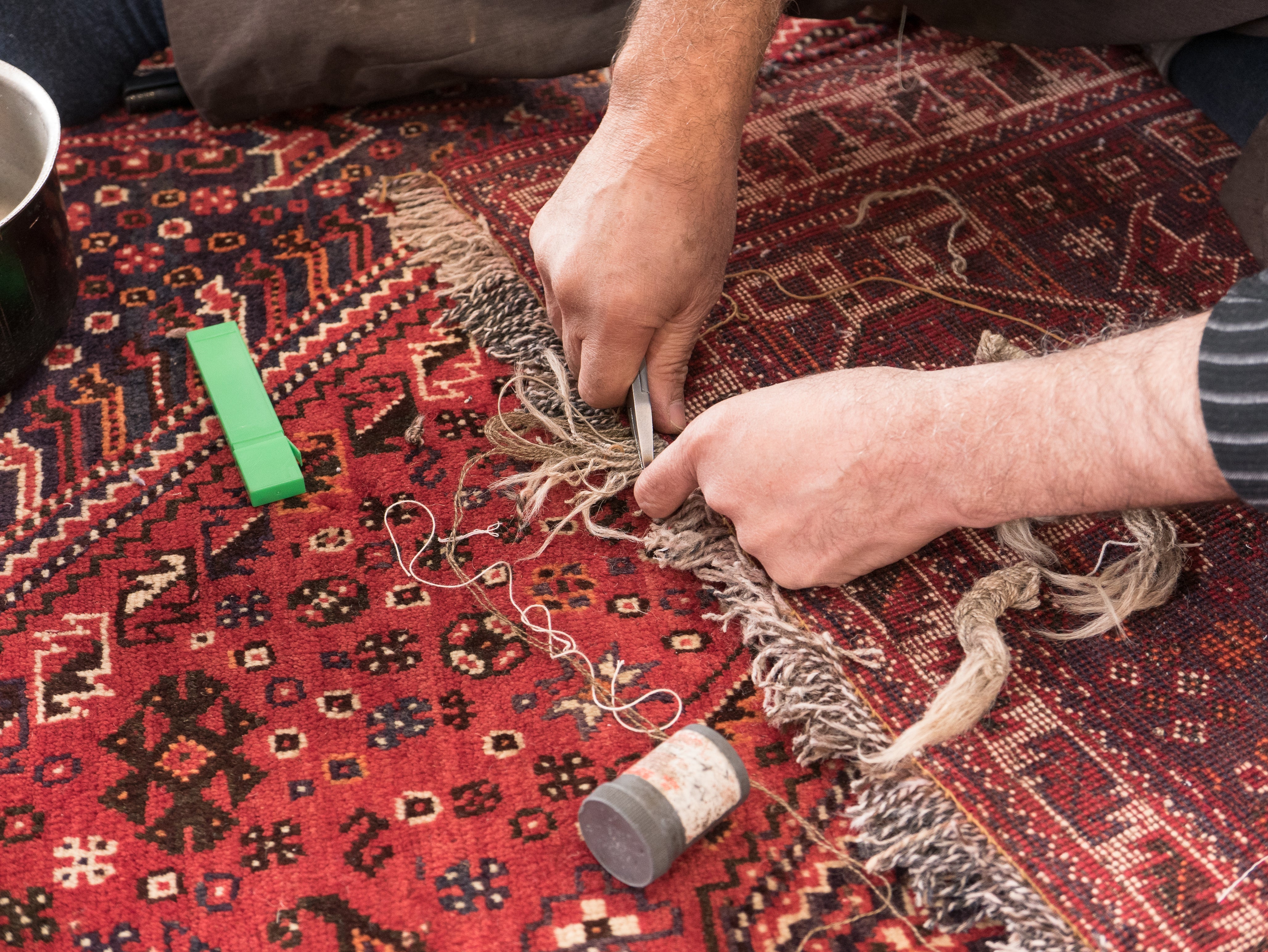
Used rugs are cleaned and sold by Zomorrodi with an honest description of their condition: unrestored, restored, or like new. Not all are deliberately left unrestored, because worn areas and damaged fringes tell the story of a rug.
Rudbar
The small town of Rudbar in northwest Iran has become famous for its embroidery. Rugs are woven here only in relatively small quantities: fine weaving in the style of the Herati pattern, either as an all-over design or with a dominant hexagon in the field, the remaining area of which is decorated with Herati motifs. The light floral border usually demonstrates great craftsmanship in its artistic, delicate design.
See also: Herati
S
Sanjan
Sanjan (also Sandjan) is located in western Iran, in the immediate vicinity of the famous provenances of Hamadan and Bidjar. The pattern of Sanjan rugs is not particularly distinctive and often draws on the typical pattern of Hamadan rugs.
Sarab
The rug provenance of Sarab borders the Tabriz district to the west and Ardabil to the east; the small town is thus located in the middle of one of Iran's largest weaving areas. The famous Serapi rugs are woven here. Sarab rugs are woven with the Turkish knot and are characterized by a tight knot, double weft, and dense wool pile. The typical pattern features a hexagon as the primary ornament, which repeats multiple times and is often interrupted by a diamond.
Sarough
Sarough (also Sarouk, Saruk, or Sarogh) is one of Iran's best-known weaving areas. Located in the West Persian province of Arak, it includes the provenances of Arak, Djosan, Ghiasabad, Mahal, Malayer, Mohajeran, Sultanabad, and Wiss. All kinds of Persian patterns are woven in Sarough, partly according to the specifications of the buyers, with a preference for the neighboring Farahan and the local Sultanabad designs, as well as the Mir-i-Boteh pattern. The very good quality of the wool pile is typical, as the virgin wool comes from the Persian highlands; the foundation is usually made of cotton. In old and antique pieces, a blue weft thread is often found. The weaving is very fine, and the pile is relatively high.
Sarough Mirs are rugs whose patterned field is decorated with the Mir-i-Boteh pattern. Old and antique rugs of the Mahal and Malayer types, which were woven in Sarough between 1880 and 1930, are particularly sought after by collectors.
A special case is the so-called American Saroughs, which were woven specifically for the American market from 1900 to 1940. Their colors are limited to rust, red, blue, and some brown or beige tones, and the floral pattern usually comes without a central medallion. In the 1970s, these pieces became popular in Iran and were re-imported there – hence the name Re-Import Sarough. Only a few made it from Iran to Europe, which is why they are particularly rare. Re-Import Saroughs also come from the small village of Mohajeran between Sarough and Hamadan. To the collection
See also: Boteh, Djosan, Wiss, Bidgene, Ziegler, Farahan, and Mahal
Savonnerie
The Savonnerie is the most famous French rug manufactory; hand-woven as well as hand-knotted rugs were made here. It received its name from its place of production, an old soap factory. The color scheme is adapted to the fashion of the upper middle class in the 18th century and was designed for representative spaces. The design is part of a room concept – stucco, furniture, upholstery, and flooring were often coordinated. The medallion decorated with vines and the similarly decorated corners have a strong architectural structure. Woven French rugs are also generally referred to as Savonnerie rugs after this manufactory.
See also: Aubusson, Tapisserie & Needlepoint, Gobelin
Schirwan
Schirwan rugs (also Shirvan) are hand-woven in the Shirwan region of eastern Caucasus from exceptionally fine wool and have a flat pile. Old Schirwans are highly valued by collectors in Europe and often feature up to 300,000 knots per square meter. The wide border is characteristic, with a wide main stripe framed by two to six side stripes. The field is often determined by imaginative geometric patterns. Blue, but also red and ivory-colored weavings are typical; the multicolored patterns create a fine, versatile coloring.
Leski rugs (also Lezgi, Lesghi, or Lesghian) are woven by the Leski tribe in northeastern Caucasus. Their typical pattern is the eight-pointed Leski star with four arrows in the background, which together create the impression of twelve points.
See also: Kuba Schirwan, Lankaran, Caucasian rugs
Schlitzkelim
Because a new weft thread is used for each new color in a kilim, a narrow slit is created in the fabric between two color areas. This is why these kilims are also called Schlitzkelims.
Schulibaft
Schulibaft rugs are – like the Lori – a finer variant of the Gabbeh. They have geometric patterns, often solid or monochrome, usually in natural cream, brown, and gray tones; however, there are also Schulibafts in bright yellow, red, or blue.
See also: Gabbeh and Lori
Silk rug
A hand-woven rug whose pile consists entirely or predominantly of natural silk. Silk allows for extremely fine weaving, bright colors, and the typical luster that changes with the light. To the collection
Semnan
Semnan is the capital of the province of the same name. The city is located on the northern edge of the province, about 220 km east of Tehran and 120 km south of the Caspian Sea at an altitude of 1,138 m on the southern edge of the Elburs Mountains.
Senneh
The city of Senneh is now called Sanandadj and is the center of the West Persian province of Kurdistan; in Iran it is also famous for handmade backgammon sets made from walnut root. Senneh rugs are sometimes also referred to as Sanandadj rugs. Classic Senneh rugs have only one weft thread and are therefore easily identifiable from the back. The finer they are woven, the flatter the pile is sheared. Senneh kilims are also typically woven particularly finely.
Shiraz
The city of Shiraz is the capital of the Iranian province of Shiraz and is located in southwestern Iran. The rugs of the region were originally woven by nomads, most of whom are now settled in smaller villages in the province. The pattern – typical of nomads – consists of simple geometric figures and lozenges in the center of the rug. The field is often red, the motifs in various shades of blue; occasionally stylized flowers and birds are also woven. Shiraz rugs are traditional peasant rugs and are therefore very robust and of solid quality.
See also: Ghashghai, Gabbeh and Lori
Sirjan
The city of Sirjan is located in the western part of Kerman province. The Afshar people settled there usually weave in Sirjan and the surrounding villages as home-based weavers, which is why Sirjan is often also referred to as Afshar. Typical, among other things, is the sehkaleh pattern: The medallion has three heads on both sides (Persian "seh" = three, "kaleh" = head). Typical colors are a light red and a warm dark blue. It is woven with the Persian knot, the warp and weft are made of cotton, and the weft is laid in double layers.
See also: Afshari
Sofreh
Sofreh means simply cloth in Persian (Farsi). Sofreh rugs were traditionally made in various sizes for the household. The Ardi or bread dough sofreh (Ardi = flour) are usually small and square and served to store bread. Larger squares from about 150 × 150 cm are called Roukorsi, translated as "cloth over the oven". Longer, narrower sofreh served as tablecloths.
Special sizes and oversized
Rugs that do not fit standard sizes: Oversized rugs from about 400 × 300 cm, very long gallery rugs, narrow special formats, and sizes between the standard sizes. To the collection
Soumak
Soumaks (also Sumak, Sumac, Soumac, Sumakh, Sumach, or Soumakh) are among the best-known flat-woven Oriental rugs. The name is said to go back to the East Caucasian city of Shemakha, from which, according to legend, the most graceful dancers of the Caucasus came. According to another theory, it is derived from the spice sumac, which was also used to dye wool reddish. In Persia, the wrapping technique of Soumak kilims is also called peech baff or kayegh. The oldest known soumaks were woven in the 7th century BC.
See also: Kelim
Pile direction
The direction in which the pile lies. If the light falls with or against the pile, the colors appear differently. This is why a rug looks different in photos from different perspectives.
Knitted rug
A sweater for the floor: Knitted rugs are not knotted, but made with a knitting technique using very thick spun and felted virgin wool, and therefore look like a cozy knitted sweater.
Suzani
The name Suzani is derived from the Persian "Suzan", translated as needle. In Central Asia – especially in Uzbekistan (Bukhara and Navoi Suzanis) and Turkestan – cotton fabrics are decorated with elaborate silk or wool embroidery; these textiles are called Suzani (also Susani). They traditionally serve as wall hangings in houses and yurts and are part of the dowry. The bright, often floral embroideries reflect the everyday life and philosophy of the nomadic peoples. The more magnificent a Suzani, the higher its prestige. Old Suzanis are highly prized collectibles in Europe and the USA today.
T
Tabriz
City on the northern border of Persia, since time immemorial a melting pot of cultural influences. The classic Tabriz medallion rugs with large medallions and floral spirals are well known. To the collection
Although the city (also Tabris or Tabriz) is located on the border with Azerbaijan, the dialect spoken there is related to the Turkish language. Crafts and especially rugs from the surrounding villages have been and continue to be traded in the bazaars. The Tabriz pattern belongs to the most influential traditional Oriental rug patterns; it is also woven in Albania, for example. A specific pattern type from Tabriz is the Zell-os-Soltan rugs.
See also: Zell os-Soltan, Mehraban, Sarab
Tafresh
The small town of Tafresh (also Tafrisch or Tahfresch) is located about one hundred kilometers east of Hamadan on the flank of Mount Kuh-i-Tafresh. An unusual pattern is woven here, which differs significantly from the other Hamadan rugs: four-way symmetrical floral and finely detailed. The central medallion is repeated in each of the four corners; typical is the sixteen-fold division of the rays of the central motif, and the striking free field areas. Older pieces also show a longitudinally symmetrical plant-bird pattern.
Since the pattern is not copied anywhere, the provenance of Tafresh is relatively easy to determine; however, only a few rugs are woven. It is woven with the Turkish knot, firm and unusually fine for Hamadan provenances. So that the pattern stands out clearly, the pile is low and the pile direction is strongly angled. The mostly red color scheme is light and cheerful – rather an exception among Hamadan rugs.
See also: Hamadan
Talish
Talish rugs are hand-woven in the southeastern Caucasus.
See also: Caucasian rugs
Taspinar
Taspinar rugs are hand-woven in the Turkish village of the same name.
Tehran
In the Iranian capital Tehran, Persian rugs have not been made for a long time, so most rugs from Tehran are old or antique. They are usually woven with the asymmetrical knot and are in red tones, with white and blue tones often adding accents. A specific pattern type from Tehran, like from Tabriz, is the Zell-os-Soltan rugs.
See also: Zell os-Soltan, Varamin
Tekke
The Tekke are one of the main tribes of the Turkmen people and live in the Republic of Turkmenistan and Afghanistan. They used to live nomadically, today most are settled farmers; after the dissolution of the Soviet Union, some have returned to nomadism. In Turkmenistan, they weave mainly in Ashgabat, Mary, and the surrounding area. During the communist revolution, numerous Tekke clans migrated to Afghanistan and Iran, others live in Uzbekistan and Tajikistan.
The rugs of the Tekke belong to the famous Turkmen rugs, whose patterns are also woven in Pakistan. Tekke rugs are also traded as Bukhara rugs.
See also: Bukhara, Yomoudh, Turkmen rugs
Tetex rug
Tetex rugs come from the factory of the same name, which produced rugs in Germany (later also in Belgium) in the 20th century. They were mostly tufted – a process that allowed high-quality rugs to be produced relatively quickly. This resulted in rugs with an oriental look and special, often large-scale patterns; today they are sought-after retro rugs.
Tibetan rug
The traditional pattern of Tibetan rugs resembles that of Chinese rugs. Today, modern rugs in pastel tones are predominantly woven in Tibet according to Western specifications, especially in large state-run weaving factories in Lhasa, and exported to Beijing. The designation is not always geographically correct, because Tibetan rugs are also partially woven by Tibetan refugees in Nepal.
Characteristic is the Tibetan highland wool from the Himalayas, which is obtained by Tibetan nomads. The sheep are very hardy due to the harsh weather conditions, their wool is very oily and slightly curly. It is often dyed with synthetic dyes, which results in more even colors and fewer color variations (so-called abrash). Since the wool is extremely robust but not particularly shiny, it is often mixed with New Zealand wool, viscose, or silk.
See also: Nepal rug, China rug
Turkmen rugs
Turkmen rugs are woven by members of Turkmen tribes such as the Tekke, Yomoudh, or Ersari. The Turkmen are particularly known for their Bukhara rugs. The different Gul or Gül patterns – often referred to as elephant foot – are the identifying marks of the nomadic tribes. To the collection
See also: Bukhara, Tekke, Yomoudh, Ersari, Afghan
U
Upcycling rug
Rugs made from existing materials: patchwork rugs made from fragments of old Oriental rugs and outdoor rugs that are handwoven from recycled PET bottles. To the collection
V
Varamin
Varamin (also Veramin) is located about 50 km southeast of Tehran and was an important administrative center during the Mongol rule. The proximity to the capital with its higher wage level has resulted in Varamin rugs almost no longer being woven. Presumably, the weaving craft established itself here at about the same time as in Ghom, at the beginning of the 20th century, and the factories were set up by Tehran investors. This is supported by the color compositions of earlier Varamin rugs, which resemble those of Ghom rugs.
See also: Ghom
Vintage
Used rugs from about 20 years old, mostly from the 1950s to 1980s, with patina and soft colors. Vintage describes a style for us above all: Some pieces are sheared, bleached, or re-dyed and thus get a modern look. To the vintage rugs
Vintage patchwork rugs are made from the good parts of various used, hand-woven rugs. The pieces are carefully selected so that the patterns and colors harmonize; the seams are robust and the back is fully lined. For both, old rugs are used instead of new materials.
See also: Patchwork kilim
W
Wiss
Wiss is located in the Sarough area on the road from Arak to Isfahan in western Iran. Almost every household has a weaving loom; robust rugs with traditional patterns are woven. Typical is the dominant hexagon as a medallion in the center field, surrounded at the top and bottom by a hook lozenge on each side. The pile is traditionally dyed with madder, a red plant dye from the root of the madder plant (Rubia tinctorum).
See also: Sarough
Y
Yalameh
Yalameh belongs to the weaving area of Isfahan in western Central Iran. Characteristic are brightness and joy of colors, typical compositions of royal blue, deep red, and subtle green. For nomadic rugs, the weaving is very fine and the pile is very short. The field is divided into exact geometric shapes – mostly squares or lozenges – in which star or animal motifs are placed. Often, especially in larger pieces, the "Se-hoze" motif appears ("three ponds"): three vertically arranged hexagon medallions, in which star and animal motifs are incorporated like reflections.
See also: Isfahan
Yazd
Yazd (also Yasd) is located in Central Iran on the southern edge of the Dascht-e-Kavir, the Great Salt Desert, and is the capital of the province of the same name. The oasis city, built mostly of mud bricks, has existed since the third millennium BC, belongs to the World Heritage List because of its architecture, and today has around 500,000 inhabitants.
Originally, Yazd rugs had a blue-tinted pattern, which was lost with increasing production. Due to the high demand, the factories increasingly leaned towards the patterns and colors of Kerman rugs, so that Yazd and Kerman are today sometimes difficult to distinguish. In addition, rugs with Keshan patterns were also woven in Yazd.
Yomoudh
The Yomoudh (also Yomudh, Yamut, Yomud) are one of the main tribes of the Turkmen people. They live mainly in Turkmenistan, partly also in Afghanistan and Iran. Yomoudh rugs are generally referred to as Bukhara rugs and differ from those of the Tekke by the very distinctive Gül pattern. Yomoudh kilims are rather rare.
See also: Bukhara, Tekke, Turkmen rugs
Z
Zell os-Soltan
Zell-os-Soltan rugs (also Saleh Soltan) are a specific pattern type from Tabriz and Tehran. They are named after Soltan Massoud Mirza, Persian Zell os-Soltan ("Shadow of the King"), the eldest son of Nāser ad-Din Shah. He could not take the throne because his mother did not come from the Qajar family. Zell os-Soltan was born in Tabriz in 1850, was the governor of Isfahan from 1872 to 1907, and the governor of Shiraz from 1907 to 1908.
Ziegler, Farahan and Mahal
In 1883, a Swiss merchant founded the company Ziegler & Co. in Manchester and opened a rug factory in Sultanabad (today Arak, Iran). There, rugs were woven according to Western color and pattern specifications, lighter and calmer than classic Persian rugs. Today, Ziegler rugs are available in light as well as bold, colorful colors. Because Ziegler originally wove the traditional Mahal or Farahan pattern, the three names are often used synonymously. To the collection
Farahan is a district in the Central Iranian province of Markazi, Mahal is named after the city and region of Mahallat. The region around Sultanabad developed into an important center for Persian export rugs from the 1870s; Ziegler & Co. also opened a branch in Mahallat in 1883.
The success was enormous, Ziegler became an international mark of quality. Particularly impressive is the flow of the multi-petaled flowers. Well-preserved antique Ziegler rugs achieve record prices today – especially in the USA. For several years, the antique designs have been re-woven in high quality in Pakistan or India.
The newly laid Ziegler rugs made from hand-spun, naturally dyed wool are part of a revival of hand-woven rugs that began in the early 1980s, driven among other things by the DOBAG initiative. Initially, the reproduction focused on Ziegler, later on almost all traditional Persian patterns – thus adaptations of antique rugs were created as well as contemporary designs with the charm of an antique rug.
Our own design lines
With modern rugs, origin hardly plays a role anymore. Some names in our shop are therefore not places or weaving areas, but our own designations for design lines that we have designed or reinterpreted. Here is what is behind them.
Arabesque
A modern rug with a golden pattern that resembles Persian calligraphy and shines against a black background; at the top and bottom, it flows out in fine, droplet-like streams. Because religious images are avoided in Islam, ornamental art and especially beautiful writing are also considered a religious element – calligraphic inscriptions therefore regularly appear in Oriental rugs.
Beni Berber
The Beni Berber rugs are inspired by the traditional patterns of Moroccan Berber rugs, with Furry Berber additionally benefiting from their high pile. Berber Loom adopts the design and traditional manufacturing method, but is made in India: Instead of knotting the wool, it is hand-looped.
See also: Berber rug
Berber kilim
With Berber kilim and Kilim Hoch2, Zomorrodi has further developed the traditional Iranian weaving technique to be able to produce significantly sturdier and thicker kilims. In the Berber kilim, the wool is dyed if necessary, combed by hand into a coarse yarn, and then woven – thus creating a special texture and a soft, well-padded rug.
For the Kilim Hoch2, naturally dyed virgin wool is wrapped around thick strands of coarsely spun virgin wool. The resulting firm strips in various colors and patterns are sewn together to the desired width with coarse stitches. The result is contemporary, very durable kilims with simple patterns.
See also: Kelim
Double Oriental
For the Double Oriental, Zomorrodi has reworked traditional pattern templates of classic Persian Oriental rugs and completely rearranged the color scheme – a combination of Oriental rug design and modern European aesthetics.
Double, Double Texture, Straight, Terra
In these designs, simplicity and reduction to the essentials are the focus: modern, straight-lined (Terra: abstract) patterns for modern interiors. Depending on the model, they are hand-woven, hand-looped, or hand-tufted. To the collection
Filzy
Filzy rugs are made from wool that has been hand-formed into felt balls of varying sizes. The felt balls are assembled into a dense, durable fabric; the pattern is created by different colors and ball sizes. The colors are generally derived from natural materials and range from warm beige and brown tones to vibrant blue, green, and red. The pattern of the Filzy Ourain consists of diamonds, reminiscent of the typical patterns of Beni Ourain Berber rugs.
See also: Beni Ourain
Furry Kelim
Furry Kelims are partly knotted and partly woven. The knotted sections are shaggy and irregular, while the woven sections have a smoother, more uniform surface and form the base upon which the knotted sections are built. Together, the two techniques create a lively contrast in appearance and texture.
See also: Kelim
Mood
Mood is a line of hand-knotted modern designer rugs for modern interiors. To the collection
Neo Bakhtiari
In the Neo Bakhtiari, the classic pattern elements of Bakhtiari rugs are arranged in fields that appear to float on a monochrome background. It is made in Iran, like the classic predecessors, with natural dyes and hand-spun wool.
See also: Bakhtiari
Neo Ikat
The Neo Ikat translates the characteristic pattern of the ikat weaving technique with natural dyes and hand-spun wool into a hand-knotted rug.
See also: Ikat
Neo Mamlouk
Neo Mamlouk is a reinterpretation of the classic Egyptian Mamlouk pattern: The traditional templates have been modified, the pattern reduced, and the color scheme completely rearranged – a combination of oriental rug design and modern European aesthetics.
See also: Mamlouk
Neo Nain
For Neo Nain, Zomorrodi has modified the traditional pattern of Persian Nain rugs with its floral vines – a kind of archetype of classic Persian rugs – and completely rearranged the color scheme.
See also: Nain
New Schirwan
New Schirwan is a line knotted in Pakistan instead of the Caucasus in the tradition of Schirwan rugs.
See also: Schirwan
New Teheran
New Teheran is inspired by the traditional pattern of Persian Sarough rugs, famous for their floral Sultanabad designs, whose delicate vines branch out almost endlessly and are only tamed by the surrounding border. The pattern templates have been modified and the color scheme completely rearranged. To the collection
See also: Sarough
Reflection
The inspiration for the hand-knotted designer rug Reflection was reflections on the surface of the water. The partially kaleidoscopic patterns fit into contemporary interiors. To the collection
Scandi
Scandi rugs draw on Scandinavian designs from the mid-20th century, whose patterns enjoy great popularity today: clean lines and understatement. They bridge the gap between boho and ethnic looks and the clarity of Art Deco interiors, appearing modern yet nostalgic.
Schlingel
Schlingel is a modern interpretation of the Lori pattern: solid-colored and monochrome in natural cream, brown, and gray tones, with the traditional stylized motifs from the daily life of nomads such as goats, camels, dogs, plants, or people.
See also: Gabbeh and Lori
Shape
The rugs in the Shape collection overcome the traditional rectangular or round shape of hand-knotted rugs: Extraordinary shapes make them look like sculptures in the room. Due to the unconventional shapes, they can be integrated into almost any room, whether a large living room or a small bedroom.
Tapis
For the hand-knotted Tapis, Zomorrodi has modified, reduced, and completely rearranged the colors of the floral pattern of French tapestry rugs. To the collection
See also: Aubusson, Tapestry & Needlepoint
Tiger Rug
A hand-knotted rug with poppy, loud colors and a big cat design.
Triple
In the Triple, some areas were hand-woven, others hand-looped. Through the two techniques, relief-like, slightly raised sections and a subtle pattern are created.
Tuja
Tuja rugs show variations of the tree of life motif in two versions: Sometimes the motifs are distributed as if randomly, sometimes individual vines and leaves are arranged in lengthwise, differently colored stripes, bordered by a monochrome border. The colors come from natural dyes; the fringes are – like with the Oxiana – gathered in small bundles and wrapped with differently colored threads.
See also: Oxiana
Vasarely
The Vasarely rug translates the aesthetics of the French painter and graphic designer of Hungarian descent Victor Vasarely into a hand-knotted rug. His work "Zebra" is considered the first work of Op Art, Vasarely as one of its co-founders. His vocabulary of shapes includes square, diamond, triangle, circle, and rod; he played with black-and-white contrasts, light-dark effects, and optically distorted grids.
Zen
The light rugs of the Zen collection are made from pure new wool. Finely knotted grooves form the pattern, the light, soft texture and different pile heights ensure a calm effect.