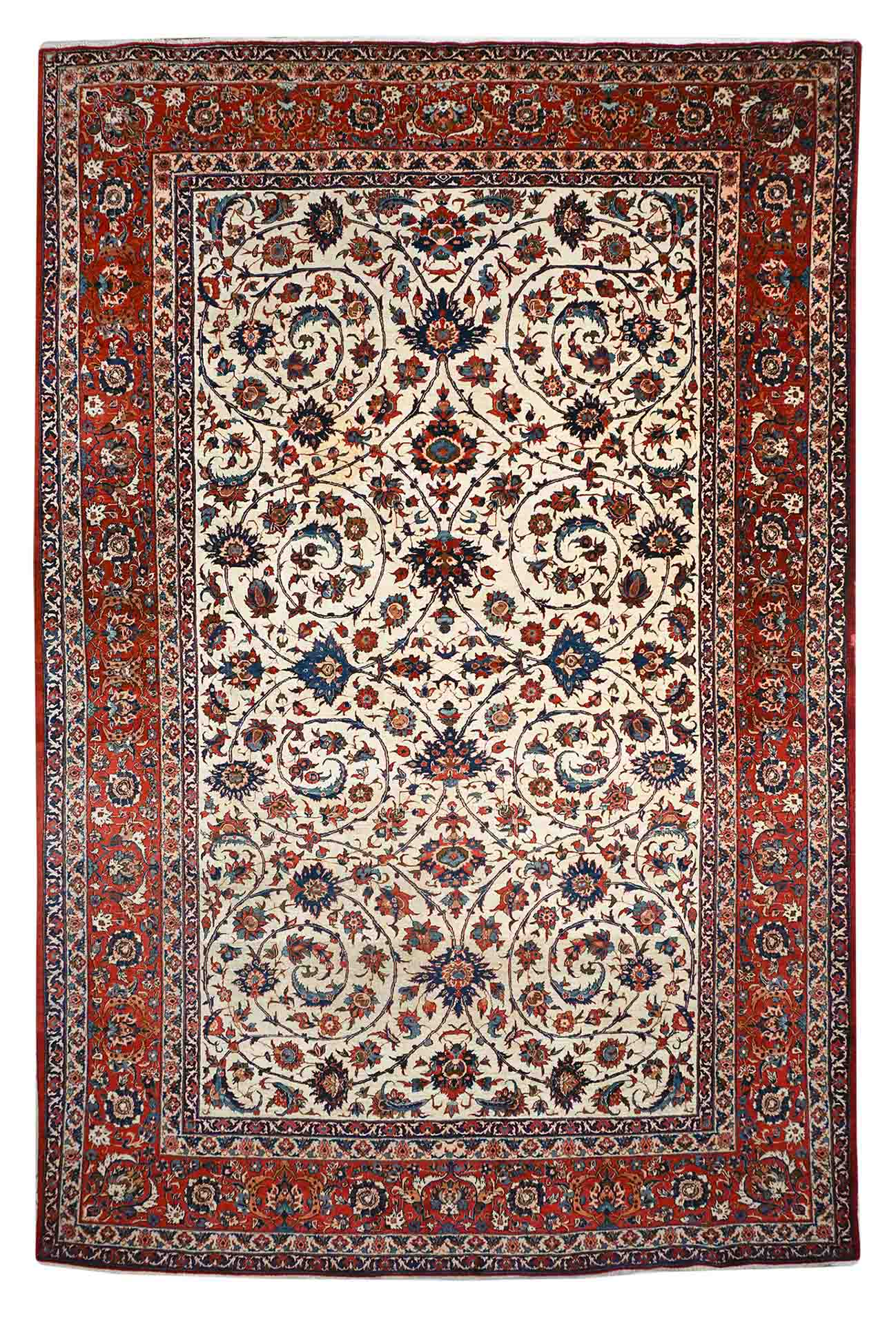
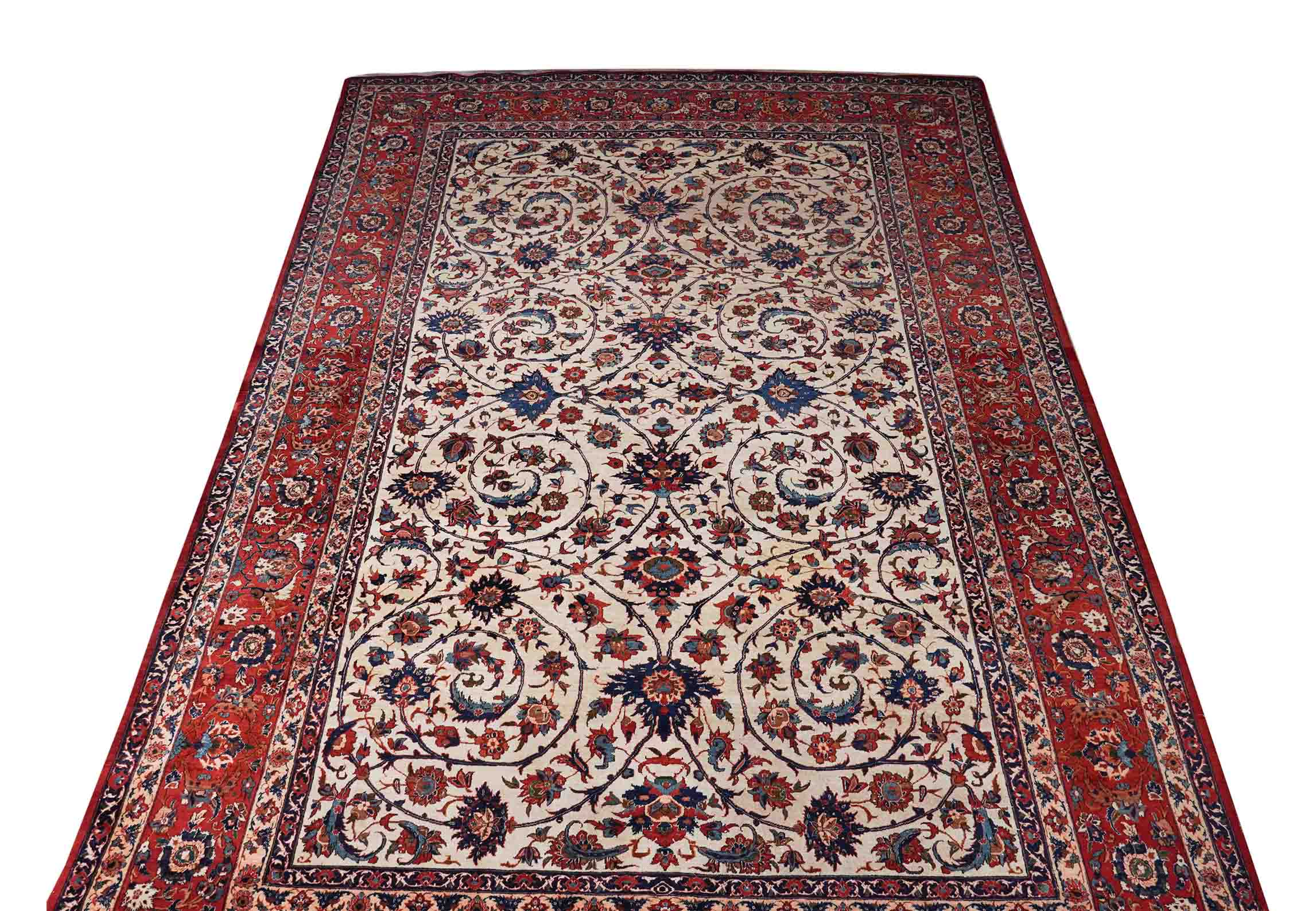
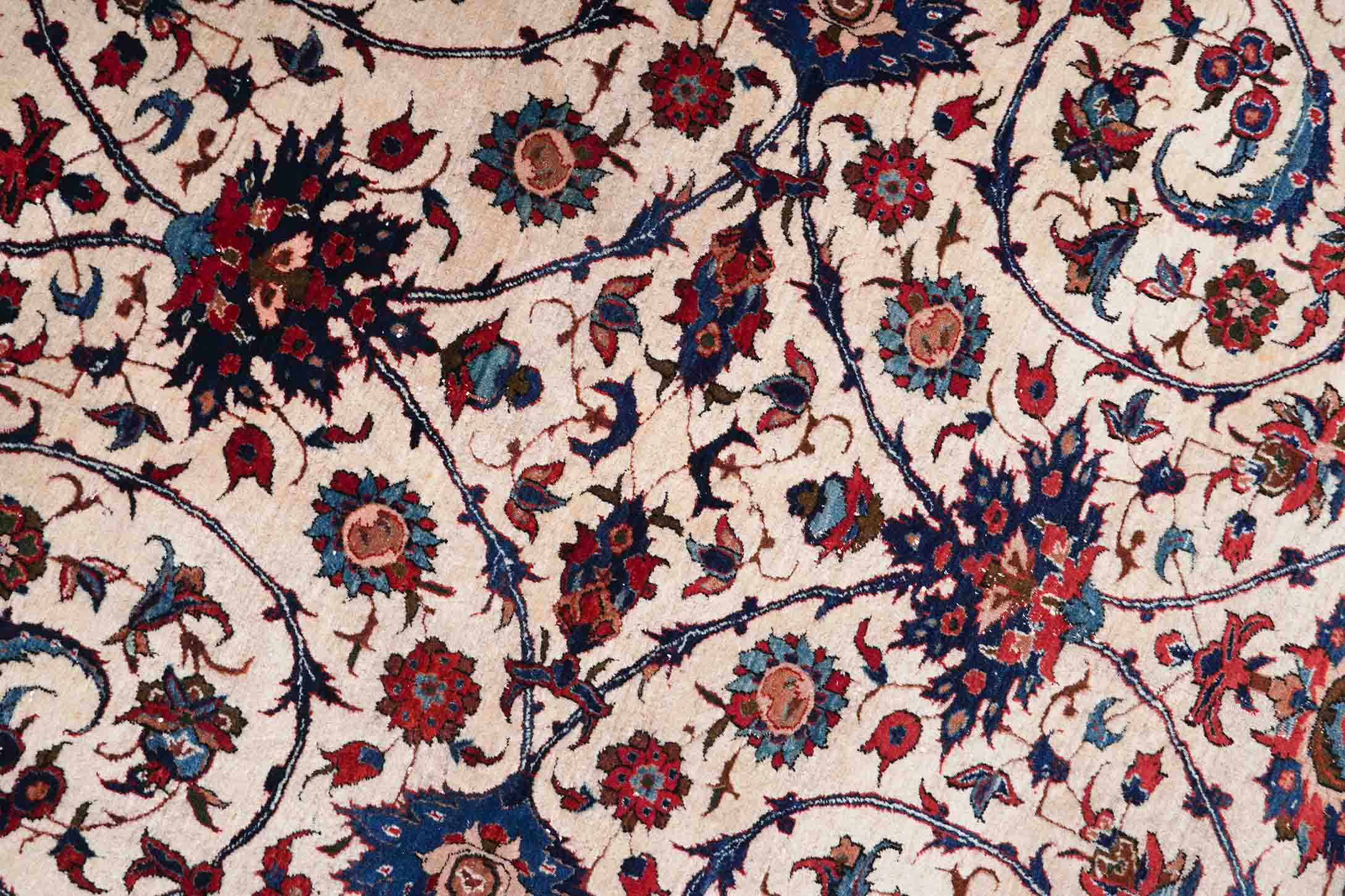
Isfahan | 415 x 298 cm | Nr. Z-2213

|
1-3 working days delivery time (within Germany) |

|
14-day home trial |

|
Free delivery & returns within the EU |
Floral Isfahan, rust red with border
| Origin |
|
| Dimensions | 415 cm x 298 cm (= 12.37 m²) |
| Construction | hand-knotted |
| Material |
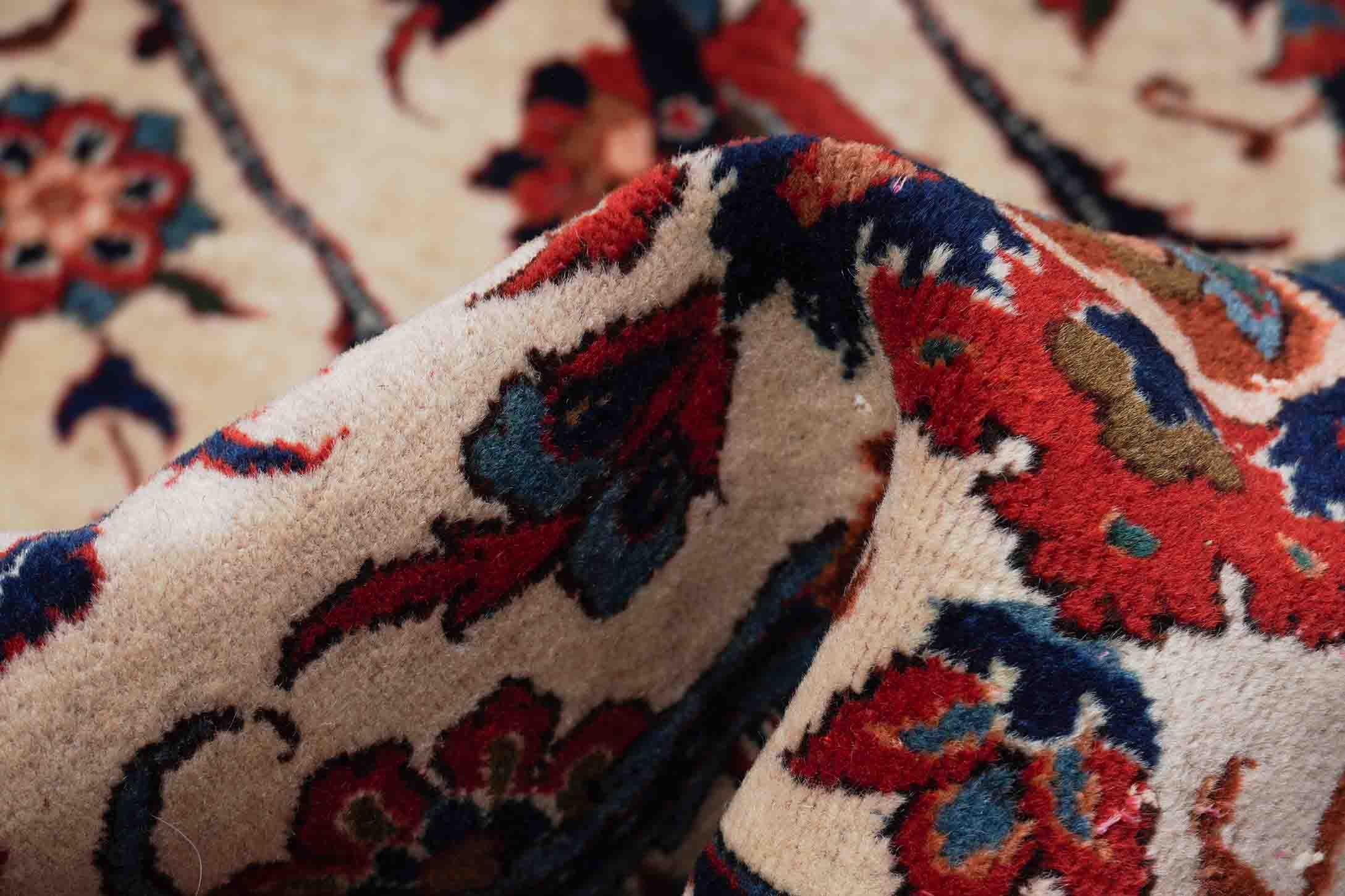
Pile: kurk wool
|
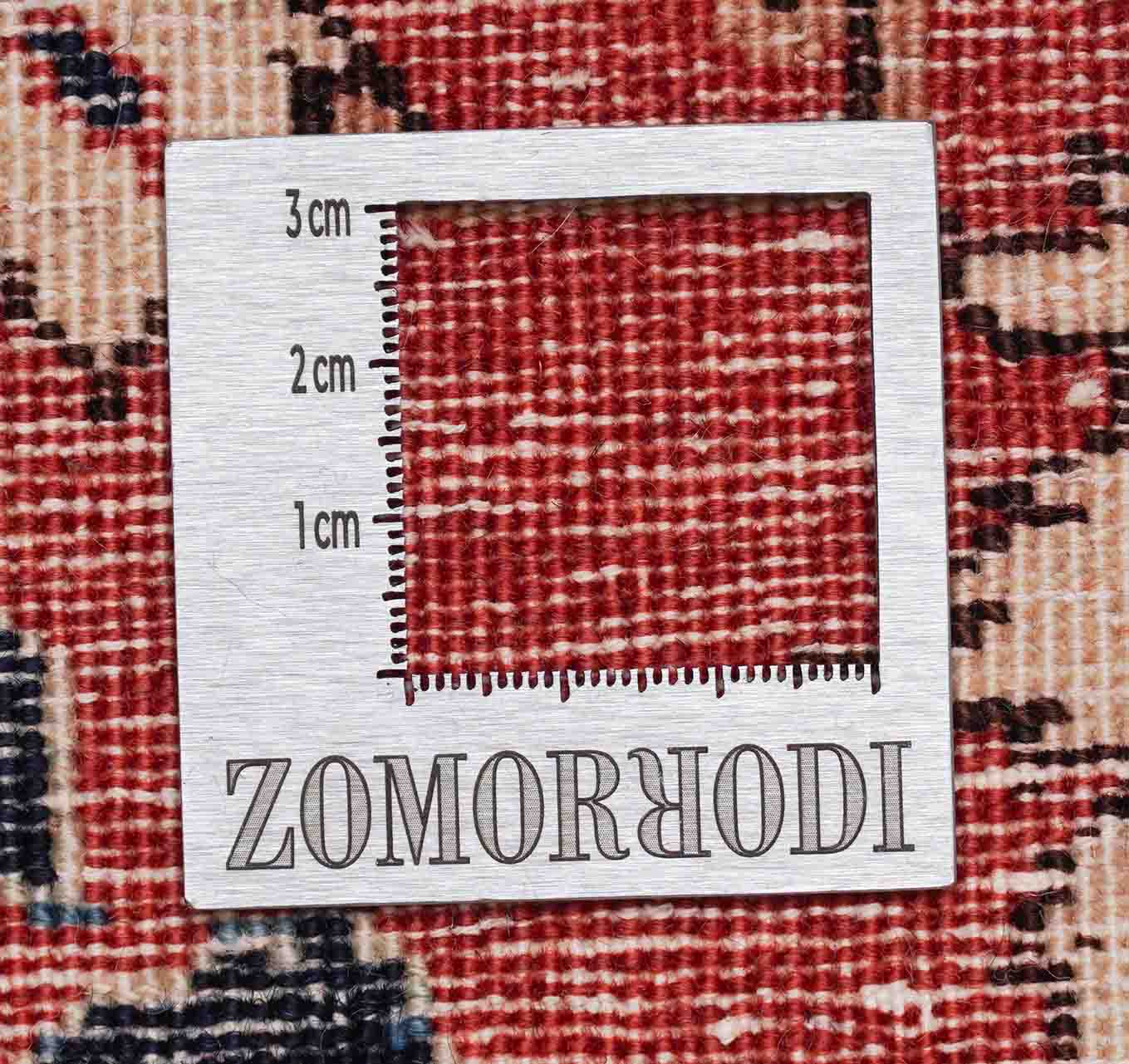
| knots per m²2 | 480.000 |
| Pile height | 5mm |
| Year of manufacture | 1960 |
| Colour | Rust red, Beige |
| Edition | one-of-a-kind piece |
Origin
The city of Isfahan is one of the architectural jewels of the Islamic world. Isfahan owes its artistic tradition, its historic townscape and its arguably unique architecture to the Safavid dynasty and to Shah Abbas in particular. Floral motifs are typical of the patterns of Isfahan rugs. Designs with fourfold or lengthwise symmetry are widespread, with a medallion in the centre surrounded by arabesques, blossoms or birds. The ground colour is usually a classic red, and a luminous blue and a light beige are typical as well. With more than 15 shades in most cases, though, the Isfahan is decidedly colourful. The borders are often green-blue and decorated with flowering vines and palmettes.
In Iran, the fineness of Isfahan knotting is stated in cheft. Cheft are fine, usually blue vertical lines along the lower end webs. The closer the lines, the finer the knotting.
To this day, many Isfahan rugs carry a discreetly knotted inscription in Persian script along the lower edge, the so-called signature. It names the maker, the provenance Isfahan and often the country as well, either as the word Iran or as the Iranian national flag in green, white and red.
Rugs from the Seirafian workshop are particularly sought after. The late master knotter Haj Agha Reza Seirafian lived from 1881 to 1975. Today he is known as the creator of the famous Seirafian rugs. Before he turned to rug making, Haj Agha Reza was a private banker in Isfahan. The Seirafian family still produces rugs based on the cartoons and designs of Haj Agha Reza Seirafian to this day. This lovely piece is an Isfahan Nayafabad.
Pattern
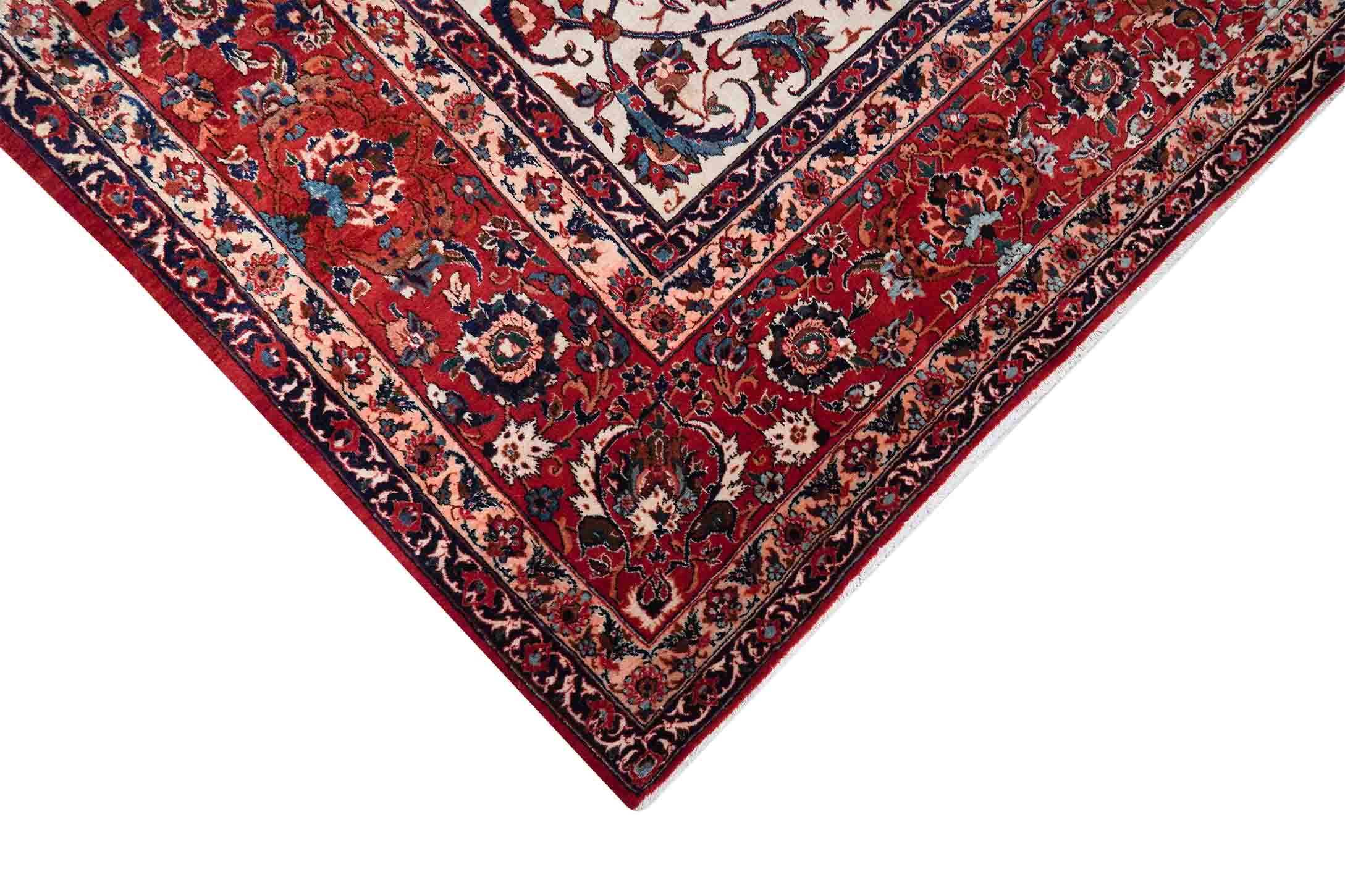
The edge of the rug is framed by a decorative border. The border forms a beautiful contrast with the centre.
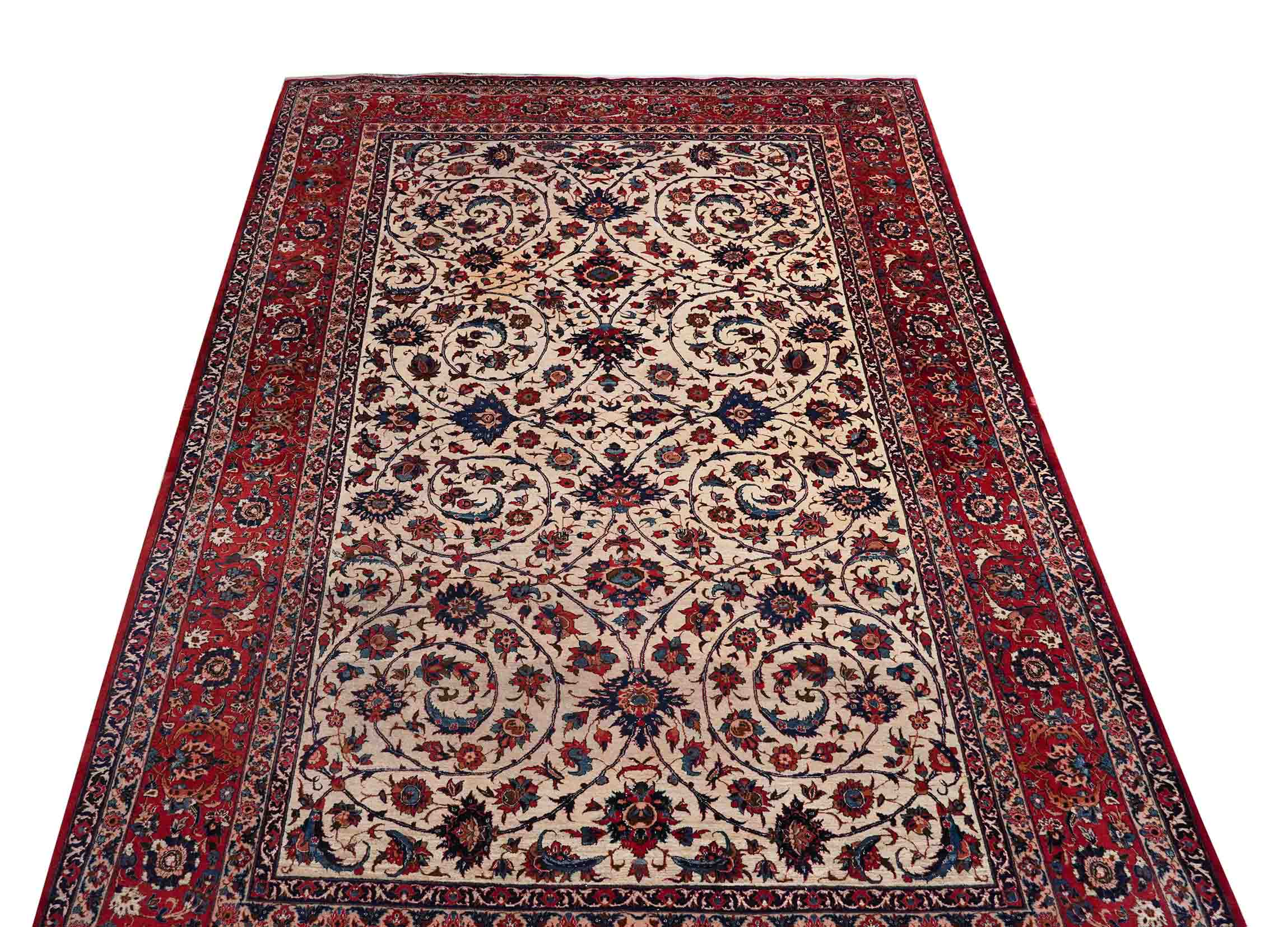
The lavish floral motifs of this Isfahan are elegantly drawn and full of variety. The graceful plant symbols, depicting blossoms, leaves and branches, are artfully intertwined.
The background of this Isfahan is cream white. Rust red and beige also dominate the overall impression. The border is worked in rust red, dark blue and beige.
Condition
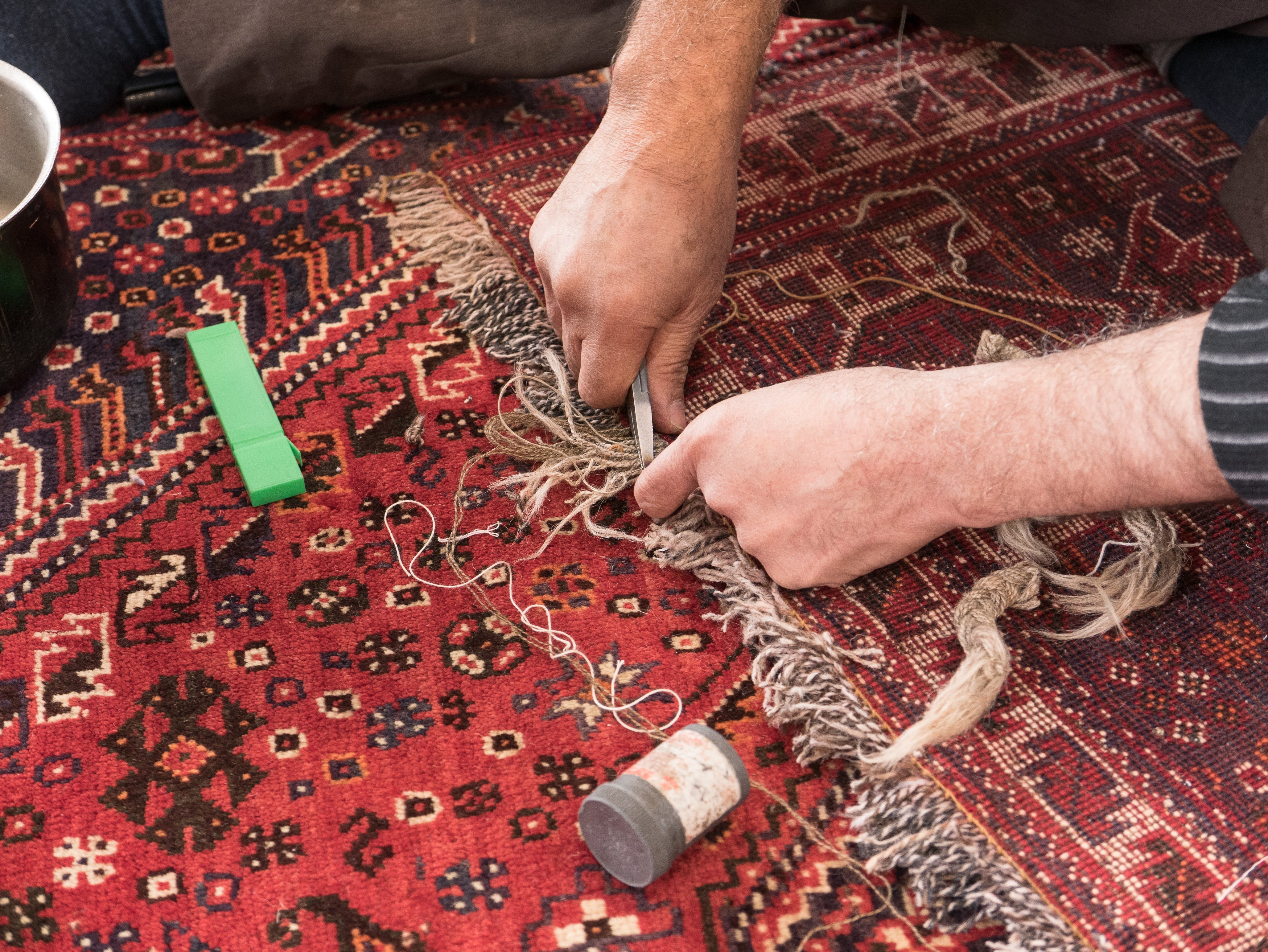
This Isfahan has had admirers before you. It was hand-knotted around 1960. It has been thoroughly cleaned and is in good but only partly restored condition. The pile is worn in places. The edges are damaged in parts. The rug has a few small stains. We haven't fully restored this Isfahan because we feel it has a special presence just as it is. If you'd like us to, we're of course happy to carry on restoring it for you. We can bring almost any rug back to near-perfect condition.
Material
The pile of this Isfahan is knotted from what is known as kork wool. Kork, or kurk, wool is a particularly fine-threaded knotting yarn that feels almost velvety. It is taken from the neck, the belly and the inner legs of the sheep and is of especially high quality. The weft and warp threads of this Isfahan are cotton. This versatile material is tear-resistant and elastic, which makes it particularly well suited to a hard-wearing foundation.
A note on the photos
Child labour? No thanks.
Child labour? No thanks. Children belong in school, not at a knotting frame or a loom. For us it therefore goes without saying that we only offer rugs made under fair conditions and without child labour.
We attach particular importance to humane working conditions and tolerate no child labour at any of our producers. Thank you for helping us to ensure fair conditions.
That is why we support the initiative Care & Fair against child labour in the rug trade.

Choose options
|
|
1-3 working days delivery time (within Germany) |
|
|
14-day home trial |
|
|
Free delivery & returns within the EU |